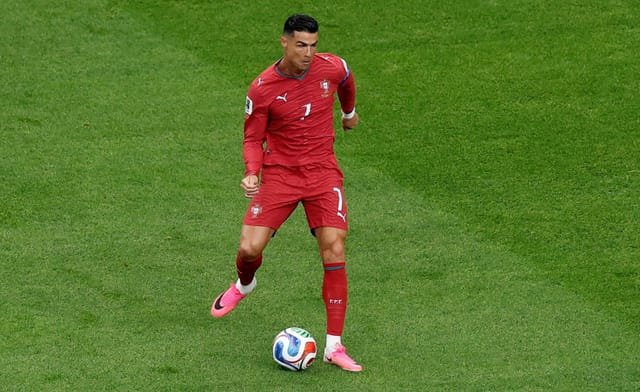
Cristiano Ronaldo‘s record-breaking sixth FIFA World Cup appearance was supposed to be a celebration of longevity and greatness. Instead, Portugal’s underwhelming 1-1 draw against tournament debutants DR Congo has reignited a difficult conversation about the veteran forward’s role in Roberto Martinez’s squad.
At 41 years and 132 days, Ronaldo became the oldest outfield player to start a men’s FIFA World Cup match. However, what should have been a historic night turned into another chapter in the growing debate over whether Portugal’s all-time leading scorer still fits the demands of elite international football.
Former Watford captain Troy Deeney delivered one of the strongest assessments of Ronaldo’s performance, suggesting the Portuguese icon no longer commands the same influence that once made him football’s most feared attacker.
“The aura, the legend that is Ronaldo is not there anymore. Those players are still playing to him.”
Deeney’s remarks may sound harsh, but they reflect a broader concern surrounding Portugal’s tactical identity and whether the team remains overly reliant on its most famous player.
Ronaldo’s Numbers Tell a Difficult Story
Against DR Congo, Ronaldo struggled to impose himself on the match. The veteran striker recorded just 25 touches across 90 minutes, attempted three shots without hitting the target, and failed to register either a goal or an assist.
For a player whose role is almost entirely centred around finishing chances inside the penalty area, the lack of involvement was striking.
Portugal enjoyed significant possession and completed far more passes than their opponents, yet they created surprisingly few clear-cut opportunities.
| Cristiano Ronaldo vs DR Congo | Statistics |
|---|---|
| Minutes Played | 90 |
| Touches | 25 |
| Shots Attempted | 3 |
| Shots on Target | 0 |
| Goals | 0 |
| Assists | 0 |
Portugal managed only seven shots throughout the match, while DR Congo created eight despite enjoying far less possession.
The statistics underline a growing issue for Martinez’s side: dominance of the ball no longer guarantees attacking effectiveness.
The Bruno Fernandes Moment That Sparked Debate
One incident in the second half encapsulated the criticism aimed at Ronaldo.
In the 68th minute, substitute Francisco Conceicao delivered a cutback into the penalty area. Bruno Fernandes appeared to be in a better position to strike, but Ronaldo chose to take the shot himself.
The effort drifted wide.
For Deeney, the moment highlighted a deeper problem.
He argued that Portugal’s players continue to prioritise creating opportunities for Ronaldo rather than making decisions based purely on what benefits the team.
The contrast with Lionel Messi’s performance for Argentina was impossible to ignore. While Messi dropped deeper, linked play, and orchestrated attacks during his hat-trick against Algeria, Ronaldo remained fixed in advanced areas waiting for service.
Different playing styles are not inherently problematic, but they require different tactical structures.
Has Portugal Become Too Dependent on Ronaldo?
Portugal possess one of the most technically gifted squads in the tournament.
Bruno Fernandes, Bernardo Silva, Vitinha, Joao Neves, Rafael Leao and Joao Felix are all capable of creating chances and scoring goals.
Yet against DR Congo, much of Portugal’s attacking play seemed designed to find Ronaldo.
Former France defender Gael Clichy believes this dynamic may unintentionally restrict other players.
“Sometimes, unconsciously, those kinds of players can take too much light.”
Clichy was careful to emphasise that this is not Ronaldo’s fault. Instead, he described it as a natural consequence of having one of football’s biggest global icons in the dressing room.
When a player has spent two decades delivering decisive moments, teammates instinctively look for him—even when alternative options might be more effective.
Managing that balance is one of Roberto Martinez’s biggest challenges.
Why Roberto Martinez Still Trusts Ronaldo
Despite mounting criticism, Martinez remains firmly committed to his captain.
After the match, the Portugal manager defended his decision to keep Ronaldo on the pitch for the full 90 minutes.
“It makes no sense to take off the greatest goalscorer in the history of football in a match where we need goals.”
From Martinez’s perspective, Ronaldo’s value extends beyond statistics.
His positioning inside the box, aerial threat and ability to attract defenders continue to create space for teammates.
Toni Kroos recently echoed that sentiment, arguing that Ronaldo remains Portugal’s best penalty-box attacker despite his advancing age.
The challenge is ensuring the team creates enough quality chances to maximise those strengths.
The Evolution of Ronaldo’s Role
Ronaldo’s transformation over the past decade has been remarkable.
Once an explosive winger capable of beating multiple defenders, he now operates primarily as a traditional number nine.
His game is built around movement, anticipation and finishing rather than dribbling and pace.
However, that evolution also means he contributes less during build-up phases and defensive transitions.
When goals do not arrive, questions about his overall impact become unavoidable.
This is not unusual for ageing forwards, but the scrutiny surrounding Ronaldo remains unique because of his extraordinary legacy.
What Portugal Must Do Moving Forward
Portugal’s opening match exposed tactical issues that extend beyond one player.
The midfield controlled possession effectively but lacked verticality and urgency in the final third.
More direct runs from wide areas, quicker passing combinations and greater unpredictability are needed if Portugal are to unlock organised defences.
Martinez may also need to consider rotating his attacking options depending on the opponent.
Using Goncalo Ramos or introducing Ronaldo later in matches against tired defenders could offer greater tactical flexibility.
The key question is whether Portugal are willing to make difficult decisions if results do not improve.
Conclusion
Criticism from pundits like Troy Deeney and Gael Clichy reflects a broader shift in how Cristiano Ronaldo is viewed at this stage of his career.
The debate is no longer about his legacy—that remains untouchable.
Instead, the focus has shifted to whether Portugal’s current system maximises both Ronaldo’s strengths and the immense talent around him.
The numbers from the draw against DR Congo raise legitimate concerns, but one disappointing performance does not define a player who has repeatedly defied expectations throughout his career.
Portugal’s World Cup campaign is still in its early stages. How Martinez manages Ronaldo’s role from here could determine whether this tournament becomes a memorable farewell or a missed opportunity for one of football’s most talented generations.
For breaking news and live news updates, like us on Facebook or follow us on Twitter and Instagram. Read more on Latest Sports on thefoxdaily.com.






COMMENTS 0