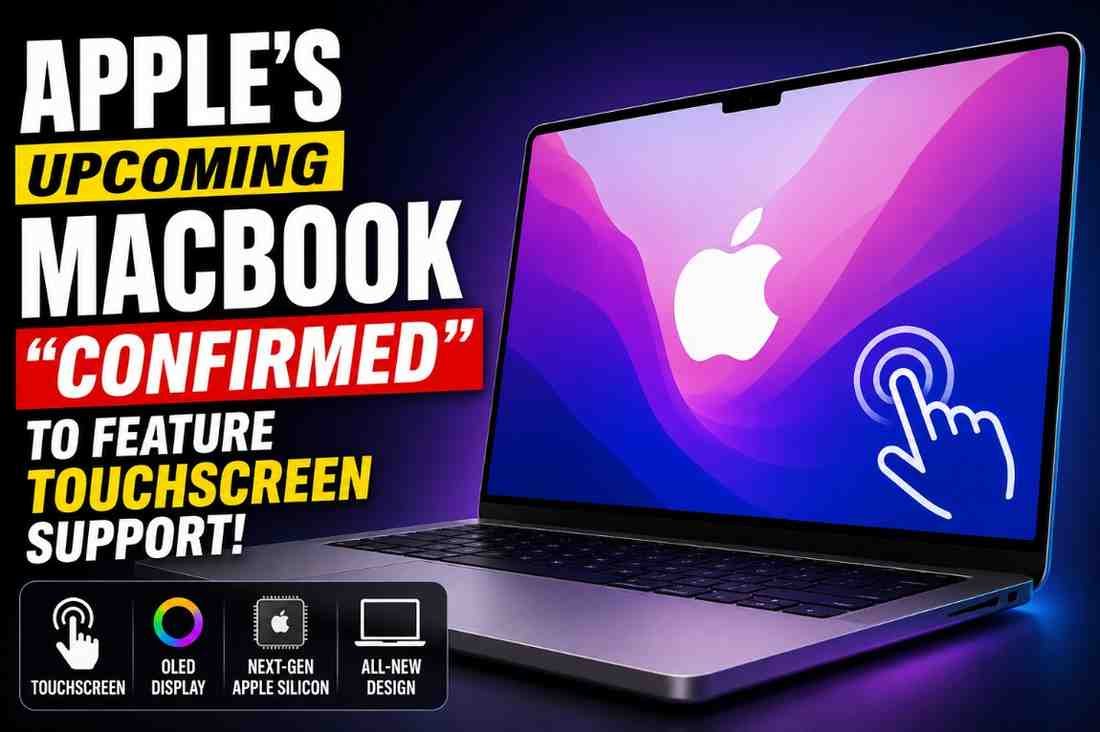
For more than a decade, Apple has consistently argued that touchscreen laptops are not the ideal computing experience. While competitors such as Microsoft, Dell, HP, Lenovo, and samsung embraced touch-enabled notebooks, Apple remained firm in keeping touch interactions largely confined to the iPhone and iPad.
That long-standing philosophy may finally be changing.
According to fresh industry leaks, Apple is reportedly developing a touchscreen MacBook that could become the company’s first laptop with direct touch input support. While Apple has not officially confirmed the project, multiple reports and supply-chain rumors increasingly point toward a significant redesign of the MacBook lineup in the coming years.
If the reports prove accurate, the move would not simply add a touchscreen to an existing laptop. It could signal a broader transformation in how Apple envisions the future of personal computing, Artificial Intelligence, productivity, and the relationship between Macs and iPads.
What the Latest Leak Reveals About Apple’s Touchscreen MacBook
The latest report comes from well-known technology tipster Instant Digital, WHO claimed that a touchscreen MacBook is “100 percent confirmed” to be in development.
While the leak does not provide a launch date, pricing details, or complete specifications, it aligns with several previous reports suggesting Apple has been actively exploring touch-enabled Mac hardware.
The rumored device is believed to feature:
- Touchscreen functionality.
- Apple’s first OLED MacBook display.
- A redesigned laptop chassis.
- Advanced Apple Silicon processors.
- Potential “Ultra” branding.
- Premium positioning above current MacBook Pro models.
Although Apple remains silent on the project, the growing consistency of leaks suggests that touchscreen technology is no longer being treated as an experimental concept inside Cupertino.
Why Apple Has Avoided Touchscreen MacBooks for So Long
One of the biggest questions surrounding the rumor is simple: why now?
For years, Apple executives openly criticized touchscreen laptops.
Former Apple leaders argued that extended touch interactions on a laptop could become uncomfortable and ergonomically inefficient. The company repeatedly positioned the iPad as its touch-first computing device while reserving the Mac for keyboard-and-trackpad workflows.
This philosophy helped create a clear distinction between product categories.
| Device | Primary Input Method |
|---|---|
| iPhone | Touchscreen |
| iPad | Touchscreen + Pencil |
| MacBook | Keyboard + Trackpad |
| Mac Desktop | Keyboard + Mouse |
This separation prevented product overlap and encouraged customers to purchase multiple Apple devices for different tasks.
However, consumer behavior has evolved dramatically since those decisions were first made.
The Windows Laptop Market Changed the Conversation
Apple’s resistance to touchscreens made sense when touchscreen laptops were still experimental.
Today, however, the situation is very different.
Premium Windows laptops now routinely include touch support as a standard feature. Devices such as the Microsoft Surface Laptop, Dell XPS 13, and HP Spectre x360 have demonstrated that touchscreen functionality can coexist with traditional laptop workflows.
Users increasingly expect flexibility rather than strict hardware categories.
As touch interfaces become more familiar through smartphones, tablets, smart displays, and even automotive systems, the absence of touchscreen functionality on premium MacBooks has become more noticeable.
Apple may now be responding to changing consumer expectations rather than simply following an industry trend.
Why OLED Could Be the Real Headline
While touchscreen support is attracting the most attention, the OLED display may ultimately be the more significant upgrade.
Current MacBooks use advanced LCD-based technologies, including mini-LED panels on premium models. OLED technology offers several advantages:
- Perfect black levels.
- Higher contrast ratios.
- Improved HDR performance.
- Better energy efficiency in certain scenarios.
- More vibrant color reproduction.
- Thinner display assemblies.
Apple has already embraced OLED technology across multiple product categories, including iPhones and smartwatches.
Bringing OLED to MacBooks would create greater consistency across Apple’s ecosystem while potentially improving battery life and visual quality.
Could Apple Be Creating a New “MacBook Ultra”?
Several reports suggest the touchscreen model may not simply be another MacBook Pro.
Instead, Apple could introduce an entirely new premium tier positioned above its existing notebook lineup.
The rumored “MacBook Ultra” branding would mirror Apple’s broader product strategy.
| Product Category | Premium Tier |
|---|---|
| iPhone | Pro Max |
| Apple Watch | Ultra |
| Apple Silicon | Ultra Chips |
| Potential MacBook | MacBook Ultra |
Such a product could target professionals, developers, content creators, AI researchers, and power users seeking the most advanced portable Mac available.
If Apple introduces Ultra branding to MacBooks, it could become the company’s flagship laptop category.
How Touchscreens Could Change the Mac Experience
The introduction of touch functionality would create entirely new interaction possibilities.
Rather than replacing the trackpad, touch support would likely complement existing workflows.
Potential use cases include:
- Photo editing with direct touch manipulation.
- Video timeline navigation.
- Document annotation.
- Drawing and sketching.
- Presentation control.
- AI-assisted content creation.
- Interactive design workflows.
Creative professionals, in particular, could benefit from more intuitive editing and design experiences.
The AI Factor Apple Isn’t Talking About Yet
One of the most overlooked aspects of the touchscreen MacBook rumor is its potential connection to artificial intelligence.
AI is rapidly changing how people interact with computers.
Future computing experiences may rely less on traditional menus and more on natural interactions involving:
- Voice commands.
- Touch gestures.
- Visual inputs.
- Context-aware AI assistants.
- Multimodal interfaces.
A touchscreen MacBook could serve as an important step toward these next-generation interaction models.
Rather than treating touch as a standalone feature, Apple may view it as part of a broader AI-driven computing strategy.
Will macOS Need to Change?
Introducing a touchscreen creates significant software challenges.
macOS was designed primarily for cursor-based navigation.
Many interface elements are optimized for precise mouse and trackpad input rather than finger taps.
If Apple launches a touchscreen MacBook, macOS may require substantial refinement.
Possible changes could include:
- Larger touch targets.
- Gesture enhancements.
- Touch-optimized system apps.
- Improved handwriting support.
- Enhanced multitasking controls.
- Deeper integration with Apple Pencil technologies.
These changes could make future versions of macOS feel more flexible while maintaining compatibility with existing workflows.
Could Apple Pencil Eventually Work on MacBooks?
A natural question follows any touchscreen MacBook discussion: will Apple Pencil support arrive as well?
Apple has historically resisted this idea, arguing that the iPad remains the preferred platform for stylus-based input.
However, professional users increasingly expect stylus compatibility on premium creative devices.
If Apple introduces touchscreens, pressure will grow to support precision pen input for artists, designers, engineers, and content creators.
Although no credible leak has confirmed Pencil support, the possibility cannot be ruled out.
Challenges Apple Must Overcome
Adding a touchscreen may sound straightforward, but several challenges remain.
| Challenge | Potential Impact |
|---|---|
| Battery efficiency | Touchscreens consume additional power |
| Display durability | More physical interaction with screen surface |
| Software redesign | macOS interface adjustments required |
| Product positioning | Avoiding overlap with iPad Pro |
| Pricing | OLED and touch technology increase costs |
Apple’s challenge will be introducing touch functionality without compromising the simplicity and performance that define the Mac experience.
A Comparison: Touchscreen MacBook vs iPad Pro
The biggest strategic question involves Apple’s own product lineup.
The iPad Pro already serves many users seeking a touch-based computing experience.
If MacBooks gain touchscreens, Apple must clearly differentiate the two devices.
The likely distinction will center on operating systems rather than hardware.
iPadOS remains optimized for touch-first experiences, while macOS prioritizes professional desktop workflows.
This approach would allow Apple to offer touch capability without merging its tablet and laptop categories entirely.
Prediction: Touchscreen Macs Could Become Standard Within Five Years
If Apple launches a successful touchscreen MacBook, the technology is unlikely to remain exclusive to a single model forever.
Historically, premium Apple innovations often migrate across product lines over time.
Examples include:
- Retina displays.
- Apple Silicon processors.
- ProMotion technology.
- Face ID-related technologies.
A touchscreen MacBook Ultra could therefore act as a testing ground before broader adoption across future MacBook Air and MacBook Pro generations.
Future Outlook: The Biggest MacBook Transformation Since Apple Silicon?
The rumored touchscreen MacBook represents more than a hardware upgrade. It could mark a philosophical shift for Apple.
For years, the company maintained that laptops did not need touchscreens. If Apple now embraces touch input, it would signal a recognition that computing habits have fundamentally evolved.
Combined with OLED technology, advanced Apple Silicon chips, and emerging AI-driven workflows, the first touchscreen MacBook could become one of the most significant Mac launches in years.
While many details remain unconfirmed, one thing is increasingly clear: the future MacBook may look very different from the laptops Apple users have known for the past two decades.
If the rumors prove accurate, Apple’s next-generation Mac could finally blur the line between traditional computing and touch-first experiences without sacrificing the power and productivity that made the MacBook one of the world’s most successful laptop families.
For breaking news and live news updates, like us on Facebook or follow us on Twitter and Instagram. Read more on Latest Technology on thefoxdaily.com.




COMMENTS 0