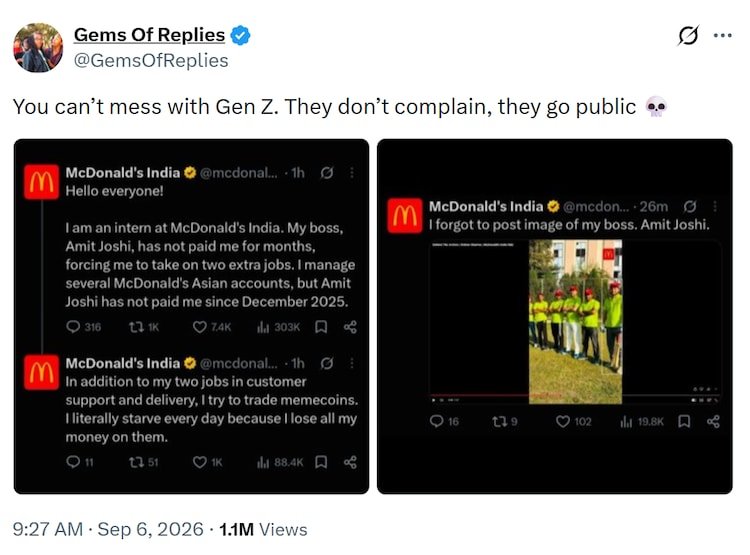
A Social Media controversy involving McDonald’s India unfolded on September 6 after a post circulating online appeared to show the company’s X account carrying an explosive complaint from an alleged intern over unpaid wages.
The post claimed that an intern working with McDonald’s India had not received a salary since December 2025 and alleged that the person was forced to take on additional jobs to manage financially. It also named a person identified as Amit Joshi as the alleged boss and claimed the intern handled several McDonald’s-related accounts across Asia.
The post was later deleted, but screenshots quickly spread across social media. The disappearance of the message added to speculation about whether the post had been genuine, whether an account had been compromised, or whether the entire image had been fabricated.
McDonald’s India (West & South), however, rejected any connection to the post. The company said the circulating content falsely used its brand name, was not posted from its official social media handle and contained discrepancies that indicated it was fabricated.
What the viral McDonald’s India post claimed
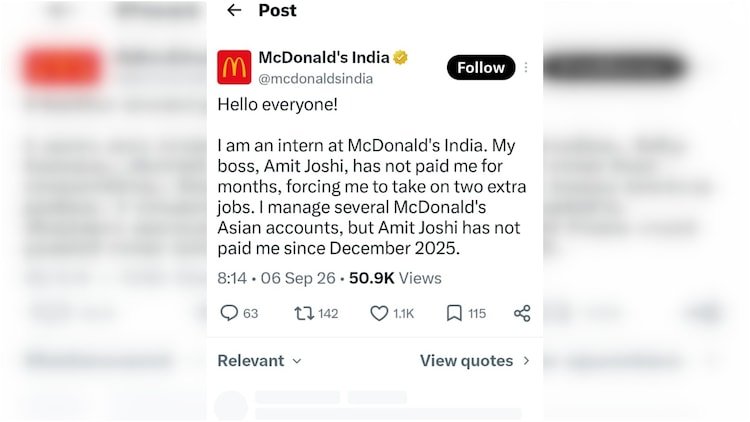
The disputed message was presented as a first-person complaint from someone claiming to be an intern at McDonald’s India. According to the text, the individual said their boss, Amit Joshi, had not paid them for several months.
The complaint further claimed that the intern had been forced to take on two additional jobs because of the missing salary. The alleged employee also said they were managing multiple McDonald’s Asian accounts despite not being paid.
The wording of the post made the allegation particularly attention-grabbing because it appeared on an account associated with a major international brand. A workplace complaint published through an official corporate account can carry much greater credibility in the eyes of social media users than a post from an anonymous individual account.
That apparent connection to the brand was a major reason the screenshots spread so rapidly.
Why the post created immediate confusion
Social media users were confronted with an unusual situation: the allegation was serious, the account appeared to be connected to McDonald’s India, and the post was subsequently removed.
Once screenshots survive online after a post has disappeared, separating an authentic social media communication from an edited image becomes considerably more difficult. A screenshot can preserve the appearance of a post without independently proving how it was created or WHO originally published it.
That distinction is especially important in this case because the company itself has disputed the authenticity of the material.
The controversy therefore quickly shifted from the alleged unpaid salary to a different question: how did the content appear to be connected to McDonald’s India in the first place?
McDonald’s India says the post was fabricated
McDonald’s India (West & South) issued a statement denying any association with the circulating content.
The company said the post falsely used the McDonald’s name and was never published from its official social media handle. It also pointed to what it described as clear discrepancies in the image as evidence that the content was fabricated.
The company urged users not to rely on or spread the unverified information.
This denial changes the nature of the story significantly. Rather than treating the alleged salary complaint as an established workplace dispute, the available information indicates that the accusation remains unverified and that McDonald’s has expressly rejected the post as authentic.
Who is Amit Joshi?
The viral post identified Amit Joshi as the alleged boss responsible for the unpaid salary. However, the identity and employment relationship described in the message have not been independently established.
There is also no verified evidence in the available material confirming that the named individual was responsible for supervising an intern at McDonald’s India or any related Business.
That makes it especially important not to treat the accusation as a confirmed allegation against a real person simply because a name and photograph appeared in the circulating screenshot.
Attaching a photograph to a viral post can create a strong impression of authenticity, but the presence of an image does not establish that the person shown is connected to the claims being made.
The salary claim has not been independently verified
The central allegation was that the alleged intern had gone unpaid since December 2025. At present, there is no independent confirmation establishing that the person worked as an intern for McDonald’s India or that they were owed wages for the period described in the post.
There is also no independently verified documentation presented with the circulating material showing an employment agreement, payroll records, internal correspondence or any formal complaint supporting the salary claim.
That does not prove that every underlying allegation is false. It means only that the claims cannot responsibly be treated as established facts based on the circulating post alone.
McDonald’s decision to explicitly label the material fabricated makes verification even more important before the allegations are repeated as genuine.
Deleted posts can continue to spread
The removal of the original post did little to stop the story from circulating. Screenshots are now being shared independently of the account from which the content appeared.
This illustrates one of the biggest challenges surrounding viral social media claims. Once users capture and repost a disputed image, the original context can quickly disappear.
People encountering a screenshot later may not know whether the original post still exists, whether it was altered, whether the account was genuinely responsible for publishing it or whether the image was created elsewhere.
As a result, deleted content can sometimes acquire a second life online, with each repost making the original circumstances harder to reconstruct.
Official account appearance does not automatically prove authenticity
The incident also highlights a broader issue facing brands and social media users: the visual appearance of an official account can be manipulated or misrepresented.
A screenshot showing a familiar logo, account name or verification indicator can look convincing at first glance. But those visual elements alone are not sufficient to establish authenticity, particularly when the original post is no longer available for direct inspection.
For users, one of the most important checks in such cases is whether the company has publicly acknowledged the message. Statements issued through established corporate channels can provide a clearer indication of whether the circulating content is genuine.
In this case, McDonald’s India has specifically denied that the disputed material came from its official social media handle.
Was the account compromised?
Questions also emerged over whether the incident could have involved unauthorized access to an account. Some reports and social media discussions speculated that the handle may have been compromised.
However, the available information does not establish a confirmed account takeover as the explanation for what happened.
The distinction matters because a hacked account and a fabricated screenshot represent two very different scenarios. In the first, an unauthorized party gains access to a legitimate account and publishes material from it. In the second, the image itself is manufactured to create the appearance of an official post.
McDonald’s public statement currently supports the conclusion that the circulating material was fabricated, but it does not provide enough information to independently establish how the content was created or circulated.
Why workplace allegations go viral so quickly
Claims involving unpaid salaries tend to attract immediate attention because they connect to a common and highly relatable workplace concern. When the alleged victim is presented as an intern and the accusation involves months of missed payments, the emotional impact can be even stronger.
The story also combined several elements that are highly shareable: a major global brand, an alleged employee dispute, a named individual, a photograph and a claim that the employee had taken additional jobs because of unpaid wages.
That combination can encourage users to react before verifying the underlying evidence.
Once thousands of people begin sharing a post, the number of views can itself become mistaken for proof. But virality measures how widely content has spread, not whether the claims are true.
The role of screenshots in misinformation
Screenshot-based Misinformation presents a particular challenge because the image often looks like primary evidence. In reality, it is simply a visual representation of what someone wants viewers to believe was posted.
Important details can be removed through cropping or editing, including timestamps, replies, links, profile information and other elements that may help establish context.
Even apparently minor inconsistencies can matter when determining whether a screenshot is authentic. McDonald’s specifically referred to discrepancies in the circulating image, which was a central part of its decision to reject the post.
For readers, the lesson is straightforward: a screenshot should be treated as something requiring verification, not as verification itself.
What remains confirmed
Several parts of the episode can be separated from the unverified claims.
Content alleging that an intern had not been paid since December 2025 circulated on September 6. The material was subsequently deleted, while screenshots continued to circulate online.
The content named Amit Joshi and included allegations involving unpaid wages and additional employment. However, the identity of the person who supposedly wrote the post has not been established from the available information.
Most importantly, McDonald’s India (West & South) has denied that it was associated with the post and said the material was fabricated.
What remains unconfirmed
The actual employment status of the alleged intern remains unverified. So does the claim that the person worked on several McDonald’s Asian accounts.
The allegation that salary payments had been withheld since December 2025 has not been independently confirmed. The claim that Amit Joshi was the alleged supervisor responsible for those payments has also not been independently established.
There is likewise no definitive public explanation, based on the currently available information, of how the disputed material came to appear as though it was connected to McDonald’s India.
Why McDonald’s response matters
For a major consumer brand, false social media claims can create reputational problems even when they are quickly deleted.
A post that appears on an official account can prompt media coverage, employee-related questions and public criticism within minutes. By the time a company issues a clarification, screenshots may already have reached millions of viewers.
That is why the company’s statement focusing on authenticity is significant. McDonald’s is not merely disputing the substance of the salary allegation; it is disputing the basic premise that the message originated from its official social media account.
That distinction should remain central to coverage of the incident.
Social media users should verify before sharing
The episode provides a broader reminder about handling viral claims involving companies, employees and named individuals.
Readers should look for the original post, check whether the company has confirmed or denied it, compare reporting from multiple credible outlets and avoid treating a screenshot as conclusive evidence.
Particular caution is necessary when an allegation names a private individual. Repeating an unverified accusation can cause reputational harm even when the original content turns out to be false or misleading.
The same principle applies to employment disputes. Genuine workplace complaints deserve serious attention, but they should be distinguished from allegations whose source and authenticity remain unclear.
What could happen next
The immediate issue is likely to remain the authenticity of the social media material rather than the salary accusation itself.
If additional evidence emerges showing how the post was created or circulated, the circumstances could become clearer. Such evidence could include platform records, further company statements, an authenticated account history or a direct statement from the person who allegedly made the complaint.
Until then, the salary allegations should not be presented as established facts.
The incident also reinforces the growing challenge faced by companies operating on social media: a false or manipulated post can appear credible long enough to become newsworthy before it is removed or challenged.
McDonald’s India controversy: what we know so far
| Issue | Current status |
|---|---|
| Alleged unpaid salary | Unverified |
| Claimed unpaid period | Since December 2025, according to the disputed post |
| Person named in the post | Amit Joshi |
| Identity of alleged intern | Not independently established |
| Status of original post | Deleted |
| McDonald’s India position | Company says the circulating content was fabricated and not posted from its official handle |
| Screenshots online | Still circulating |
Bottom line
The McDonald’s India X account controversy began with a post that appeared to accuse a named boss of withholding an intern’s salary for months, but the central claims remain unverified.
McDonald’s India (West & South) has explicitly denied any association with the circulating content and said discrepancies in the image show that it was fabricated. The original material has since been deleted, while screenshots continue to circulate across social media.
For now, the most responsible reading of the incident is that an alleged workplace complaint became a viral social media story without independent confirmation of the people, employment relationship or salary dispute described in it. Until credible evidence establishes otherwise, the claims should be treated as unverified rather than as a confirmed case of unpaid wages at McDonald’s India.
For breaking news and live news updates, like us on Facebook or follow us on Twitter and Instagram. Read more on Latest Technology on thefoxdaily.com.






COMMENTS 0