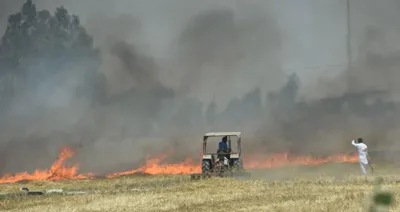
Every October, as the monsoon retreats and temperatures begin to fall, fires appear across agricultural fields in north India. What starts as isolated flames can develop into widespread smoke that travels towards cities, including Delhi, just as winter pollution becomes a growing concern.
The practice is known as stubble burning, or paddy residue burning. After rice is harvested, farmers are left with stalks and straw that must be cleared before the next crop can be planted. Burning removes this residue quickly, allowing farmers to prepare their fields for wheat without spending heavily on labour or machinery.
However, the recurring fires cannot be explained simply as a matter of farmers choosing to burn crop waste. The problem is tied to how rice is harvested, the economics of small farms, restrictions intended to conserve groundwater and the limited time available between the rice and wheat seasons.
The consequences extend beyond agricultural fields. Smoke from crop fires contributes to seasonal air pollution, while the heat can affect soil organisms and the burning process releases carbon and nutrients into the atmosphere. Satellite monitoring helps track the fires, but some may go undetected because of when they are lit and when satellites pass overhead.
Understanding why the fires recur requires looking at the entire agricultural system. For many farmers, the decision is made under pressure: clear the field quickly enough to plant wheat on time, or risk higher costs and a potentially less profitable harvest.
Stubble Burning: What Happens After the Paddy Harvest?
Stubble is the portion of a crop that remains in the field after harvesting. In paddy cultivation, it includes the standing rice stalks left behind by harvesting machinery and loose straw scattered across the ground. Paddy refers to rice in its harvested, unprocessed form before milling removes the outer layers of the grain.
In north India, rice is commonly grown during the monsoon season, followed by wheat in winter. Once the rice crop has been harvested, farmers must prepare the same land for wheat, making the removal or management of paddy residue an important part of the seasonal transition.
Burning is attractive because it clears much of the residue quickly. Instead of collecting, transporting or processing the straw, a farmer can burn it and prepare the field for the next crop within a short period.
The scale of the problem is substantial. According to the satellite-monitoring figures cited in the supplied report, the Consortium for Research on Agroecosystem Monitoring and Modelling from Space, associated with the Indian Agricultural Research Institute, counted 287 paddy-residue fire incidents between September 15 and October 6.
Madhya Pradesh recorded 118 fires, followed by Punjab with 88 and Uttar Pradesh with 65. These figures represent the incidents reported during that monitoring period and should not be interpreted as a complete count of all fires or as a measure of the total area burned.
The reported rise in fires in Madhya Pradesh has been linked by experts cited in the source report to some farmers shifting from crops such as soybean to paddy amid extreme weather risks. If cropping patterns change, residue-management challenges can spread beyond the regions most commonly associated with stubble burning.
The central question, therefore, is not merely why farmers burn straw. It is why the alternatives can be so difficult to use within the time and financial constraints of the harvest season.
How Combine Harvesters Changed the Stubble-Burning Problem
To understand why stubble burning became such a persistent problem, it is necessary to look at how harvesting methods changed. Before mechanised harvesting became widespread, farmers generally cut paddy by hand, close to the ground. The harvested plants were then taken for threshing, the process of separating grain from the rest of the plant.
The grain could be sold or stored, while straw could be used as fodder for cattle and other purposes. Residue that remained could be incorporated into the soil. Because harvesting and field preparation relied more heavily on manual labour, the transition between paddy and wheat was organised differently.
The spread of combine harvesters, particularly from the mid-1990s, transformed the process. A combine performs harvesting and grain separation in a single operation, reducing the time and labour needed to bring in a crop.
However, mechanical harvesting can leave a substantial amount of stalk and straw in the field. The supplied report describes farmers leaving around a foot of stubble because machinery generally cuts higher than manual harvesting close to the roots.
This creates a residue-management problem. The combine makes harvesting faster, but the remaining straw still needs to be removed, chopped, incorporated into the soil or managed through another method before the next crop can be planted.
Mechanisation is not inherently responsible for stubble burning. In fact, machinery can also help farmers manage residue without setting it alight. The difficulty is that the equipment required for these alternative methods may be expensive, unavailable when needed or unsuitable for farmers with limited financial resources.
As a result, the same technology that helps farmers harvest quickly can leave them facing an additional expense and a tight deadline. When the next crop must be sown soon, the cost of clearing the residue becomes a critical part of the decision.
Three Choices for Farmers: Labour, Machinery or Fire
After harvesting paddy, farmers generally have several ways to deal with the remaining straw. They can collect it manually, use machinery to manage it in the field or burn it. Each option comes with different costs, time requirements and practical limitations.
1. Manual removal and collection
Farmers can hire labour to collect straw and clear the field. Where livestock are kept, some of the residue may be useful as fodder. This approach can make productive use of the straw rather than treating it entirely as waste.
However, collecting large quantities of residue manually is labour-intensive. Farmers must find enough workers and complete the work quickly enough to prepare the land for wheat. When labour is expensive or difficult to obtain during the busy harvest season, manual removal may not be practical.
2. Machinery for residue management
Another option is to use specialised agricultural equipment to chop or manage the straw, allowing wheat to be sown with residue remaining in the field. Depending on the machinery and farming method, this can reduce the need to remove or burn all the stalks.
The challenge is affordability. The supplied report places the cost of equipment used to cut and clear straw at approximately Rs 1.5 lakh to Rs 2.5 lakh, while a sufficiently powerful tractor can cost several times more.
Such expenses can be difficult for small farmers to bear, particularly if the equipment is used for only a limited period each year. Hiring machinery may be an alternative, but its availability, rental cost and timing can determine whether it is a workable solution.
3. Burning the residue
Burning is attractive because it is relatively quick and requires little expenditure on specialised equipment. A farmer can clear the field in a short period without arranging a large workforce or purchasing expensive machinery.
But its immediate convenience comes with wider costs. Smoke contributes to air pollution, while burning can damage soil organisms and remove organic material that could otherwise be returned to the soil.
For a farmer working with limited money and time, however, these longer-term environmental costs may compete with an immediate need to sow the next crop. The decision is shaped by the options actually available, not simply by which method is environmentally preferable.
Why Small Farmers Face the Greatest Financial Pressure
The economics of residue management are particularly challenging for farmers with small landholdings. Purchasing specialised machinery requires substantial upfront investment, while the equipment may be needed only during a short period of the agricultural calendar.
The supplied report notes that more than eight in ten Indian Farmers operate small landholdings. It also highlights the difficulty faced by farmers cultivating just two to five acres, for whom purchasing large agricultural implements may be financially unrealistic.
For these farmers, the decision is not simply between an environmentally friendly option and an environmentally harmful one. It involves comparing the cost of machinery or labour with the consequences of delaying wheat sowing.
A farmer who cannot afford specialised equipment may need to rely on hired services. Yet if many farmers need the same machinery at the same time, access can become a scheduling problem as well as a financial one. Equipment that arrives after the ideal sowing window may be of limited practical help, even if the farmer can afford the service.
Shared machinery services, equipment-rental arrangements and access to local residue-management facilities can help reduce the burden of ownership. However, these approaches need to be organised so that farmers can obtain the equipment when it is needed, rather than after the harvest rush has passed.
This is why solutions to stubble burning cannot depend entirely on asking individual farmers to purchase machinery. Any effective approach must consider the cost of equipment, access to labour, the availability of services and the time required to prepare fields.
The 2009 Groundwater Law and the Shrinking Agricultural Calendar
One of the most important factors behind the timing of stubble burning is the narrow interval between the paddy harvest and wheat sowing. In Punjab, this calendar has been influenced by measures intended to protect groundwater, a resource that has been under pressure from intensive agricultural irrigation.
The Green Revolution of the 1960s transformed food production in India through high-yielding crop varieties, fertilisers, irrigation and other agricultural changes. Punjab and Haryana became major contributors to the country’s food supply, with paddy becoming an important part of the cropping system.
Rice requires substantial water under many common cultivation methods, and decades of intensive groundwater pumping contributed to falling water tables in parts of the region. This created a need to reduce pressure on groundwater resources, including by changing when farmers could plant paddy.
The Punjab Preservation of Subsoil Water Act, 2009, restricted early paddy cultivation. As described in the supplied report, farmers were prohibited from sowing paddy nurseries before May 10 and from transplanting seedlings before a date notified by the state.
A nursery is where rice seedlings are initially raised, while transplanting involves moving those seedlings into the main field. Delaying these activities was intended to align more of the crop’s water demand with the monsoon, reducing the need for groundwater irrigation during the earlier part of the season.
The measure addressed an important environmental concern, but it also affected the agricultural timetable. When paddy is planted later, it generally reaches harvest later, leaving less time to prepare the field for the following wheat crop.
This creates a policy challenge: groundwater conservation and timely crop production are both important, but the transition between them can place farmers under pressure. The law did not create the entire stubble-burning problem, which also involves mechanisation, farm economics and residue-management options. However, the changed calendar has become an important part of the explanation for why the fires recur during a concentrated period each year.
What Is the 25-Day Trap Between Paddy and Wheat?
The expression “25-day trap” describes the short period many farmers have to manage the transition from paddy harvesting to wheat sowing. Once the rice crop is harvested towards the end of October, the field must be prepared for wheat, which should generally be sown by mid-November for timely establishment.
During this interval, farmers may need to harvest the remaining paddy, manage the residue, prepare the soil and sow wheat. Each task takes time, and delays in one stage can affect the next.
The pressure becomes more severe when machinery leaves a substantial amount of straw in the field. Farmers must decide how to remove or manage it without losing too much time. If the required equipment is unavailable or too expensive, burning can appear to be the only option that fits the schedule.
Late wheat sowing can expose the crop to less favourable conditions later in the growing season. As temperatures rise towards the end of the crop cycle, wheat may experience heat stress during sensitive stages of grain development, potentially reducing the time available for grain filling and affecting yields.
For farmers, this creates a difficult trade-off. Spending additional days on residue management may reduce the time available for sowing, while burning allows quicker field clearance but carries environmental and soil-related costs.
The problem is therefore not just the presence of straw. It is the interaction between residue, machinery, labour, farm finances and the sowing calendar. Without practical alternatives that fit within this narrow window, awareness campaigns and penalties alone may struggle to eliminate the practice.
How Much Paddy Straw Does India Burn Every Year?
The scale of agricultural residue makes the challenge difficult to solve through individual farm-level decisions alone. According to an estimate attributed in the supplied report to Dr BL Attri, acting director of the ICAR-Directorate of Mushroom Research in Solan, India generates approximately 125 million to 140 million tonnes of paddy straw each year.
Of this, an estimated 35 million to 40 million tonnes are burned. These figures indicate that a substantial volume of residue needs to be managed, although the exact quantities can vary between years and agricultural regions.
Managing such a large amount of straw requires more than asking farmers to stop burning. The residue must have a practical destination or be handled through methods that farmers can access within the available time.
Potential approaches include using suitable machinery to retain or incorporate residue in the field, collecting straw for other uses where viable and improving access to residue-management services. The suitability of each method depends on local conditions, crop practices, equipment availability and the economics of handling the material.
Straw collection and alternative uses can also face logistical challenges. Large volumes must be gathered, transported, stored or processed, and these activities can add costs. An alternative may be technically possible but still fail to attract farmers if the service is unavailable at the right time or the financial return is insufficient.
The scale of residue generation means that solutions need to operate across agricultural supply chains, not just within individual fields. Reliable services and viable uses for collected straw could help reduce the pressure to burn, provided they are practical for farmers and can handle the quantities involved.
Why Paddy Straw Does Not Decompose Quickly Enough
One possible alternative to burning is to leave the straw in the field and allow it to decompose. Soil microorganisms can break down plant material, returning organic matter and nutrients to the soil. However, paddy straw can be difficult to decompose quickly, particularly when farmers have only a short period before the next crop must be planted.
Dr Sandeep Sharma, a soil microbiologist at Punjab Agricultural University, identifies several reasons for the slow decomposition of paddy straw: its lignin and silica content, its high carbon-to-nitrogen ratio, and the effects of moisture, temperature and nitrogen availability.
Lignin makes plant material resistant to breakdown
Lignin is a complex substance that helps strengthen plant tissues and makes stems rigid. Because it is resistant to decomposition, plant material containing substantial lignin can take longer to break down than softer organic matter.
Silica adds another challenge
Rice plants absorb silica from the soil and deposit it in their tissues. This mineral contributes to the structure of the stalks and is one of the characteristics associated with the persistence of paddy residue.
The carbon-to-nitrogen ratio affects microbial activity
Microorganisms need carbon for energy and nitrogen to build their cells. Paddy straw contains a relatively high proportion of carbon compared with nitrogen, which can affect how quickly microbes decompose it. When suitable nitrogen is limited, the breakdown process may slow or temporarily compete with the needs of growing plants.
Weather conditions influence decomposition
Moisture and temperature also determine how active soil microorganisms can be. If conditions are dry or temperatures fall, microbial activity may decline, slowing the decomposition process precisely when farmers are trying to prepare their fields for wheat.
Dr Sharma cautions that complete decomposition within 10 to 15 days is not consistently demonstrated. He distinguishes between accelerating decomposition and preparing a field in time for the next crop. Research cited in the supplied report indicates that microorganisms may need an adequate period of around three weeks under suitable conditions, while farmers can have less time available.
This does not mean that biological residue management is impossible. It means that the effectiveness of a method depends on the material, field conditions, application practices and the time available. A technique that improves decomposition may still need to be combined with other field-management practices to ensure timely wheat sowing.
What Stubble Burning Does to Soil Health
Burning may clear a field quickly, but the heat can affect the living organisms that support soil functions. Soil contains communities of bacteria, fungi and other microorganisms that help decompose organic matter and make nutrients available to plants.
According to the supplied report, Dr Sharma cited studies from Haryana in which burning paddy straw heated soil to approximately 55°C and reduced populations of several groups of microorganisms. These included bacteria, fungi, actinomycetes and nutrient-solubilising microbes.
Actinomycetes are bacteria-like microorganisms that contribute to the decomposition of complex organic materials. Nutrient-solubilising microbes help make certain nutrients, including phosphorus, more accessible to plants. Reducing their populations can affect the biological processes that support soil fertility.
The effects are not necessarily permanent or identical across all fields. Dr Sharma noted that many microbial populations recovered within 30 to 60 days in the studies he discussed, although some biomass-recycling activities remained impaired. He also cautioned that repeated burning may cause persistent changes, while permanent damage has not been established universally.
These qualifications matter because the impact of burning depends on factors such as the intensity and frequency of fires, soil conditions and the organisms being measured. It would be inaccurate to assume that every field experiences the same degree of lasting damage.
Nevertheless, repeated burning can disrupt the biological processes through which soil organisms recycle plant material. When straw is burned rather than returned to the soil, much of its organic carbon is released into the atmosphere instead of becoming part of the soil’s organic matter.
Maintaining soil health requires attention to more than short-term crop output. Organic matter, microbial activity and nutrient cycling contribute to the soil’s capacity to support crops over time. Residue-management practices that protect these processes can therefore have value beyond reducing smoke during the autumn harvest season.
What Nutrients Are Lost When Farmers Burn Straw?
Crop residue contains carbon and nutrients that can contribute to soil processes if the material is managed appropriately. Burning transforms much of the straw’s organic material, releasing carbon and some nutrients into the atmosphere, while leaving ash behind.
Dr Attri, as quoted in the supplied report, said burning releases straw carbon, nitrogen and sulphur into the atmosphere and deprives soil organisms of readily usable carbon sources. The loss of organic inputs can affect the resources available to microorganisms that help recycle nutrients.
Ash can return some mineral constituents to the field, but it is not a substitute for the full range of organic material in straw. Burning removes much of the carbon that could otherwise contribute to soil organic matter, while the remaining ash can influence the soil’s chemical properties.
The report also highlights the possibility of changes in soil pH, which measures how acidic or alkaline the soil is. Ash is often alkaline, and repeated burning may affect soil chemistry under certain conditions. The actual effect depends on the soil and the frequency and intensity of burning, so it should not be assumed that every field experiences the same change.
These effects help explain why returning or managing residue without burning can be beneficial when the method is suitable. However, residue retention must be planned carefully to avoid interfering with the next crop’s establishment. The goal is not simply to leave straw on the surface but to manage it in a way that supports soil function and allows timely sowing.
Why Satellites May Miss Some Stubble Fires
Satellite monitoring is an important tool for tracking agricultural fires across large areas. Instruments such as MODIS and VIIRS detect thermal signals associated with active fires, allowing researchers and authorities to identify hotspots that may be difficult to observe from the ground.
However, satellite observations are snapshots rather than continuous surveillance. The supplied report notes that satellites passing over India at around 10:30 am and 1:30 pm may miss fires started later in the afternoon.
A farmer who lights a field at 4 pm may therefore start a fire after a satellite’s observation window has passed. If the fire does not coincide with a later observation, it may not appear in the recorded count even though smoke has entered the atmosphere.
A 2025 study of air pollution in north-west India, cited in the supplied report, suggested that crop burning may be shifting towards the late afternoon. The study’s authors cautioned that their estimate for 2024 could be an undercount because of this timing issue.
This creates an important limitation for interpreting satellite-based fire statistics. A lower number of detected hotspots does not automatically mean that burning has declined by the same proportion. Changes in fire timing, cloud conditions, detection methods and observation frequency can influence the results.
Satellite data remain valuable for understanding the distribution and timing of agricultural fires, but they are most useful when interpreted alongside other evidence, including ground observations and air-quality measurements. Better monitoring can help authorities identify hotspots and evaluate trends, but it cannot by itself eliminate the economic pressures that lead farmers to burn residue.
How Much Does Stubble Burning Contribute to Delhi’s Air Pollution?
Smoke from agricultural fires can travel across large distances, affecting air quality in cities far from the fields where the fires occur. Delhi’s seasonal pollution is influenced by multiple sources, including transport, industry, construction dust and other emissions. Crop-residue burning adds another source during the autumn harvest period.
The supplied report cites a 2025 study that estimated the contribution of crop burning to PM2.5 pollution in Delhi and its surrounding areas at 18% between October 16 and November 30 in 2022, 16% during the corresponding period in 2023 and 9% in 2024.
PM2.5 refers to fine particulate matter with a diameter of 2.5 micrometres or less. These particles are small enough to penetrate deep into the respiratory system, making elevated concentrations a public-health concern.
The study also found that crop burning’s estimated contribution could rise to around 50% on days when smoke plumes travelled directly from burning hotspots towards the city. These higher contributions were reported for short periods of two or three days at a time, rather than as the average for the entire season.
The distinction between seasonal averages and individual pollution episodes is important. Crop fires can become a major factor during particular weather conditions, especially when smoke is transported towards Delhi. But their contribution varies with the location and intensity of burning, wind direction and atmospheric conditions.
Delhi’s pollution problem cannot therefore be attributed entirely to stubble burning. The city and surrounding areas produce emissions throughout the year, and cooler, relatively stagnant winter conditions can limit the dispersion of pollutants. Smoke from agricultural fires can intensify this existing burden, but it is only one part of a broader air-quality challenge.
Reducing stubble burning could help lower seasonal pollution episodes, particularly when winds carry smoke towards urban areas. Lasting improvements in Delhi’s air quality, however, also require action on other sources of pollution and attention to the weather conditions that influence how pollutants accumulate.
Why Punishing Farmers Alone May Not End the Fires
Stubble burning creates costs that extend well beyond the individual farm, but the decision to burn is often made under immediate economic pressure. Farmers must manage the residue within a narrow sowing window, and alternatives may require money, labour or machinery that is not readily available.
This creates a gap between the wider public interest in cleaner air and the practical choices facing farmers. The benefits of avoiding burning are shared by communities and the environment, while the immediate cost of managing the residue often falls on the farmer.
For that reason, reducing burning requires more than rules or penalties. Farmers need access to practical and affordable alternatives that work within the agricultural calendar. These could include reliable machinery services, residue collection systems and methods that allow wheat to be sown without first removing all the straw.
Equipment-sharing arrangements may help farmers who cannot afford to purchase specialised machinery. Such services need sufficient capacity during the busiest weeks, however, because delays can undermine their usefulness. Availability at the right time is as important as the existence of the technology.
Research and extension services also have a role in identifying methods that work under local conditions. Practices that perform well in one soil type or farming system may require adaptation elsewhere. Farmers need clear information about costs, benefits, equipment requirements and the implications for the next crop.
Ultimately, a durable solution must make non-burning methods both environmentally preferable and practically viable. If farmers are expected to change their practices, they need a credible way to clear or manage residue without jeopardising the timing or economics of wheat cultivation.
What It Will Take to Break the 25-Day Cycle
The recurring fires in north India are the result of several pressures converging at the same time. Mechanised harvesting leaves residue that must be managed, groundwater conservation measures have influenced the paddy calendar, and the short gap before wheat sowing makes delays costly. High equipment costs further narrow the choices available to small farmers.
Addressing the problem therefore requires coordinated action across the agricultural system. Machinery must be accessible when fields need to be cleared, residue-management methods must be suited to local conditions, and farmers need enough time to adopt them without putting the next crop at risk.
There is also a need to recognise that agricultural policy objectives can interact in complicated ways. Protecting groundwater is important, but changes in crop timing can affect harvesting and the preparation of land for the following season. Policies addressing water use, crop selection and residue management need to be considered together rather than in isolation.
Better satellite monitoring can improve understanding of where and when fires occur, while air-quality studies can help estimate their contribution to pollution episodes. Yet monitoring is only part of the response. The central challenge remains making alternatives accessible and affordable for the farmers who face the tightest constraints.
The long-term goal is not simply to prevent a match from being struck. It is to change the conditions that make burning seem like the only workable option. That means reducing the cost of residue management, improving access to machinery and ensuring that alternative methods fit within the time available between crops.
Conclusion: The Real Reason India’s Farmers Burn Stubble Every October
India’s annual stubble-burning crisis is more complicated than a story of farmers lighting fires. It reflects the combined effects of mechanised harvesting, expensive residue-management equipment, groundwater conservation measures and the pressure to sow wheat within a narrow window after the paddy harvest.
For many farmers, burning remains the fastest and least expensive way to clear their fields. Yet the consequences can include worsening seasonal air pollution, the loss of organic carbon and nutrients, and disruption to the microorganisms that support soil health. Satellite monitoring helps track the fires, but some incidents may be missed when they occur outside observation times.
The reported figures show that crop burning can make a significant contribution to Delhi’s PM2.5 pollution during particular periods, although it is not the city’s only pollution source. Reducing these fires is therefore important both for agricultural sustainability and for public health, but it must be part of a wider strategy to improve air quality.
Breaking the 25-day cycle will require practical alternatives that farmers can afford and access when they need them. Better machinery services, workable residue-management methods, research and coordinated agricultural policies can all contribute to that effort.
The central lesson is that farmers cannot be expected to solve a system-wide problem through individual choices alone. If burning is to decline sustainably, the alternatives must work within the realities of farm finances, harvesting methods and the agricultural calendar.
For breaking news and live news updates, like us on Facebook or follow us on Twitter and Instagram. Read more on Latest Technology on thefoxdaily.com.






COMMENTS 0