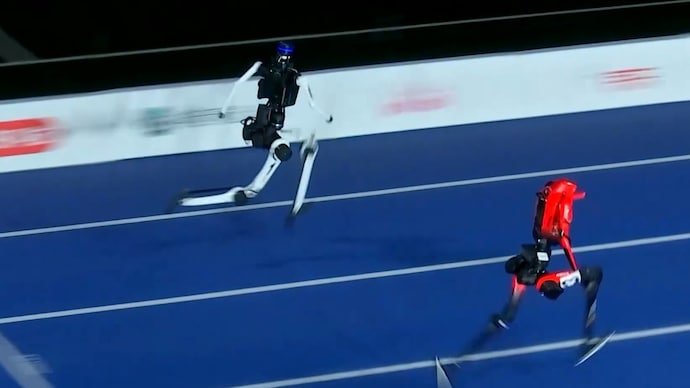
A Chinese humanoid robot has produced one of the most striking demonstrations yet of how quickly robotics is advancing, running 100 metres in 9.39 seconds at the World Humanoid Robot Games in Beijing.
The machine, Tiangong Ultra, developed by the Beijing Humanoid Robot Innovation Center, crossed the finish line faster than Usain Bolt’s famous 9.58-second human world record set in Berlin in 2009. The robot’s performance came in a preliminary heat rather than an official human Athletics competition, so it does not replace Bolt’s world record in the sport of athletics. It does, however, provide a remarkable benchmark for the progress of humanoid machines.
The result was even more dramatic because Tiangong Ultra was not alone in breaking the 10-second barrier. Lightning, a humanoid robot developed by smartphone maker Honor, finished the same heat in 9.47 seconds, also faster than Bolt’s human record.
The performances underline a rapidly changing robotics landscape in china, where companies, universities and research institutions are competing to improve humanoid robots’ speed, balance, Artificial Intelligence and ability to perform tasks in the physical world.
Tiangong Ultra’s 9.39-second sprint
Tiangong Ultra did not dominate the race from the opening moments.
According to reports from the event, the robot initially trailed Lightning before producing a powerful late surge. It accelerated past its rival near the finish and completed the 100 metres in 9.39 seconds.
Lightning was only 0.08 seconds behind, finishing in 9.47 seconds.
The margins are striking when compared with the human benchmark. Bolt’s 9.58-second performance in Berlin on August 16, 2009, remains the men’s 100m world record recognised by World Athletics. The Jamaican sprinter’s run was recorded with a legal tailwind of 0.9 metres per second.
| Performance | Time | Difference from Bolt’s 9.58 seconds |
|---|---|---|
| Tiangong Ultra, 2026 | 9.39 seconds | 0.19 seconds faster |
| Lightning, 2026 | 9.47 seconds | 0.11 seconds faster |
| Usain Bolt, 2009 | 9.58 seconds | Human world record |
The comparison is useful, but it needs an important qualification. A humanoid robot and a human athlete are not competing under the same physiological or sporting conditions. Robots do not have muscles, fatigue in the biological sense or the same restrictions governing human athletics. Their running performance is instead a test of mechanical design, motor control, balance, software and power management.
That makes the result less a replacement for Bolt’s sporting achievement and more a striking demonstration of what engineers can now make a two-legged machine do.
From 21.50 seconds to 9.39 seconds in one year
Perhaps the most remarkable part of Tiangong Ultra’s performance is not simply that it crossed the 100m mark faster than Bolt’s record. It is how dramatically the robot improved compared with its own previous performance.
At the inaugural World Humanoid Robot Games, Tiangong Ultra won the 100m event in 21.50 seconds.
A year later, its reported time was 9.39 seconds.
That represents an improvement of more than 12 seconds, or roughly 56% compared with its previous time. In elite human sprinting, improvements of anything approaching that scale would be extraordinary. In robotics, the comparison illustrates how quickly a platform can change when engineers modify its hardware, control systems and software.
The progress also demonstrates why humanoid robotics is moving beyond laboratory demonstrations. Engineers are increasingly using competitions to test machines under conditions where balance, acceleration, turning, recovery and endurance all matter.
Why running 100 metres is difficult for a humanoid robot
Running looks simple when performed by a human athlete, but it is a complicated control problem for a machine.
A humanoid robot must constantly manage its centre of mass while its feet repeatedly leave and reconnect with the ground. Each stride produces forces that can destabilise the machine. A small error in the timing of a leg movement can result in a stumble or complete loss of balance.
The machine also needs to coordinate multiple systems simultaneously. Motors must generate enough force for acceleration, sensors must detect changes in body position, and control software must adjust movement rapidly enough to keep the robot upright.
Speed creates another problem: the faster a robot runs, the less time its control system has to correct mistakes.
That is why the achievement at the Beijing games is about more than raw speed. It reflects progress in the interaction between mechanical engineering and software control.
Lightning shows the race is bigger than one robot
Tiangong Ultra’s achievement might have been impressive enough on its own, but Lightning’s 9.47-second run showed that multiple Chinese teams are pushing humanoid running Technology at the same time.
Lightning had already attracted attention before the main competition. Chinese state Media reported that the robot had recorded a 9.32-second time in a preparatory test and reached a peak speed of 14.5 metres per second.
Its development also illustrates how manufacturers are experimenting with robot proportions to improve performance.
According to Chinese broadcaster CCTV, Lightning stood 169 centimetres tall during the humanoid half-marathon and had 95-centimetre legs. Its legs were later lengthened by 10 centimetres ahead of the games.
Longer legs can potentially increase stride length, although changing a robot’s proportions also creates engineering challenges involving balance, weight distribution and control.
The results suggest that humanoid robotics is entering an era in which manufacturers are optimising machines not merely to walk but to run efficiently and competitively.
The half-marathon result reveals another side of the technology
Short-distance speed is only one measure of robotic performance.
Tiangong Ultra had previously won the world’s first humanoid robot half-marathon in Beijing. Lightning also won this year’s humanoid half-marathon, completing the race in 50 minutes and 26 seconds.
The half-marathon is a very different challenge from a 100m sprint. A robot that accelerates quickly must also manage energy consumption, heat, mechanical stress and stability over a much longer period.
That difference is important because the ultimate commercial value of humanoid robots is unlikely to come from winning races. Companies are interested in whether machines can perform useful work repeatedly, safely and economically.
A robot that can sprint extremely quickly but cannot operate reliably for hours would have limited practical value. Conversely, a machine that can walk, lift, manipulate objects and work continuously could be valuable even if it never approaches record sprinting speeds.
China’s humanoid robot industry is expanding rapidly
The Beijing games provide a snapshot of the scale of China’s ambitions in humanoid robotics.
The 2026 event features 2,056 robots from 666 teams representing 16 countries across six continents. That is a substantial increase from the inaugural edition.
The competition is also much broader than sprinting.
The games feature 51 events spanning athletic competitions and practical robot tasks. Activities include running, Football, table Tennis, dancing and industrial-style challenges.
That variety is significant because it tests different capabilities. A sprint measures dynamic movement and acceleration. Football requires perception, coordination and interaction with other machines. Industrial tasks are closer to the applications companies ultimately want humanoid robots to perform.
The event is therefore functioning as both a sporting spectacle and a public demonstration of China’s robotics capabilities.
Why China is betting heavily on humanoid robots
Humanoid robots are attracting attention because their physical form could allow them to operate in environments designed for people.
Factories, warehouses, offices and homes already contain stairs, doors, tools, shelves and workstations designed around the human body. A robot capable of moving and manipulating objects in a broadly human-like way could potentially operate in those environments without requiring every workplace to be redesigned.
That is one reason China’s robotics industry is increasingly focused on humanoid machines.
The sector combines several areas of technological development: artificial intelligence, computer vision, batteries, sensors, motors, actuators, lightweight materials and real-time control systems.
Progress in one area can improve the overall machine. Better motors can provide more acceleration. Better sensors can improve balance. Better software can make movement smoother. More capable AI systems can potentially allow robots to understand and respond to complex environments.
The 9.39-second sprint is therefore best understood as the visible result of advances across an entire technology stack.
The robot did not simply become “faster than Bolt”
The headline comparison with Usain Bolt is undeniably dramatic, but it can also obscure what the race actually demonstrates.
Bolt’s 9.58 seconds remains the recognised men’s 100m world record. It was achieved under the rules of human athletics, against other human athletes and under conditions monitored by the sport’s governing authorities.
Tiangong Ultra’s 9.39 seconds belongs to a different category. The robot’s performance does not mean that machines have surpassed human athletic achievement in the same sporting sense.
Instead, the comparison provides a familiar benchmark for audiences. Almost everyone understands that running 100 metres in under 10 seconds represents exceptional speed. When a machine reaches that territory, it becomes easier to appreciate how far robotics has advanced.
There is also an important engineering question behind the headline: can a robot achieve such speed consistently?
One exceptional run is less important commercially than repeatable performance. Manufacturers need robots that can perform reliably, recover from errors and operate safely without frequent mechanical failures.
Speed is impressive, but stability remains a challenge
The Beijing competition has also shown that record-setting speed does not automatically mean perfect control.
Reports from the race noted that the robots displayed instability after finishing. Tiangong Ultra stumbled, while Lightning fell after its run.
That detail is easy to overlook amid the excitement surrounding the times, but it may be one of the most useful lessons from the event.
For real-world robotics, stability is often more important than headline speed. A factory robot cannot simply run as fast as possible if doing so increases the chance of damaging itself, nearby equipment or people.
Engineers therefore face a trade-off between speed, power consumption, stability, durability and safety.
The next major advances may not necessarily produce another dramatic reduction in a 100m time. They may instead make robots capable of achieving high performance repeatedly without losing balance.
Investment interest is rising alongside technical progress
The rapid development of humanoid robots is also attracting financial attention.
Unitree, one of China’s best-known robotics companies, saw its shares jump more than fivefold during its Shanghai trading debut earlier in the week, giving the company a reported market value of around $50 billion.
The market response illustrates the level of investor enthusiasm surrounding humanoid robotics, although a high valuation does not guarantee that the technology will become commercially successful at scale.
The industry still faces difficult questions about production costs, battery life, reliability, Software Development, maintenance and the ability to deploy robots safely alongside people.
Those issues will ultimately determine whether humanoid robots become widely used tools or remain primarily impressive demonstrations.
The World Humanoid Robot Games are becoming a technology showcase
The expansion of the Beijing competition reflects how quickly interest in humanoid robots is growing.
With thousands of machines and hundreds of teams taking part, the games provide companies and research institutions with a public environment in which to compare different approaches to robot design.
China’s domestic participation is particularly large, with hundreds of teams from companies, universities and research institutions involved.
That creates an ecosystem in which improvements can spread quickly. Universities can experiment with new control techniques, companies can refine hardware and manufacturers can identify which technologies are commercially promising.
Competitions also provide something laboratories cannot always replicate: a clear performance benchmark.
A robot either completes a race, lifts a weight, plays a match or performs a practical task successfully. Those measurable outcomes make it easier to track progress from one year to the next.
What the 9.39-second run could mean for robotics
The biggest significance of Tiangong Ultra’s performance is not that a machine has supposedly replaced the world’s fastest human. It is that humanoid robots are progressing from slow, carefully controlled demonstrations toward much more dynamic movement.
The jump from 21.50 seconds to 9.39 seconds in a year illustrates the pace of experimentation and optimisation.
If similar progress occurs in other areas, humanoid robots could become increasingly capable of navigating complex environments, carrying objects, assisting workers and performing repetitive physical tasks.
However, the path from a record-setting demonstration to a commercially useful robot is long. Speed alone does not solve the problems of reliability, safety, cost or autonomy.
The next race is not really against humans
Tiangong Ultra’s 9.39-second run makes for an extraordinary headline, but the more important competition is taking place between robotics companies themselves.
Manufacturers are racing to build machines that can move more naturally, understand their surroundings, manipulate objects and operate safely for extended periods.
The World Humanoid Robot Games provide a highly visible way to demonstrate those advances.
For now, the 100m result offers a vivid symbol of the industry’s progress. Usain Bolt’s 9.58-second mark remains a landmark in human athletics, while Tiangong Ultra’s 9.39 seconds belongs to a new category of machine performance.
The remarkable part is not simply that a robot ran faster than a human record. It is that a two-legged machine capable of sensing, balancing and controlling its body at extraordinary speed can now do so at all.
That is what makes the Beijing sprint more than a novelty. It is a glimpse of how quickly the boundary between experimental robotics and high-performance machines is moving.
For breaking news and live news updates, like us on Facebook or follow us on Twitter and Instagram. Read more on Latest Technology on thefoxdaily.com.



COMMENTS 0