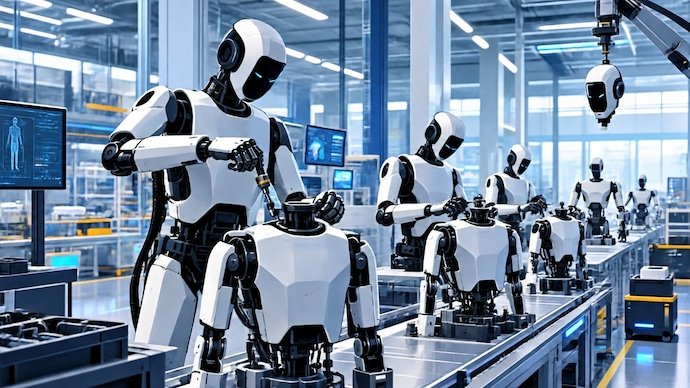
China’s push to turn humanoid robots from experimental machines into mass-produced industrial products has reached a striking new stage: robots are now being used to help build other robots.
Chinese robotics company UBTECH Robotics has opened a new humanoid robot smart factory in Liuzhou, Guangxi Zhuang Autonomous Region, designed for large-scale production of industrial humanoid robots. The company says the facility can produce one industrial humanoid robot every 10 minutes, with an annual production capacity of up to 10,000 robots.
The development is notable not simply because of the production speed. The factory itself is designed around a highly automated manufacturing system in which humanoid robots, robotic arms, unmanned vehicles and digital management systems work together across the production process.
UBTECH says the facility mainly produces robots from its Walker S and Cruzr series. The setup illustrates a broader shift in robotics manufacturing: instead of humanoid robots remaining primarily research projects or demonstration machines, manufacturers are building production systems specifically designed to make them at industrial scale.
Inside China’s new humanoid robot assembly line
The new factory covers approximately 14,000 square metres and stands about 13.8 metres high, according to UBTECH. It was developed by UBTECH together with Siemens Digital Industries Software.
At the centre of the operation is a digital management system that UBTECH describes as the factory’s “smart brain.” Rather than relying entirely on people to coordinate individual production stages, the system is designed to manage manufacturing information, material movement and quality-control processes.
That means the factory is not simply a conventional assembly line with a few robots added to it. The objective is to create an interconnected production environment in which machines and software coordinate multiple stages of manufacturing.
UBTECH says the system can help determine what needs to be produced, coordinate the movement of components and monitor the quality of completed robots. Each robot is also assigned its own serial number, allowing it to be tracked throughout the manufacturing process.
That traceability becomes particularly important when production moves from small batches to thousands of machines. A manufacturer producing humanoid robots at scale needs to know which components went into each unit, where the unit was assembled and how it performed during testing.
Robots helping prepare the parts for other robots
The most attention-grabbing aspect of the facility is the role of humanoid robots themselves.
UBTECH says its Cruzr Y1 and Cruzr S2 robots are deployed for logistics-related tasks inside the factory. Their jobs include unloading materials, stacking components, loading materials and transporting items around the production floor.
In practical terms, this creates an unusual manufacturing loop. Some robots are being used to move and prepare the materials that eventually become part of other robots.
The concept is important because humanoid robots are being developed partly to operate in environments originally designed for people. Their human-like form allows them to work around equipment, tools and workspaces without requiring every factory to be completely redesigned around a new machine shape.
But the factory does not depend exclusively on humanoid robots. Instead, UBTECH is combining several types of automation equipment, each suited to different manufacturing tasks.
Humanoid robots are only one part of the automation system
The production line also incorporates collaborative robotic arms, unmanned logistics vehicles, power-assist manipulators and rotating worktables, according to the company.
This mixed approach is significant. Humanoid robots may be capable of performing a wide range of tasks, but that does not necessarily mean they are the most efficient machine for every individual operation.
A robotic arm, for example, can be designed specifically for repetitive precision movements. An automated logistics vehicle can move materials without needing the walking and balancing capabilities of a humanoid machine. A specialized manipulator can assist with lifting or positioning heavy components.
By combining these systems, the factory can assign different jobs to different machines rather than requiring one type of robot to do everything.
UBTECH says the arrangement also allows multiple robot models to be produced on the same production line. That flexibility can reduce the need for completely separate assembly systems for different models.
The result is closer to a coordinated robotic ecosystem than a factory operated by one category of machine.
What does “one robot every 10 minutes” actually mean?
The claim that the factory can produce one industrial humanoid robot every 10 minutes is best understood as a measure of planned production capacity and manufacturing throughput, rather than evidence that an entire robot is assembled from raw materials in exactly 10 minutes.
Large-scale factories divide manufacturing into numerous stages. Components may be prepared, assembled, tested and moved through different areas before a finished product reaches the warehouse.
At the stated rate, continuous operation at one completed robot every 10 minutes would correspond to a theoretical throughput of 144 robots per 24 hours. Over an entire year, however, actual output depends on operating schedules, demand, maintenance, production planning and other factors.
UBTECH gives the facility an annual production capacity of 10,000 humanoid robots. That figure provides a clearer indication of the scale the company is targeting than the headline production interval alone.
The distinction matters because manufacturing capacity and actual annual production are not necessarily the same thing. A factory can be engineered to handle a particular volume without necessarily operating continuously at maximum capacity.
Every finished humanoid robot gets a health check
Building a humanoid robot is only one part of the challenge. A machine with multiple joints, sensors, motors, electronic systems and software must also demonstrate that those systems work together reliably.
UBTECH says every completed humanoid robot undergoes more than four hours of whole-machine testing before leaving the factory.
The company also says finished robots receive a 360-degree visual inspection. The process is designed to examine the robot’s appearance from all directions and identify potential defects.
This final inspection is particularly relevant to humanoid robots because their performance depends on the interaction of many components. A production problem involving a joint, sensor, actuator or electronic connection could affect the machine well beyond the individual component itself.
Extensive end-of-line testing therefore becomes increasingly important as manufacturers attempt to move from demonstration units to commercial fleets.
The warehouse is automated too
Automation at the Liuzhou facility does not stop when a robot reaches the end of the assembly line.
UBTECH says its automated warehouse can store 112 humanoid robots in an area of only 65 square metres. Automated guided vehicles, unmanned forklifts and other logistics systems are used to move robots and components between production, testing and storage areas.
This creates another important feature of the factory: the movement of products is itself part of the automation strategy.
In a conventional manufacturing environment, moving components between workstations can require significant human labour. Automated logistics systems can instead transport materials according to digitally managed production requirements.
For a factory producing large numbers of relatively complex machines, reducing unnecessary manual movement can become an important part of overall efficiency.
Why China is scaling up robot manufacturing
UBTECH’s factory is being established against the backdrop of a much larger expansion of robotics manufacturing in China.
China has become a major centre for industrial robot production and deployment, while companies and research institutions are increasingly working on humanoid robots designed for manufacturing, logistics and other real-world applications.
Official industrial production data also point to continued growth in the country’s robotics sector. According to China’s National Bureau of Statistics, 98,677 industrial robots were produced in July, representing a year-on-year increase of 30.2%. During the first seven months of the year, industrial robot output reached 635,056 units, up 28.5% year on year.
These figures cover industrial robots broadly and should not be confused with humanoid robot production. Traditional industrial robots, including robotic arms used extensively in factories, remain a much larger established category.
What the figures do show is the industrial environment in which humanoid robot manufacturers are attempting to scale production.
From research laboratories to factory floors
For years, humanoid robots were primarily associated with research laboratories, university demonstrations and highly controlled experiments. The machines could walk, manipulate objects or demonstrate increasingly sophisticated artificial intelligence, but producing them reliably and economically at scale presented a different challenge.
A factory such as UBTECH’s addresses that second problem: how do you manufacture thousands of humanoid machines rather than build them as individual engineering projects?
That requires standardized components, repeatable assembly procedures, quality control, software integration, automated testing and logistics systems capable of supporting high-volume production.
The factory therefore represents not only a manufacturing facility but also an experiment in how humanoid robots themselves might fit into future industrial operations.
The bigger question: who builds the factories of the future?
The idea of robots building robots sounds futuristic because it changes the traditional relationship between automation and manufacturing.
Historically, factories used machines to perform specific repetitive operations while people handled tasks that required dexterity, adaptation, supervision or decision-making. Modern factories increasingly combine industrial robots, artificial intelligence, computer vision, autonomous vehicles and digital management platforms.
Humanoid robots introduce another possibility: a general-purpose machine capable of performing several types of work in spaces originally designed for human workers.
If such machines become sufficiently reliable and cost-effective, manufacturers could potentially deploy them across multiple tasks without rebuilding entire facilities for each application.
However, the technology still faces practical questions. High-volume production does not automatically prove that humanoid robots are economically competitive with specialized machines. Reliability, maintenance, energy consumption, software performance, safety and the cost of each robot will all influence whether factories can justify large deployments.
There is also a difference between demonstrating that a humanoid robot can perform a task and proving that it can perform that task consistently for thousands of hours in a commercial environment.
Why this factory matters for the humanoid robot industry
UBTECH’s Liuzhou facility highlights a transition that could become increasingly important for the robotics industry: the industrialization of humanoid robot production.
The most significant feature may not be the headline figure of one robot every 10 minutes. It is the infrastructure surrounding that production rate.
Humanoid robots are being integrated with robotic arms, automated transport systems, warehouse technology, digital production management and automated inspection. Together, these technologies are intended to create a manufacturing system capable of producing multiple humanoid models at scale.
There is an important distinction between a robot that can perform a task and an industry capable of producing that robot reliably in large numbers. The latter requires an entire supply chain and manufacturing ecosystem.
China’s expanding industrial robotics sector provides a substantial base for that development, while factories such as UBTECH’s offer a glimpse of what mass production of humanoid machines could look like.
The irony is hard to miss: the factories being built to create the next generation of robotic workers are themselves becoming increasingly robotic.
Whether humanoid robots eventually become common across manufacturing, logistics and other industries will depend on their economics, reliability and real-world performance. But with dedicated facilities now being designed to produce thousands of them, the technology is moving another step away from the laboratory and closer to the factory floor.
For breaking news and live news updates, like us on Facebook or follow us on Twitter and Instagram. Read more on Latest Technology on thefoxdaily.com.






COMMENTS 0