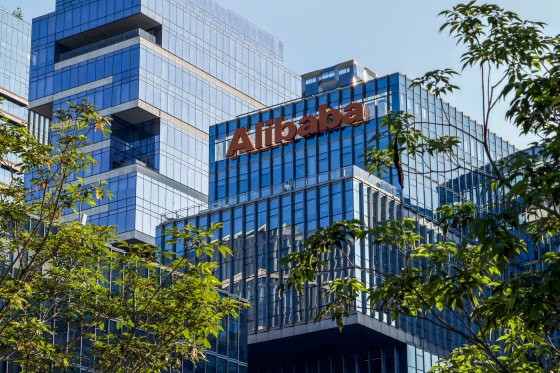
Alibaba has unveiled a new Artificial Intelligence chip and outlined plans to develop much larger AI models, highlighting China’s growing push to strengthen its domestic technology capabilities as competition with the United States intensifies.
The Chinese technology giant announced the new hardware and AI plans at its annual flagship conference in Hangzhou on Tuesday. Chief executive Eddie Wu described the new Zhenwu V900 as the “most powerful AI chip in China today” and said it can deliver three times the performance of Alibaba’s previous-generation Zhenwu M890.
The announcement comes just days before Chinese President Xi Jinping is due to meet US President Donald Trump in Washington, with artificial intelligence, Trade and tariffs expected to feature prominently in discussions between the two countries.
Alibaba also revealed plans to train a future AI model with between five trillion and 10 trillion parameters, potentially placing it at a scale significantly larger than the company’s current flagship Qwen model. The announcement underscores how Chinese technology companies are attempting to compensate for restrictions on access to advanced foreign chips by developing domestic alternatives and expanding computing infrastructure.
Alibaba calls Zhenwu V900 China’s most powerful AI chip
The centerpiece of Alibaba’s announcement was the Zhenwu V900, a new chip designed for the computing workloads required by modern artificial intelligence systems.
Wu said the V900 delivers three times the performance of Alibaba’s previous Zhenwu M890 chip. Alibaba uses its Zhenwu chips in data centers operated through its cloud Business, where they provide computing resources for the company and its cloud customers.
AI Chips perform the enormous number of calculations required to train large models and generate responses after those models have been trained.
Training involves processing vast quantities of data to develop the statistical patterns that allow an AI system to generate text, analyze information, create images or perform other tasks. Inference refers to the calculations performed when an already-trained model responds to a user or application.
The distinction is increasingly important as AI companies compete not only to develop increasingly capable models but also to provide the computing infrastructure needed to run those systems at scale.
Alibaba’s claim that the V900 is China’s most powerful AI chip is a company statement rather than an independently established industry ranking. Measuring chip performance can depend on workloads, software optimization, memory systems and other technical factors, meaning comparisons between competing AI accelerators are not always straightforward.
Alibaba plans an AI model with up to 10 trillion parameters
Alongside its chip announcement, Alibaba said it plans to train a new AI model with between five trillion and 10 trillion parameters.
Parameters are numerical values that an AI model adjusts during training. They are often used as a rough indication of a model’s scale, although parameter count alone does not determine how capable an AI system will be.
Alibaba’s latest Qwen3.8-Max model has 2.4 trillion parameters, according to the company. A future model reaching 10 trillion parameters would therefore represent a substantial increase in scale.
Chinese AI company Moonshot has also been developing very large models. Its Kimi K3, released in July, has been described by the company as the world’s largest open model, with 2.8 trillion parameters.
The rapid increase in model size illustrates the direction of competition in the AI industry. Companies are investing heavily in larger models, more efficient training methods and specialized computing systems while also exploring techniques that can produce stronger performance without simply increasing the number of parameters.
For Alibaba, the development of its own chips and larger models are closely connected. More powerful models require enormous computing resources, while the availability of specialized chips can determine how quickly and economically those models can be trained and operated.
Alibaba targets more than 20 gigawatts of computing capacity
Alibaba is also planning a major expansion of the infrastructure behind its cloud computing operations.
The company said it expects to have more than 20 gigawatts of computing capacity by 2032, citing rapidly increasing demand for AI computing.
The scale of the planned expansion illustrates one of the less visible challenges of the AI boom. Advanced models require far more than processors alone. Data centers need electricity, cooling systems, networking equipment, storage, power infrastructure and access to suitable facilities.
As AI models become larger and businesses deploy them across more applications, demand for data center capacity is increasing rapidly. Companies building AI infrastructure are therefore increasingly competing for electricity, advanced chips and other components of the data center supply chain.
Alibaba’s expansion plans indicate that the company expects AI workloads to become a major driver of cloud computing demand for years to come.
China’s AI push faces US chip restrictions
Alibaba’s announcement comes against the backdrop of extensive US restrictions on China’s access to some advanced semiconductor technologies.
US export controls have limited Chinese companies’ access to certain advanced AI chips and semiconductor manufacturing equipment. The restrictions are designed to limit China’s ability to obtain or produce some of the most advanced computing technologies.
Chinese technology companies have responded by investing in domestic chip design, alternative supply chains and more efficient AI development strategies.
Alibaba’s Zhenwu program is part of that broader effort. Huawei has also been developing new AI chip technologies as it seeks to challenge established global semiconductor companies, including Nvidia.
Chinese AI companies have historically relied in part on Nvidia hardware for frontier AI model training. Restrictions on the sale of some advanced Nvidia chips to China have increased the importance of domestic alternatives.
That does not mean China’s AI industry has eliminated its dependence on foreign technology. The ability to design an AI processor is only one part of the semiconductor equation. Manufacturing advanced chips at scale requires sophisticated fabrication facilities, equipment, materials and production expertise.
Chip design is only one part of the competition
The progress of China’s AI industry will depend on more than how quickly companies such as Alibaba and Huawei can develop new chip architectures.
Semiconductor manufacturing remains a critical factor because increasingly powerful chip designs require advanced manufacturing processes to deliver their intended performance and efficiency.
Counterpoint Research senior analyst Parv Sharma said the extent to which the AI and chipmaking gap between China and the United States narrows will depend partly on China’s ability to advance the foundries that manufacture chips, rather than chip design alone.
This distinction is crucial in the global semiconductor race. A company can develop an advanced processor design but still face limitations if the necessary manufacturing technology, production capacity or high-end equipment is unavailable.
China has therefore placed increasing emphasis on semiconductor self-reliance. The goal is not simply to produce individual chips domestically but to build a broader ecosystem covering design, manufacturing, packaging, software and data center infrastructure.
Chinese AI models are expanding globally
China’s AI ambitions extend beyond domestic infrastructure. Open models developed by Chinese companies have increasingly attracted attention in international markets.
Many Chinese open AI models can be accessed or adapted at relatively low cost compared with some proprietary systems developed by leading US AI laboratories. That pricing and accessibility can make them attractive to developers and businesses seeking to deploy AI without committing to expensive closed platforms.
Chinese models have consequently begun making inroads in markets outside China, including the United States.
The development creates another dimension to the US-China Technology competition. The contest is no longer limited to which country can build the fastest AI accelerator or train the largest model. It also involves software ecosystems, developer adoption, pricing, open-source or open-model strategies and the ability to turn AI technology into commercially useful products.
For Alibaba, the Qwen family is an important part of that effort. The company is simultaneously developing models, chips and cloud infrastructure, allowing it to control more parts of the AI technology stack.
AI technology becomes part of the US-China relationship
The timing of Alibaba’s announcement gives the development additional geopolitical significance.
Xi Jinping’s planned meeting with Trump comes as Washington and Beijing continue to compete over advanced technologies, trade and strategic industries. AI has increasingly become part of that competition because advanced computing can have applications across commercial, scientific and National Security fields.
US technology leaders have raised concerns about China’s progress in artificial intelligence. Anthropic CEO Dario Amodei and other US AI figures have argued that China’s rapid development creates strategic challenges for the United States.
At the same time, Chinese companies have sought to demonstrate that restrictions on access to advanced US technology have not stopped domestic AI development.
Alibaba’s announcement therefore serves both a commercial purpose and a broader demonstration of technological capability. The company is presenting its domestic chips and AI models as part of an increasingly self-reliant computing ecosystem.
More computing could help China offset chip limitations
One strategy available to Chinese AI companies is to compensate for differences in individual chip performance by increasing the amount of computing available for training and inference.
Neil Shah, vice president of Counterpoint Research, said that using additional computing power to offset chip limitations can help China maintain strength in its domestic AI market.
This approach does not eliminate the importance of advanced chips. Less efficient hardware can increase electricity consumption, infrastructure costs and the amount of time required to train models.
But large-scale computing infrastructure can still allow companies to develop competitive AI systems even when access to the world’s most advanced accelerators is restricted.
Alibaba’s planned expansion to more than 20 gigawatts of computing capacity reflects this broader strategy. Rather than depending exclusively on individual chip performance, the company is building an ecosystem in which large amounts of computing can be deployed across its cloud infrastructure.
Alibaba says AI demand is growing rapidly
Wu said Alibaba is “mobilizing every resource” to meet customer demand for AI.
He also warned that shortages throughout the AI data center supply chain are limiting how quickly the company can expand its computing infrastructure.
Those constraints are not unique to China. The global AI industry has faced intense demand for accelerators, networking equipment, electricity and data center capacity as companies race to deploy increasingly powerful systems.
The resulting infrastructure competition has made the availability of power and physical data center capacity almost as important as access to advanced processors.
Alibaba’s long-term infrastructure target suggests that the company expects AI workloads to remain a major source of demand for its cloud business rather than representing a short-term technology cycle.
Wu predicts a dramatic expansion of machine intelligence
Alibaba’s CEO also offered a sweeping view of where artificial intelligence could eventually lead.
Wu compared the growth of AI with the Industrial Revolution and argued that “machine intelligence” could eventually expand far beyond current levels.
He acknowledged that machine intelligence today is not a substitute for human intelligence but predicted that machines could eventually produce more than 1,000 times the amount of “thinking” generated by humanity collectively.
Such statements are forecasts rather than measurable descriptions of current AI capabilities. They also illustrate the increasingly ambitious expectations surrounding artificial intelligence among technology companies investing heavily in the field.
The more immediate reality is that AI systems already require enormous amounts of computing power, and companies are racing to develop chips and infrastructure capable of meeting that demand.
What Alibaba’s announcement means for the AI race
Alibaba’s latest announcements show how the AI competition between China and the United States is expanding beyond individual chatbot models.
The company is pursuing several parts of the technology stack simultaneously: specialized AI chips, large-scale models, cloud computing and data center infrastructure.
The Zhenwu V900 represents Alibaba’s effort to strengthen its domestic hardware capabilities, while the planned five-to-10-trillion-parameter model demonstrates its ambition to compete at the upper end of AI model development.
The company’s 2032 computing target adds another dimension, indicating that Alibaba expects the ability to deploy massive amounts of computing capacity to remain a central competitive advantage.
Whether these efforts will close the technological gap with leading US companies depends on factors including chip manufacturing, software optimization, model efficiency, access to computing infrastructure and the continued development of semiconductor technology.
For now, Alibaba’s announcement provides another indication that China’s AI industry is responding to export restrictions with a combination of domestic chip development, larger models and massive investments in computing infrastructure.
With AI expected to feature prominently in the broader US-China relationship, the progress of companies such as Alibaba is likely to remain closely watched as both countries compete for influence over the next generation of artificial intelligence technology.
For breaking news and live news updates, like us on Facebook or follow us on Twitter and Instagram. Read more on Latest World on thefoxdaily.com.






COMMENTS 0