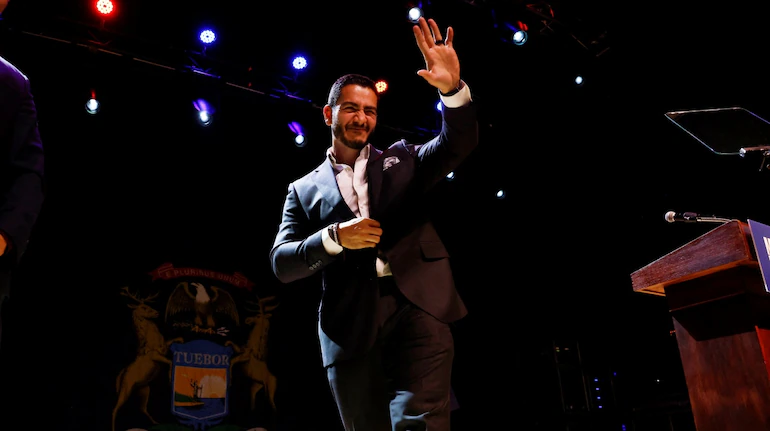
Abdul El-Sayed made history after winning Michigan’s Senate race against Republican candidate Mike Rogers, becoming the first Muslim elected to the United States Senate. But his victory speech was not limited to celebrating the electoral breakthrough. The 42-year-old Democrat also used the occasion to take pointed swipes at President Donald Trump and Vice President JD Vance, both of whom had criticised him during the campaign.
Addressing Vance, El-Sayed highlighted the irony that the vice president would be constitutionally required to administer his oath of office when the new Senate convenes in January.
“Habibi, there is this delicious irony in the fact that you’re constitutionally obligated to swear me in, in January,” El-Sayed said.
He also had a message for Trump, who had repeatedly questioned his loyalty to the United States and criticised him during the election campaign.
“I know you struggle with my name, so after JD swears me in, you can just go on and call me Senator,” he said.
Taking a dig at his Republican opponent, El-Sayed told supporters: “You chose hate, and Michigan chose hope.”
His victory marks a significant moment in American electoral politics, not only because of his historic religious representation but also because of the political controversies surrounding his campaign. The result also carries a personal connection to India through his wife Sarah Jukaku, whose family traces its ancestry to Bhatkal in Karnataka.
Who Is Abdul El-Sayed? The Journey From Public Health to the US Senate
Abdul El-Sayed, 42, is the son of Egyptian immigrants and has built his career around public health, government administration and progressive politics. Before entering the Senate, he served as director of the Detroit Health Department and headed Wayne County’s health and human services department.
He graduated from the University of Michigan and later earned a medical degree from Columbia University. He also holds a doctorate from the University of Oxford, where he studied as a Rhodes Scholar.
Despite his academic and administrative background, El-Sayed had never held elected office before his Senate victory. His earlier attempt to enter electoral politics came in the 2018 Michigan Democratic gubernatorial primary, where he finished second after suffering a double-digit defeat.
His political fortunes changed during the 2026 Senate election cycle. El-Sayed defeated Democratic Representative Haley Stevens in the party’s August primary before facing Republican Mike Rogers in the general election.
Rogers, a former congressman and FBI agent, had received Trump’s backing. He had narrowly lost the 2024 Michigan Senate election to Democrat Elissa Slotkin before returning to contest the state’s open seat.
Medicare for All and Economic Affordability at the Centre of His Campaign
El-Sayed campaigned on a progressive platform focused on universal healthcare, economic affordability and reducing the influence of outside money in American elections.
One of his central proposals was Medicare for All, a plan that would replace the existing combination of private and public health insurance with a government-run, single-payer healthcare system.
The proposal reflects his background in medicine and public health. His campaign also emphasised the cost of living and the need to make essential services more accessible to ordinary Americans.
El-Sayed received support from prominent progressive figures, including Senator Bernie Sanders and Representative Alexandria Ocasio-Cortez. Their backing helped connect his campaign with a broader movement within the Democratic Party seeking changes to healthcare, economic policy and campaign financing.
His victory came after he overcame an earlier electoral setback and a closely contested Democratic primary. The Senate result now gives him a national platform to advance the policy positions that shaped his campaign.
Trump’s Attacks and the Controversy Over Israel
El-Sayed’s campaign faced repeated criticism from Trump and other Republican leaders. They attempted to associate him with terrorist organisations despite no evidence of such connections and questioned his loyalty to the United States.
His criticism of Israel also became a major political flashpoint, particularly during the Democratic primary against Haley Stevens. The issue attracted substantial outside spending and intensified divisions within the party over US policy towards Israel.
Nearly $60 million in outside money was spent during the election contest, with the American Israel Public Affairs Committee (AIPAC) spending almost $30 million to oppose El-Sayed. It was the organisation’s largest investment in a single race.
Stevens, who lost the Democratic primary, subsequently endorsed Rogers on November 1. She argued that El-Sayed had not done enough to address her concerns and those of the Jewish community.
The controversy continued beyond the primary. El-Sayed also faced criticism over comments he made following an attack on a Michigan synagogue earlier this year. He later apologised, saying he was sorry to anyone who felt his remarks might have been hurtful.
These disputes became an important part of the political environment surrounding his campaign, with questions about Israel, community relations and his political positions drawing attention alongside his healthcare and economic proposals.
How Abdul El-Sayed Has a Karnataka Connection
Beyond his historic achievement in American politics, El-Sayed has a family connection to India through his wife, Sarah Jukaku. Her family traces its ancestry to Bhatkal, a coastal town in Karnataka’s Uttara Kannada district, approximately 140 km from Mangaluru.
El-Sayed has spoken publicly about his association with his wife’s South Indian family and how Indian culture has influenced his household during their two decades of marriage.
In an interview with People magazine, he joked about becoming deeply familiar with the traditions of his wife’s family.
“Listen, I’ve been married in a South Indian family for 20 years, like… I am well inducted now; I… you know, I might be more Indian than I am Arab,” he said.
He has also described growing up surrounded by Indian cultural influences through his immediate family.
“I’m like surrounded by desi women my whole life like I have two desi daughters and a desi wife,” he said.
Speaking at a Pakistan Independence Day gathering organised by the Pakistan Association of America in Michigan on August 23, El-Sayed also referred to his wife’s Indian ancestry.
“My wife is desi. She’s from the other side of the partition line,” he said.
His remarks reflect the cultural connections within his family, linking his Egyptian background with his wife’s South Indian heritage.
Who Is Sarah Jukaku? Her Family’s Roots in Bhatkal
Sarah Jukaku is a psychiatrist who was born and raised in Michigan to Indian immigrant parents. Her father, Dr Jukaku S Tayeb, is a nephrologist originally from Bhatkal.
He completed his MBBS at Bangalore Medical College before moving to the United States in the 1980s. His family’s connection to Karnataka has remained an important part of Sarah’s background.
Sarah met El-Sayed at the University of Michigan, where both were students. She later studied at the University of Oxford and earned her medical degree from Columbia University’s Vagelos College of Physicians and Surgeons in 2015.
The couple married in May 2006 and have two daughters, Emmalee and Serene. They live in Ann Arbor, Michigan.
JH Shamsuddin Jukaku: The Political Legacy Behind the Bhatkal Connection
Sarah’s family history in Karnataka also includes her grandfather, JH Shamsuddin Jukaku, a prominent lawyer and political figure who served as deputy minister for finance in the erstwhile Mysore State under Chief Minister BD Jatti.
He was remembered for his contribution to the development of Bhatkal, including efforts to bring electricity to the region. Reportedly among the first lawyers from the area, he provided legal assistance to people belonging to different communities.
His public service and contribution to the town remain significant parts of the family’s history.
According to The Times of India, a cousin of Sarah said the family was particularly happy about El-Sayed’s electoral success and his association with the values of their grandfather, especially honesty and public service.
Members of the Jukaku family have been closely following the Michigan election, with several relatives living in Bengaluru and other parts of India, while Sarah’s immediate family is largely settled in the United States.
For the family, El-Sayed’s victory represents more than a political milestone. It connects their ancestral hometown of Bhatkal with an important moment in American political history.
What Does Abdul El-Sayed’s Victory Mean for US Politics?
El-Sayed’s victory came amid significant Democratic gains in the 2026 US midterm elections. Democrats secured control of both chambers of Congress, with Michigan emerging as an important battleground after two-term Democratic Senator Gary Peters decided not to seek re-election.
Republicans had cleared the field for Rogers, but his campaign faced challenges linked to his association with Trump, rising prices and concerns over the economic consequences of the president’s tariffs and the war with Iran.
Rogers had previously criticised Trump but increasingly aligned himself with the president. He also expressed concern about the conflict with Iran, writing on social media in September:
“The war with Iran needs to end, and end quickly.”
El-Sayed’s victory is expected to strengthen the progressive wing of the Democratic Party as it looks towards the 2028 presidential election. His campaign has also brought renewed attention to proposals such as Medicare for All and the debate over the influence of outside money in elections.
His election to the Senate also represents a milestone for Muslim representation in the United States Congress. As the first Muslim elected to the US Senate, El-Sayed’s arrival will add a new dimension to the institution’s religious and cultural representation.
From Bhatkal to Washington: A Historic Political Milestone
Abdul El-Sayed’s victory brings together several strands of American political and social life: progressive policy debates, questions of religious representation, campaign controversies and the influence of outside spending.
His remarks directed at Trump and Vance turned his victory speech into a pointed response to the criticism he faced during the campaign. His reference to being sworn in by Vance also underscored the constitutional responsibilities that follow an election victory.
For the Jukaku family, the result carries an additional personal significance. Their ancestral connection to Bhatkal in Karnataka now forms part of the story surrounding a historic US Senate election.
El-Sayed’s journey from public health administration and an unsuccessful gubernatorial primary campaign to becoming the first Muslim elected to the US Senate marks a major change in his political career. His next challenge will be to translate the promises of his campaign into legislative priorities when he takes office in January.
For breaking news and live news updates, like us on Facebook or follow us on Twitter and Instagram. Read more on Latest World on thefoxdaily.com.





COMMENTS 0