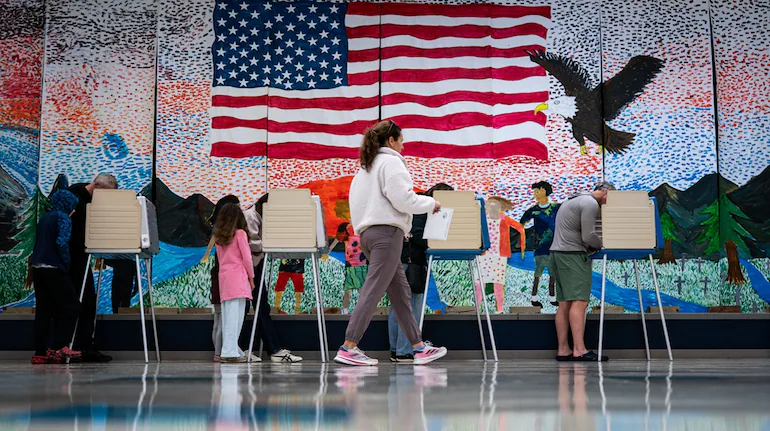
Democrats are seeking to secure a majority of US governorships for the first time in two decades as voters head to the polls in Tuesday’s Midterm Elections. Gubernatorial contests across 36 states could reshape the political balance between state governments and President Donald Trump’s administration, while influencing the administration of the 2028 presidential election.
The elections are taking place amid voter concerns over the economy, inflation, healthcare and the future of democracy. The results will determine control of governorships in states representing approximately 80% of the US population, including several major presidential battlegrounds.
36 States Hold Gubernatorial Elections
Governors are being elected in 36 states, with competitive contests taking place in populous states such as Texas and Florida, presidential battlegrounds including Michigan and Wisconsin, and traditionally Republican states such as Iowa and Ohio.
Republicans currently control 26 of the country’s 50 governorships, while 19 states have no incumbent seeking re-election. Democratic governors currently represent approximately 60% of the US population, although the party does not hold a majority of state governorships.
The large number of competitive races has drawn national attention, particularly amid concerns about Trump’s approval ratings and their potential impact on Republican candidates. During the campaign, Trump held rallies in strongly Republican areas alongside candidates seeking election as governors.
“Our goal is not just the majority of the population, but the majority of states,” Meghan Meehan-Draper, executive director of the Democratic Governors Association, told The Associated Press, according to the PTI report.
Democrats Last Held Majority of Governorships in 2006
Democrats last secured a majority of US governors’ offices in 2006, when they gained six governorships during the final midterm elections of Republican President George W Bush’s second term. Republicans regained the majority four years later, in 2010.
A Democratic majority could give the party greater influence over state-level policies and increase the number of governors willing to challenge or oppose Trump’s agenda.
Trump has faced disputes primarily with Democratic-led states over several issues, including the deployment of National Guard troops, immigration operations, conditions attached to federal funding and federal efforts to influence election rules. These disagreements have also involved proposed restrictions on postal voting and questions about the balance of authority between state and federal governments.
Alaska, Georgia, Iowa and Ohio Among Competitive Races
About a dozen gubernatorial contests are considered particularly competitive. Democrats see opportunities to gain governorships in Alaska, Georgia, Iowa and Ohio, where incumbents cannot seek another term. Nevada is also a closely watched contest, with state Attorney General Aaron Ford challenging Republican Governor Joe Lombardo.
Georgia and Alaska have not elected a Democratic governor since 1998, while Iowa and Ohio have not done so since 2006. These open-seat contests offer Democrats opportunities to expand their presence in states where Republicans have held the governorship for several years.
Republicans, meanwhile, have an opportunity to gain a governorship in Kansas, where Democratic Governor Laura Kelly cannot seek another term. Kansas has traditionally voted Republican in statewide elections.
Wisconsin, Michigan and Oregon Races Draw Attention
In Wisconsin, Republican US Representative Tom Tiffany is competing against Democrat David Crowley, the Milwaukee County executive who narrowly won his party’s primary.
Republicans are also targeting the open governor’s office in Michigan. In Oregon, Democratic Governor Tina Kotek is facing another challenge from Republican state Senator Christine Drazan.
Democrats are also looking at potential opportunities in Texas, Florida, Oklahoma and Nebraska, although the political circumstances differ considerably across these states.
Ohio Campaign Advertisement Sparks Controversy
The Ohio gubernatorial contest attracted national attention after Republican candidate Vivek Ramaswamy’s campaign released an advertisement featuring criticism of Democratic candidate Amy Acton by her estranged mother.
The advertisement referred to a family history involving Acton’s childhood and her stepfather, who was indicted for raping her when she was a child. Her mother had lost custody of her children decades earlier.
The campaign advertisement drew criticism from members of both political parties, including Republican Governor Mike DeWine. Trump praised the advertisement, while Vice-President JD Vance, who is from Ohio, defended it.
The controversy added another dimension to a closely watched contest that could determine whether Democrats gain control of the governorship in a state that has not elected a Democratic governor since 2006.
Texas Race Puts Abbott Against Democratic Challenger
Texas is another important contest, with Democratic state Representative Gina Hinojosa challenging Republican Governor Greg Abbott, who is seeking a third term.
No Democrat has won statewide office in Texas since 1994, making Hinojosa’s campaign a significant test for the party. She initially entered the general election campaign with substantially fewer financial resources than Abbott.
In September, Latino politicians and other political figures approached the Democratic Governors Association seeking $10 million in campaign support. They argued that Hinojosa had made the race competitive.
The association provided $1 million, considerably less than the amounts it spent supporting candidates in Arizona, Georgia, Iowa, Michigan, Nevada, Ohio and Wisconsin.
Abbott did not attend Trump’s rally in Texas, an absence viewed by some observers as reflecting the political sensitivity surrounding the president’s standing in the state.
Florida, California and New York Also in Focus
Republicans are seeking to retain control of Florida, the country’s third-most populous state. Republican US Representative Byron Donalds is contesting the governorship against Democrat David Jolly, a former Republican congressman.
In California, Democrat Xavier Becerra is expected to win comfortably, while New York Governor Kathy Hochul is also considered well positioned in her re-election campaign.
The contrasting contests across these states highlight the different political environments in which Democrats and Republicans are competing to control governorships.
Governors Could Influence the 2028 Presidential Election
Governorships are also at stake in all six battleground states from the 2024 presidential election: Arizona, Georgia, Michigan, Nevada, Pennsylvania and Wisconsin.
The governors elected in these states could play an important role in overseeing aspects of the 2028 presidential election. Their responsibilities and influence over state election administration could become particularly significant amid Trump’s efforts to expand federal involvement in election rules.
The results could therefore shape not only the political balance between state governments and Washington but also the environment in which the next presidential election is administered.
Democratic Governors Seen as Potential 2028 Presidential Candidates
Several Democratic governors seeking re-election are also being discussed as possible presidential candidates in 2028. They include Maryland Governor Wes Moore, Illinois Governor JB Pritzker and Pennsylvania Governor Josh Shapiro.
Analysts say a strong election result, substantial fundraising and the ability to help other Democratic candidates win could strengthen a governor’s standing among party donors and activists ahead of the next presidential campaign.
However, the gubernatorial contests are primarily focused on state leadership, and the election results will not by themselves determine the Democratic Party‘s eventual presidential nominee.
2026 Elections Could Produce Historic Firsts
The elections could also mark important milestones in the representation of women and minority communities in state leadership.
Gina Hinojosa is seeking to become Texas’ first Latina governor. In New Mexico, Deb Haaland is campaigning to become the first Native American woman to lead a US state.
Several other Black candidates nominated by the two major political parties are also contesting gubernatorial elections. Seven Black candidates are on the ballot, in addition to Maryland Governor Wes Moore, according to the supplied report.
Only three Black Americans have been elected governor in the country’s history, making the outcome of these races significant for representation in state-level executive offices.
Gubernatorial Results Could Reshape US Political Landscape
The contests across 36 states represent a major test for both parties as they compete for control of state governments ahead of the 2028 presidential election.
For Democrats, gaining a majority of governorships would mark their first such achievement since 2006 and expand their influence over state-level policymaking. Republicans, meanwhile, are seeking to defend their existing majority and retain control in several politically important states.
Beyond party control, the results will determine who leads state governments, how states respond to federal policies and who oversees election administration in several key battlegrounds. The outcome could have consequences extending well beyond the current midterm cycle.
For breaking news and live news updates, like us on Facebook or follow us on Twitter and Instagram. Read more on Latest World on thefoxdaily.com.





COMMENTS 0