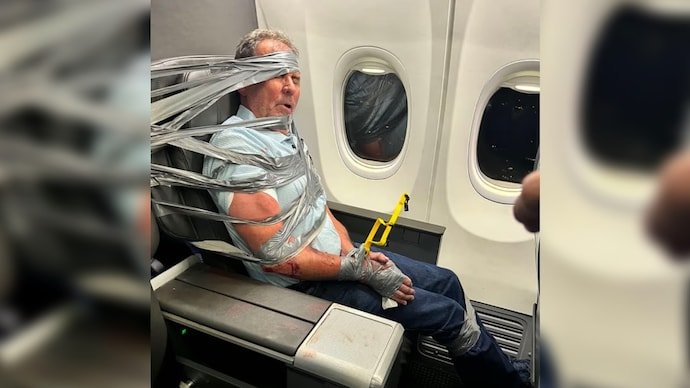
A dramatic incident aboard an American Airlines flight from Texas to New Jersey ended with a passenger being restrained with duct tape and zip ties after an alleged midair outburst escalated into violence, forcing the aircraft to divert to Baltimore.
American Airlines Flight 618 was traveling from Dallas-Fort Worth International Airport to Newark Liberty International Airport on September 3 when a passenger in first class reportedly became increasingly disruptive about two hours into the journey.
Witnesses said the situation quickly escalated from shouting to physical aggression. The passenger allegedly directed racial and anti-gay slurs toward people on the aircraft, attacked the man sitting beside him and pushed a woman who attempted to intervene.
Several passengers eventually helped restrain him after flight attendants provided duct tape and zip ties. The man was held in his seat for the remainder of the flight to Baltimore-Washington International Thurgood Marshall Airport, where law enforcement took him into custody.
The passenger was later identified by authorities as Arthur Lundeen, 67, of Arizona. Maryland Transportation Authority Police arrested him on state charges following the landing, while the FBI began gathering information to determine whether federal charges could also be appropriate.
What happened on American Airlines Flight 618?
The flight was operating normally from Dallas-Fort Worth to Newark when the disruption began roughly two hours after departure.
According to witnesses who spoke with investigators and media outlets, Lundeen began shouting at another passenger seated nearby. His behavior became increasingly hostile, drawing the attention of a flight attendant who attempted to calm him.
The situation reportedly deteriorated further when the passenger began using racial and homophobic slurs. Witnesses said he directed the N-word at a Black flight attendant and also used an anti-gay slur.
What followed was no longer simply a verbal disturbance. According to passengers who witnessed the confrontation, Lundeen became physically aggressive toward the man sitting next to him.
The violence created an immediate safety concern inside the aircraft, where the confined Environment and limited space make an uncontrolled physical confrontation particularly dangerous.
Passenger allegedly attacked the man sitting next to him
Juan Mejia, a retired law enforcement officer who was aboard the flight, said the incident appeared to escalate almost instantly.
Mejia told CBS News that the atmosphere changed “like a light switch,” with the situation moving from relative calm to shouting and chaos. He said he saw the passenger with his hands around the neck of the man sitting beside him.
Another passenger, Richard Olenick, also described hearing the passenger use a racial slur against a flight attendant and witnessing the increasingly hostile behavior.
The accounts from passengers suggest that the confrontation became serious enough to require intervention from people seated nearby rather than remaining an argument between two individuals.
Woman intervenes and is allegedly pushed
A female passenger reportedly attempted to help during the confrontation but was allegedly pushed by Lundeen.
That development prompted other passengers to intervene. Three men moved toward the passenger and attempted to stop him from continuing the disturbance.
Among those who helped restrain him were Mejia and Olenick. Their experience and ability to respond quickly became important as the crew worked to maintain control of the situation until the aircraft could land.
The incident demonstrates how rapidly an unruly-passenger situation can turn into a broader safety emergency when physical violence begins inside a crowded aircraft.
Passengers used duct tape and zip ties to restrain him
As the struggle continued, flight attendants provided duct tape and zip ties that were used to immobilize the passenger.
Video and photographs taken aboard the plane show the man secured in his seat, with duct tape wrapped around his body and additional restraint used around his head. His hands were also restrained with zip ties.
The passengers involved said the man continued resisting while they attempted to keep him under control.
Mejia told CBS News that the passenger fought back during the restraint and bit his hand. He said the incident left him with teeth marks and that there was blood involved during the struggle.
The men were ultimately able to keep the passenger restrained long enough for the plane to divert and land in Baltimore.
Why the plane was diverted to Baltimore
American Airlines confirmed that Flight 618 was diverted to Baltimore-Washington International Thurgood Marshall Airport because of a disruptive passenger.
The Federal Aviation Administration also confirmed the diversion.
The aircraft had been scheduled to continue from Dallas-Fort Worth to Newark, but the alleged violence created circumstances in which continuing to the original destination was considered less appropriate than landing sooner and transferring the situation to law enforcement.
The flight reportedly landed in Baltimore around 15 minutes after the diversion decision. Police met the aircraft at the gate and took the passenger into custody.
Once he was removed, the flight was able to continue to Newark.
Passenger identified as Arthur Lundeen
The man involved was initially described in early reports as unidentified. Authorities later identified him as Arthur Lundeen, a 67-year-old Arizona resident.
His identification adds an important detail to the case that was not available when videos of the incident first circulated online.
Lundeen was arrested by Maryland Transportation Authority Police following the landing. Authorities said he was booked on state charges connected with the alleged conduct during the flight.
The FBI has also been involved in reviewing the circumstances and is determining whether additional federal charges could follow.
What charges does he face?
According to authorities, Lundeen was arrested on allegations that include second-degree assault and disorderly conduct.
The charges relate to the conduct described by witnesses and law enforcement. They are allegations, and the criminal case must proceed through the legal system before guilt can be determined.
The FBI’s involvement introduces the possibility of federal action because serious incidents aboard commercial aircraft can raise questions beyond state criminal law.
At the time of the initial reports, authorities had not indicated that federal charges had been finalized.
Did alcohol play a role?
Witnesses suggested that alcohol may have contributed to the passenger’s behavior, although that has not been established as the cause of the incident.
Mejia recalled a flight attendant saying the passenger had been served one drink. That account does not, by itself, establish intoxication or explain why the passenger allegedly became violent.
The precise trigger for the outburst remains unclear.
Determining whether alcohol, a medical issue, a psychological episode or another factor contributed to the behavior would require evidence beyond the passenger accounts that have emerged publicly.
Passengers described a sudden escalation
One of the most striking details in the accounts from witnesses is how quickly the disturbance intensified.
Mejia said he had not noticed anything unusual about Lundeen before the incident. Then, within a short period, the atmosphere changed dramatically.
That sudden escalation is one reason unruly-passenger incidents can be challenging for airline crews. Flight attendants must evaluate whether a passenger can be calmed through verbal intervention or whether the situation has reached a level where physical restraint and diversion become necessary.
In this case, witnesses said the behavior progressed beyond verbal abuse and into alleged physical attacks, leaving the crew and passengers with little room for delay.
American Airlines says safety was the priority
American Airlines said Flight 618 diverted to Baltimore because of a disruptive customer.
The airline said law enforcement met the aircraft upon arrival and assisted with removing the passenger before the flight continued to Newark.
The carrier emphasized that the safety and security of its customers and employees are its top priorities and said it does not tolerate violence.
The statement also thanked the flight crew for their professionalism and passengers for their understanding during the disruption.
Notably, the airline did not publicly provide a detailed account of the passenger’s alleged statements or actions, leaving much of the incident’s chronology to witness accounts and investigators.
Why passengers became part of the response
Commercial aircraft have procedures for dealing with disruptive travelers, but the responsibility for physical restraint is highly sensitive because of the risk of injury to the passenger, crew members and other travelers.
In this incident, witnesses said the intervention became necessary after the passenger allegedly attacked another person and pushed a woman.
The fact that retired law enforcement officer Juan Mejia was among the passengers who intervened was also significant. His prior experience may have helped him and the other passengers respond in a controlled manner while waiting for the plane to land.
The use of duct tape and zip ties, meanwhile, illustrates how extreme the situation had become from the perspective of those trying to prevent further violence.
What happened after the landing?
Once Flight 618 reached Baltimore, law enforcement officers boarded or met the aircraft and took control of the situation.
Lundeen was removed from the flight and arrested. The remaining passengers were able to continue their journey after the disruptive traveler was taken into custody.
Authorities subsequently began examining the incident, with the FBI evaluating whether the case could involve federal offenses in addition to the state charges filed by Maryland authorities.
The Investigation is also important because several people were reportedly involved in the physical confrontation, meaning investigators may need to establish the sequence of events and determine exactly what happened before, during and after the restraint.
A viral video turned a flight diversion into a national story
The incident drew widespread attention after photographs and video from inside the aircraft began circulating online.
Images showing a passenger covered in duct tape and restrained in an airline seat are highly unusual and immediately explain why the episode attracted so much public interest.
But visual evidence does not necessarily capture the complete sequence of events. A short video can show the final moments of a confrontation without explaining what occurred in the minutes leading up to it.
In this case, witness accounts have provided additional context about the alleged verbal abuse, assault and intervention that preceded the restraint.
Unruly passengers remain a major aviation concern
The American Airlines incident also comes amid continuing concerns about disruptive behavior aboard commercial flights in the United States.
Federal aviation data cited by CBS News indicates that more than 1,160 unruly-passenger incidents had been reported in the United States so far in 2026. The full-year total for 2025 was about 1,600 incidents.
Although most passenger disagreements never reach the level seen on Flight 618, serious cases can create cascading consequences. A single disruptive traveler can lead to flight diversions, missed connections, additional airport operations and significant stress for hundreds of passengers.
For airlines, preventing such incidents from escalating is therefore both a safety issue and an operational priority.
Why diversion is often the safest option
A pilot has to consider the safety of everyone aboard when a passenger becomes violent or uncontrollable.
Continuing toward the scheduled destination may mean keeping a dangerous situation inside the aircraft for much longer. Diverting to a nearby airport allows the crew to reduce that period and hand the situation over to trained law enforcement personnel on the ground.
Flight 618’s diversion to Baltimore followed that logic. Rather than continuing to Newark with an allegedly violent passenger on board, the aircraft landed at a closer airport where officers could intervene.
The fact that the flight subsequently continued to Newark after the passenger was removed shows that the diversion was specifically connected to the disruptive traveler rather than a broader mechanical or operational emergency.
The case raises questions about in-flight restraint
The use of restraints aboard an aircraft inevitably raises questions about when physical intervention becomes necessary and who is responsible for carrying it out.
In serious cases, the immediate priority is preventing a passenger from injuring others or interfering with the operation of the aircraft. But any physical restraint also carries risks, particularly when several people are involved in a confined space.
Witnesses said the passenger continued to resist after being restrained and that at least one person helping to control him was bitten.
Those details underscore why crew members generally seek to stabilize a situation as quickly as possible and why an aircraft may be diverted when an unruly passenger cannot be safely controlled.
What investigators still need to establish
Although multiple witnesses have described the same broad sequence of events, authorities still need to establish the details of the confrontation through interviews, video evidence and other information collected from the flight.
Among the questions investigators may examine are what triggered the passenger’s initial outburst, the precise nature of the alleged assaults, whether anyone suffered injuries and whether any other laws were violated aboard the aircraft.
The role of alcohol or any other factor contributing to the passenger’s behavior will also depend on evidence rather than speculation.
Until the case moves through the courts, the allegations should be understood as claims made in connection with an ongoing criminal matter rather than final findings of guilt.
American Airlines Flight 618 incident at a glance
| Detail | What happened |
|---|---|
| Flight | American Airlines Flight 618 |
| Route | Dallas-Fort Worth to Newark |
| Date of incident | September 3, 2026 |
| Unruly passenger | Arthur Lundeen, 67, of Arizona |
| Reported conduct | Alleged racial and anti-gay slurs, physical aggression and assault |
| Restraint used | Duct tape and zip ties |
| Diversion airport | Baltimore-Washington International Thurgood Marshall Airport |
| Arresting agency | Maryland Transportation Authority Police |
| Reported state charges | Second-degree assault and disorderly conduct |
| Federal investigation | FBI reviewing the incident for possible federal charges |
What the American Airlines incident shows
The dramatic images from Flight 618 may have made the incident look surreal, but the underlying issue was a serious aviation safety problem. A passenger allegedly went from shouting to physical violence at cruising altitude, forcing fellow travelers and crew members to intervene before the aircraft could be diverted.
The use of duct tape and zip ties was the visible result of an escalating confrontation in which passengers said they believed someone was at risk of being hurt. The subsequent diversion to Baltimore allowed law enforcement to take over and removed the immediate threat from the cabin.
Arthur Lundeen now faces state criminal allegations, while federal authorities assess whether further action is warranted. The precise reasons for his outburst remain unclear, and questions surrounding the events will ultimately be addressed through the investigation and court process.
For American Airlines and the passengers aboard Flight 618, however, the immediate priority was clear: contain the disturbance, get the aircraft safely on the ground and prevent the violence from escalating further. After the passenger was arrested in Baltimore, the flight continued to Newark, bringing an extraordinary disruption to an end.
For breaking news and live news updates, like us on Facebook or follow us on Twitter and Instagram. Read more on Latest World on thefoxdaily.com.




COMMENTS 0