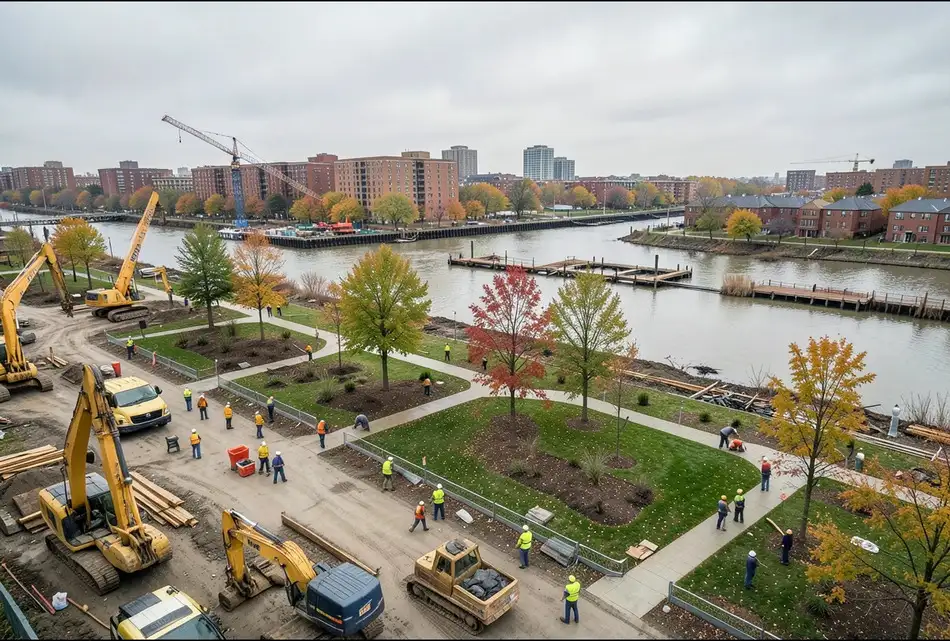
A waterfront site in Brooklyn that remained unused for more than two decades is finally being transformed into a public park. New York City Mayor Zohran Mamdani announced on October 1, 2026, that construction had begun on Box Street Park in the Greenpoint neighbourhood, marking a major step towards fulfilling a promise made to residents as part of the 2005 Williamsburg-Greenpoint waterfront rezoning.
The project will turn a former Metropolitan Transportation Authority (MTA) facility and parking lot along Newtown Creek into 2.5 acres of public recreational space. The planned park will include an elevated esplanade, accessible walking routes, gardens, a lawn, terraced seating, a basketball court, picnic areas, separate dog runs for small and large dogs, and a public restroom.
With an estimated investment of $40 million, Box Street Park is expected to be completed by the end of summer 2028. Its development is intended to address the shortage of accessible outdoor space in Greenpoint, an area that has experienced substantial residential development since the city’s waterfront rezoning more than 20 years ago.
The announcement also represents a significant milestone for local residents and community organisations that have spent years advocating for the promised waterfront park. While residential construction transformed large parts of Greenpoint and Williamsburg, several planned public spaces took much longer to materialise.
What is the Box Street Park project?
Box Street Park is a planned 2.5-acre public green space in Greenpoint, Brooklyn, along Newtown Creek. The project will replace an underused waterfront property with recreational facilities, landscaped areas and public access to the shoreline.
The site was previously used by the MTA as a facility and parking area. For years, it remained largely inaccessible to the public, with fencing, deteriorating asphalt and overgrown vegetation marking the location despite the city’s earlier commitment to create a park there.
The new development is designed to provide residents with a place to walk, exercise, spend time outdoors and gather along the waterfront. It will also help connect existing sections of public space along the northern Brooklyn shoreline.
According to the city, the project will fill a gap in the waterfront green-space network at the northern end of Greenpoint. Once completed, Box Street Park will connect with existing waterfront esplanades to its east and west, improving continuity along the shoreline.
The current construction phase covers 2.5 acres. The city has also indicated that the park could eventually expand by another 0.5 acres after the MTA relocates its Emergency Response Unit from the southeastern corner of the property.
What facilities will the new Brooklyn park offer?
The design combines waterfront access, recreational facilities and landscaped public areas. Rather than creating only a traditional neighbourhood lawn, the project is intended to serve residents with different interests and accessibility requirements.
Elevated waterfront esplanade
One of the central features will be an elevated esplanade overlooking the waterfront. It will give visitors an opportunity to walk along the shoreline and enjoy views of the surrounding area.
The esplanade is also part of the broader plan to connect Box Street Park with other waterfront public spaces. This connection could make it easier for residents and visitors to move between different sections of Greenpoint’s shoreline without encountering the same gaps in public access that have existed for years.
ADA-accessible pathways and seating
The park will include pathways designed to meet accessibility requirements under the Americans with Disabilities Act (ADA). These routes are intended to make the outdoor space easier to use for people with disabilities, older residents and families with children.
Terraced granite seating will provide places for visitors to rest, sit and spend time near the waterfront. The combination of accessible routes and seating is expected to make the park usable for a wider range of people rather than limiting its facilities to visitors interested in sports or physical activities.
Gardens, native trees and green spaces
Landscaping will be a major part of the development. The city plans to use native trees, plants, grasses, shrubs and perennials suited to the local environment.
Planned plant species include blackgum and Eastern redbud trees, purple love grass, little bluestem grasses, Virginia rose and seaside goldenrod. These plantings are intended to improve the appearance of the park while supporting local wildlife and strengthening the site’s environmental resilience.
Native vegetation can also provide practical benefits in urban neighbourhoods. Trees and plants can help moderate temperatures, improve the local environment and create habitat for birds and other wildlife. The city says the landscaping will help cool and clean the air while contributing to the area’s resilience to extreme weather.
Basketball court and picnic areas
Sports and community recreation will be supported through a basketball court and designated picnic areas. These facilities are intended to give residents opportunities to exercise, meet friends and spend time outdoors.
The basketball court will provide a dedicated space for recreational play, while picnic facilities will accommodate families and groups looking for a place to gather. The lawn and gardens will offer additional open areas for everyday use.
Separate dog runs and public restroom
Dog owners will have access to separate runs for small and large dogs. Providing distinct areas is intended to make the facility more practical for pet owners and their animals.
A public restroom is also included in the plan. This is an important amenity for a neighbourhood park expected to attract families, walkers, sports participants and visitors spending extended periods along the waterfront.
Why did the park take 21 years to become a reality?
The history of Box Street Park is closely connected to the major redevelopment of Greenpoint and Williamsburg that began with the city’s 2005 waterfront rezoning.
In 2005, New York City approved a rezoning plan that opened substantial portions of the North Brooklyn waterfront to residential development. The plan was intended to accommodate new housing while also providing public benefits, including waterfront parks and open spaces.
Approximately 50 acres of waterfront parkland were envisioned as part of the broader plan. The commitment was particularly important because Greenpoint and Williamsburg were undergoing a transition from areas with significant industrial land uses into increasingly residential neighbourhoods.
The redevelopment brought new housing and a growing population to the waterfront. However, the delivery of public green spaces did not progress at the same pace as residential construction.
Box Street Park became one of the locations associated with this long-running gap between development promises and the delivery of public amenities. Although the site had been identified for a park, it remained unused for years while the surrounding neighbourhood continued to change.
The delay was not simply a matter of choosing a landscaping design. The project required coordination among city agencies, state authorities and other stakeholders, particularly because the site had been used for MTA operations.
Local elected representatives and community organisations continued to push for the project. Their efforts focused on securing the promised green space and ensuring that waterfront access remained part of Greenpoint’s future as the neighbourhood became more densely populated.
The October 2026 construction announcement marks the transition from a long-standing planning commitment to active development. However, the park will not be available for public use immediately. Residents will have to wait until construction is completed and the site is ready to open.
How the $40 million project is being funded
The Box Street Park development has an estimated capital cost of $40 million. The city has outlined a funding structure involving municipal investment, City Council support and contributions from local developers.
The current 2.5-acre project is fully funded through the following sources:
- Mayor’s Office: $34.5 million, including a $2 million investment added by the Mamdani administration through the September Capital Commitment Plan.
- City Council: $500,000 in funding.
- Local developers: Approximately $5 million through air rights sales and private funds.
The funding arrangement reflects the role of public investment and private contributions in delivering infrastructure associated with large-scale neighbourhood redevelopment. The city’s capital commitment provides the principal financial support, while developer contributions add to the resources available for construction.
The project’s fully funded status is significant because long-delayed public infrastructure plans can remain uncertain when funding is incomplete or dependent on future budget decisions. With the current construction phase funded, the immediate focus is on carrying out the work and meeting the projected completion schedule.
What Mayor Zohran Mamdani said about the development
Announcing the start of construction, Mamdani described the project as the fulfilment of a commitment that Greenpoint residents had waited decades to see delivered.
He said the park would provide New Yorkers with a place to walk, play, rest and gather along the water, with gardens, open green space and pathways connecting neighbourhood residents to the waterfront.
The mayor also highlighted the role of community organising in bringing the project forward, presenting the construction announcement as an example of a long-standing local demand moving into implementation.
New York City Parks Commissioner Tricia Shimamura said the waterfront park would offer residents an accessible place to connect with the natural environment and their neighbours. She also described the development as part of the city’s wider effort to improve public access and green space along the Greenpoint-Williamsburg waterfront.
City Council Member Lincoln Restler, who has worked with neighbourhood residents on the project, said the park had remained an unfulfilled commitment despite the construction of tens of thousands of new homes in the community over the intervening years.
Other local representatives, including Congresswoman Nydia Velázquez, State Senator Kristen Gonzalez and Assemblymember Emily Gallagher, also welcomed the construction milestone.
The North Brooklyn Parks Alliance described the project as an important step towards creating a more continuous waterfront park system in the area. Its executive director, Katie Denny Horowitz, also pointed to the coordination required between New York City and New York State to advance the development.
Greenpoint’s growing population has increased the demand for public parks
The need for Box Street Park is connected to the wider transformation of Greenpoint. Over the past two decades, the neighbourhood has experienced substantial residential development, changing its population and the demand placed on local public infrastructure.
New housing has brought more residents to an area where industrial properties and underused waterfront sites once occupied significant amounts of land. As more people move into the neighbourhood, demand has increased for parks, recreational facilities, walking routes and accessible public spaces.
Local representatives have repeatedly highlighted the limited availability of park space per resident in Greenpoint. The issue is particularly relevant in densely developed urban neighbourhoods, where residents may not have private gardens or convenient access to large green spaces.
Public parks serve several purposes beyond recreation. They provide places for exercise, social interaction and relaxation, while offering outdoor space for children, older people and residents who may not have access to other community facilities.
Waterfront parks have an additional role in neighbourhoods that have historically been separated from the shoreline by industrial and commercial uses. Opening these areas to the public can improve access to the water and create new routes for walking and outdoor activities.
Box Street Park is expected to address part of this demand, although it will not resolve the broader shortage of green space across North Brooklyn on its own. Its importance lies in adding another public space to a waterfront network that has developed gradually over many years.
Box Street Park is part of a wider waterfront redevelopment effort
The project forms part of a broader effort to create a connected system of public spaces along the Greenpoint and Williamsburg waterfront. The 2005 rezoning included plans for multiple parks and open spaces rather than a single large development.
One of the best-known projects in this wider plan is Bushwick Inlet Park, a proposed 27-acre green space intended to serve North Brooklyn. Its development has also taken place in stages, with different parcels becoming available for public use at different times.
The city has previously committed funding towards completing sections of Bushwick Inlet Park, including a $75 million allocation announced in 2021 for further development. Other waterfront projects have involved restoring former industrial properties and creating smaller recreational spaces.
Box Street Park is a separate project, but it contributes to the same broader objective: improving public access to the North Brooklyn waterfront and connecting individual green spaces into a more continuous network.
Another part of the waterfront improvement effort has involved the Motiva parcel, where plans have included wetlands, native plantings and a small beach. Such projects demonstrate the range of approaches being used to transform former industrial and commercial waterfront properties into public spaces.
When Box Street Park is completed, its connections with existing esplanades should help improve pedestrian access along the shoreline. The eventual addition of another half-acre, following the relocation of the MTA Emergency Response Unit, could further expand the available public space.
What happens next in the Box Street Park project?
With construction announced on October 1, 2026, the next stage involves carrying out the planned development, including the installation of pathways, waterfront features, recreational facilities, landscaping and public amenities.
The city expects construction to be completed by the end of summer 2028. That means the project is likely to require continued work through 2027 and into 2028 before the park can welcome visitors.
Several important elements will need to come together before the site is ready for public use:
- Construction and site development: The former parking and MTA facility site must be transformed into the planned public park.
- Waterfront access: The elevated esplanade, accessible pathways and terraced seating will need to be completed.
- Recreational facilities: The basketball court, picnic areas, dog runs and public restroom must be installed.
- Landscaping: Native trees, grasses, shrubs, gardens and other plantings will help establish the park’s green spaces.
- Future expansion: The city has identified the possibility of adding approximately 0.5 acres after the MTA Emergency Response Unit relocates from the southeastern corner.
The additional half-acre is separate from the current 2.5-acre capital project. Its eventual delivery will depend on the relocation of the MTA facility and the associated coordination required to make that portion of the site available.
For residents, the immediate milestone is the start of construction. The longer-term test will be whether the city completes the facilities and opens the park within the announced timeframe.
Why the project matters for Brooklyn residents
Box Street Park represents more than the conversion of an unused property into a landscaped public area. It addresses a longstanding question about how cities should balance residential development with the public infrastructure needed to support growing communities.
The 2005 rezoning helped reshape Greenpoint and Williamsburg, but the lengthy wait for some promised public spaces illustrates the challenges of delivering parks alongside large-scale development. Housing can rise relatively quickly, while public infrastructure may require land transfers, agency coordination, environmental planning and long-term capital funding.
The new park will give Greenpoint residents another place to exercise, meet neighbours, spend time outdoors and access the waterfront. Its accessible pathways and varied facilities are intended to serve people with different mobility needs and recreational interests.
The development will also contribute to the wider effort to make the North Brooklyn waterfront more accessible. For a neighbourhood that has experienced significant changes since 2005, the project is a reminder that public access and recreational space remain important parts of urban redevelopment.
Although the park is not expected to open until 2028, the start of construction marks the end of a long period in which the site remained an unfulfilled public-space commitment. After 21 years, Greenpoint is finally moving closer to receiving the waterfront park promised to its residents.
Frequently Asked Questions
Where is Box Street Park being built?
Box Street Park is being developed in the Greenpoint neighbourhood of Brooklyn, New York City, along Newtown Creek. The site was previously used as an MTA facility and parking lot.
How large will Box Street Park be?
The current construction project will create 2.5 acres of public green space. The city has identified the possibility of adding another 0.5 acres after the MTA Emergency Response Unit relocates from part of the site.
When will Box Street Park be completed?
Construction is expected to be completed by the end of summer 2028. The park is not expected to be ready for public use until the development work is finished.
How much is New York City investing in Box Street Park?
The project has an estimated cost of $40 million. The funding includes $34.5 million from the Mayor’s Office, $500,000 from the City Council and approximately $5 million from local developers through air rights sales and private funds.
What facilities will the park include?
The park will feature an elevated waterfront esplanade, ADA-accessible pathways, terraced granite seating, gardens, a lawn, a basketball court, picnic areas, separate dog runs for small and large dogs, and a public restroom.
Why did the project take so long?
The park was part of the public-space commitments associated with the 2005 Williamsburg-Greenpoint waterfront rezoning. Its development required coordination among city and state agencies, including arrangements involving the former MTA facility on the site. Local residents and community organisations continued to advocate for the project during the delay.
Will Box Street Park connect to other waterfront parks?
Yes. The completed park is expected to fill a gap along the northern Greenpoint waterfront and connect with existing waterfront esplanades to the east and west, contributing to a more continuous public shoreline.
For breaking news and live news updates, like us on Facebook or follow us on Twitter and Instagram. Read more on Latest World on thefoxdaily.com.



COMMENTS 0