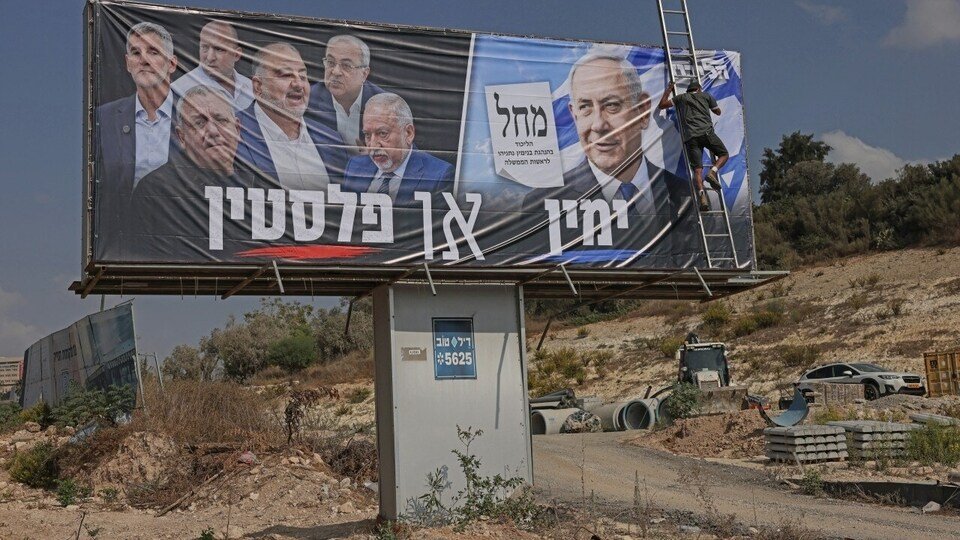
Israeli Prime Minister Benjamin Netanyahu and his leading challenger, Gadi Eisenkot, offer voters contrasting leadership styles and different approaches to domestic governance. However, their positions on several major security questions including the future of Gaza, the conflict with Iran and the establishment of a Palestinian state remain closer than their political rivalry might suggest.
Israel’s election, the first national vote since the Hamas-led attacks of October 7, 2023, comes amid public concern over national security, settler violence, democratic institutions and the country’s international standing. Yet the political debate has shifted substantially towards the right on security matters, narrowing the policy space available to opposition candidates seeking to replace Netanyahu.
Eisenkot, a former chief of the Israel Defense Forces (IDF), has presented himself as an alternative to Netanyahu’s long political dominance. He has criticised the government’s handling of the war and its domestic policies, but he has also backed a hard line against Hamas, opposed Palestinian statehood and supported maintaining Israeli control over security between the Jordan River and the Mediterranean Sea.
The result is a contest in which voters may see a meaningful difference in leadership and governing priorities without a comparable divide over the central questions shaping Israel’s military policy.
Why Netanyahu and Eisenkot Are Closer on Security Than Their Rivalry Suggests
Netanyahu’s Likud party has framed the election as a choice between his leadership and an opposition that it portrays as weaker on national security and more willing to accept a Palestinian state. Eisenkot’s public positions complicate that argument because he has rejected several policy options associated with a negotiated territorial settlement.
He has said he would end Hamas’s rule in Gaza within 18 months, whether through US President Donald Trump’s peace plan or military force. He has also expressed support for building Israeli settlements in the occupied West Bank, while promising to crack down on settler violence.
Eisenkot has firmly opposed the presence of a foreign army between the Jordan River and the Mediterranean Sea. His position reflects a security doctrine centred on Israel retaining control over the territory and preventing an outside military force from operating there.
These positions leave limited room for a fundamental change in Israel’s approach to Palestinian statehood or territorial security. While Eisenkot has spoken about diplomatic solutions and criticised the government’s conduct of the wars, he has not endorsed the creation of an independent Palestinian state.
Tamar Hermann, a pollster and senior fellow at the Israel Democracy Institute, said the opposition’s security agenda was not substantially different from that of the right, apart from disagreements over the West Bank.
Her assessment highlights the constraints facing opposition parties. To win power, they must appeal to voters dissatisfied with Netanyahu while reassuring a public that remains concerned about attacks, military preparedness and the possibility of another October 7-style assault.
Gaza Remains a Central Test for Israel’s Next Government
The future of Gaza is one of the most consequential issues confronting the candidates. The October 7 attacks and the subsequent war transformed Israel’s security debate, with public attention focused on preventing another large-scale assault and determining who will govern Gaza.
Eisenkot has argued that Hamas’s rule should end within 18 months. His proposed approach leaves open whether that objective would be achieved through Trump’s peace plan or continued military force.
That position places him closer to Netanyahu on the stated objective of removing Hamas from power than a sharp government-versus-opposition divide might suggest. The differences would likely emerge in how the war is managed, how military gains are translated into diplomatic outcomes and how the government handles negotiations over hostages and Gaza’s future.
Eisenkot previously served on the war cabinet after joining Netanyahu in an emergency national unity government following the October 7 attacks. He resigned months later, accusing the prime minister of prolonging the war and sacrificing Israel’s hostages. Netanyahu has denied those accusations.
The disagreement reflects a broader debate within Israel over the relationship between military operations and political objectives. Critics of Netanyahu have argued that the government has not adequately converted military achievements into a lasting settlement, while supporters have maintained that continued pressure is necessary to protect the country.
Eisenkot has spoken about turning military achievements into diplomatic gains, suggesting that his leadership could place greater emphasis on negotiations. However, his commitment to ending Hamas’s rule and his rejection of Palestinian statehood indicate that any change would occur within significant security and political constraints.
For Gaza, the distinction could be important. A change in Israeli leadership might affect the conduct of negotiations and the management of military operations, but it would not automatically produce agreement on Palestinian sovereignty, postwar governance or the long-term relationship between Israel and Gaza.
Iran Policy: Eisenkot Questions Netanyahu’s Ambitions
The conflict with Iran is another area in which the candidates may differ more in their assessment of military objectives than in their underlying concern about Israeli security.
Netanyahu has pursued a forceful approach towards Tehran and has described Iran’s nuclear programme and military capabilities as major threats. During the US-Israeli bombing campaign discussed in the supplied reporting, he presented regime change in Iran as an objective.
Eisenkot has criticised that ambition as too expansive. Analysts say he would be more inclined to explore ways of bringing regional conflicts towards a resolution, including through diplomacy after military operations.
His position does not necessarily indicate a willingness to accept Iran’s regional influence or abandon military pressure. Instead, it suggests a distinction between using force to achieve specific security goals and attempting to transform the political system of another country.
That distinction could affect how an Eisenkot-led government communicates its objectives, evaluates the risks of escalation and approaches diplomatic negotiations. It would not, by itself, establish that Israel would adopt a fundamentally different security policy towards Iran.
The broader challenge for either government would be balancing deterrence with the risk that military action could trigger retaliation, widen regional conflict and make a diplomatic settlement more difficult. Israel’s domestic political consensus on security may limit how far any new prime minister could depart from existing policy.
West Bank Settlements Expose a More Visible Policy Divide
The occupied West Bank offers a clearer point of disagreement between Eisenkot and Netanyahu’s governing coalition, although the divide is not equivalent to support for Palestinian statehood.
Eisenkot has criticised violence by extremist Israeli settlers, describing it as “Jewish terror”. He has argued that the state should take a tougher approach to such attacks and has supported drafting ultra-Orthodox Israelis into the military, another issue that has generated political conflict within Netanyahu’s coalition.
He has also said he does not support building settlements in the controversial E1 area of the West Bank, where the government had opened land for bidding, citing the international backlash associated with the project.
At the same time, Eisenkot has expressed support for settlement construction elsewhere in the West Bank. His position is therefore not a rejection of the settlement project as a whole, but a more selective approach combined with a promise to enforce the law against violent settlers.
This distinction matters because settlement expansion is closely linked to questions about Palestinian territorial continuity and the possibility of a future Palestinian state. Eisenkot’s opposition to Palestinian statehood places a fundamental limit on the extent of any change in that direction under his leadership.
Netanyahu’s critics argue that his coalition has encouraged extremist elements and failed to respond adequately to violence against Palestinians. The government’s defenders may view settlement development and security control as legitimate national priorities. The election will test how voters weigh these competing arguments, particularly when security concerns remain dominant.
Israeli Public Opinion Has Shifted Towards the Right
The candidates are competing in a political environment shaped by the October 7 attacks and the wars that followed. Public concern about the prospect of another major attack has strengthened support for continued Israeli troop deployments in Gaza and Lebanon, according to the supplied reporting.
Polling also suggests greater support for settlement construction in the occupied West Bank than in previous years. At the same time, many Israelis believe the state has responded too leniently to settler violence, revealing that support for settlements does not necessarily translate into support for lawlessness.
An Agam Labs poll cited in the reporting found that nearly one-third of Jewish Israelis said they had become more right-wing as a result of the war. The same polling organisation reported that 60% of Jewish Israeli respondents wanted a new prime minister.
These findings point to a political landscape in which dissatisfaction with Netanyahu can coexist with support for many of the security policies associated with his government. Voters may want a different leader without necessarily wanting a major shift in Israel’s approach to military force, Gaza or Palestinian statehood.
Far-right National Security Minister Itamar Ben-Gvir has also been particularly popular among young Israelis, according to the supplied account. His policies have included tougher conditions for Palestinian prisoners, reinforcing the prominence of hard-line security positions in the political debate.
Public opinion is not uniform, and poll findings depend on the questions asked, the sample and the timing of the survey. Nevertheless, the overall picture described in the reporting is one of a rightward shift in security attitudes alongside concerns about Netanyahu’s leadership and the direction of his coalition.
Why the Opposition Is Targeting Right-Leaning Voters
Eisenkot’s political challenge is not simply to persuade voters who oppose Netanyahu. He must also attract enough people who previously supported the governing coalition to create a viable parliamentary alternative.
Naftali Bennett, another opposition leader who heads a centre-right party, has criticised concessions to Palestinians during the campaign. His approach reflects the strategic calculation facing opposition politicians: they may need to use language and policies familiar to right-wing voters to persuade them to change their political allegiance.
Gayil Talshir, a senior lecturer in political science at the Hebrew University of Jerusalem, said the liberal camp would need to attract several seats’ worth of voters who had supported Netanyahu’s coalition in the 2022 election. To do so, she argued, opposition leaders would have to speak in terms that appeal to the right.
This electoral calculation helps explain why Eisenkot has maintained hard-line positions on security even while criticising Netanyahu’s conduct of the wars. A candidate who moved too far away from the prevailing public consensus could risk losing voters who want a new prime minister but remain wary of concessions they believe could weaken Israeli security.
It also creates a policy dilemma. A campaign designed to win over conservative voters may reduce the room for a new government to pursue significant changes once in office. The need to build a coalition could further restrict its choices.
Leadership Style and Political Background Set the Candidates Apart
Although their security positions overlap, Netanyahu and Eisenkot have sharply contrasting backgrounds and political styles.
Netanyahu, 77 according to the supplied reporting, is a veteran political operator who has led Israel for a total of 19 years across multiple periods in office. His public image has been shaped by decades of political campaigning, television appearances and an emphasis on his experience in national security and international diplomacy.
Eisenkot, 66, is a former military chief who entered electoral politics more recently. Born to Jewish Moroccan immigrants, he grew up in the working-class Red Sea city of Eilat and served in the IDF’s Golani infantry brigade before rising through the military ranks.
As a senior military figure, Eisenkot was associated with the Dahiya Doctrine, named after a Hezbollah stronghold in Beirut’s southern suburbs. The doctrine is described in the supplied reporting as an approach involving overwhelming force against urban areas to deter militant groups.
Netanyahu appointed Eisenkot as IDF chief of staff in 2014. Their relationship later changed as Eisenkot entered politics and became one of the prime minister’s principal challengers.
Their time together in the emergency national unity government after October 7 demonstrated that the two men could cooperate during a national crisis. Their subsequent split over the war’s direction and the handling of hostages exposed the differences in their political priorities.
Eisenkot’s personal experience of the war also shapes his public profile. His youngest son died fighting in Gaza, a loss that underscores the human cost of the conflict without necessarily determining his position on military strategy.
Could a Change of Government Improve Israel’s International Standing?
Some foreign diplomats and Israeli critics of Netanyahu believe a different government could help repair Israel’s relationships with international partners. They point to the polarising role of Netanyahu and far-right ministers Ben-Gvir and Bezalel Smotrich, whose positions and statements have attracted international criticism over their treatment of Palestinians.
The supplied reporting says Ben-Gvir and Smotrich have been barred from several Western countries over allegations of inciting violence against Palestinians. Their offices did not respond to requests for comment in the original report.
A new government could change the tone of Israel’s diplomacy and its approach to relations with foreign governments. But a leadership change alone would not guarantee a fundamental policy shift, particularly if the incoming coalition retained hard-line positions on Gaza, settlements and Palestinian statehood.
Offir Gutelzon, an Israeli technology entrepreneur living in California who planned to return to Israel to vote against Netanyahu, argued that replacing the government would be only a first step. In his view, substantive policy changes would also be necessary.
His argument reflects a wider question facing voters and Israel’s international partners: whether a new prime minister would change the country’s strategic direction or mainly alter how existing policies are communicated and implemented.
Coalition Mathematics Could Determine Israel’s Next Government
The election is being contested under Israel’s parliamentary system, in which a party’s performance alone does not determine who becomes prime minister. The decisive question is whether political groups can assemble a coalition that commands a majority in the 120-seat Knesset.
The latest polls cited in the supplied reporting showed Eisenkot’s Yashar party with a narrow lead over Netanyahu’s Likud party. Neither was projected to secure a majority independently, making coalition negotiations central to the outcome.
Even if the opposition wins more seats, its ability to form a government would depend on whether parties with differing political priorities can cooperate. Disagreements over Palestinian Israeli parties and the composition of a governing alliance could prevent an apparent electoral victory from translating into a stable administration.
Seat counts could take days to settle, followed by weeks or months of negotiations, according to the supplied account. The final political outcome could therefore remain uncertain even after voters have cast their ballots.
This makes it difficult to predict how much policy change an election would deliver. The prime minister’s identity may change, but the positions of coalition partners, public opinion and security developments would continue to shape the government’s options.
What the Election Means for Gaza, Iran and Palestinian Statehood
The contest between Netanyahu and Eisenkot illustrates the difference between a change in leadership and a change in national policy. Their contrasting backgrounds and governing styles offer voters distinct alternatives, but their positions overlap on several issues that matter most to Palestinians and regional governments.
Both candidates have taken hard-line positions on Hamas, and neither supports the establishment of a Palestinian state. Eisenkot has indicated a greater interest in translating military achievements into diplomatic outcomes and has questioned Netanyahu’s ambition to achieve regime change in Iran. Yet these differences fall short of a comprehensive break with Israel’s existing security doctrine.
On the West Bank, Eisenkot has been more critical of extremist settler violence and has opposed the E1 settlement project, while still supporting settlement construction more broadly. His approach could alter enforcement priorities and specific government decisions without reversing the overall direction of settlement policy.
The election is also a referendum on Netanyahu’s handling of October 7 and the conflicts that followed. For his opponents, the issues include the conduct of the wars, the treatment of hostages, the independence of institutions and Israel’s standing abroad. For many voters, however, preventing another major attack remains a decisive concern.
Ultimately, the significance of the election will depend not only on who receives the most votes or seats but also on the coalition that emerges and the policies it can implement. A new leader could change the tone of Israeli government and its diplomatic approach, but the broad security consensus described in the polling suggests that a dramatic shift on Gaza, Iran or Palestinian statehood would face substantial political obstacles.
For breaking news and live news updates, like us on Facebook or follow us on Twitter and Instagram. Read more on Latest World on thefoxdaily.com.





COMMENTS 0