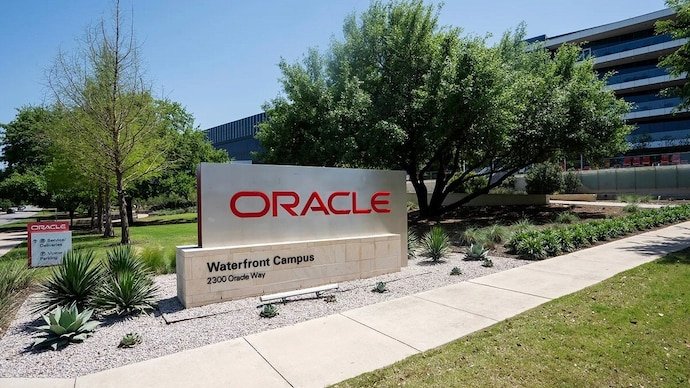
Oracle employees are facing another round of job cuts at a time when the technology company is spending tens of billions of dollars expanding its Artificial Intelligence infrastructure and data-centre capacity.
The latest Layoffs began on September 14, according to reports, with affected employees being informed that their roles were being eliminated as part of a broader restructuring. Oracle has not disclosed the total number of employees affected in the latest round or provided an official geographic breakdown.
The cuts have also triggered an outpouring of emotional posts from Oracle employees, relatives and former colleagues on LinkedIn and other social media platforms. Several employees in India have described losing positions they had held for years and are now seeking referrals and new opportunities.
The layoffs came shortly before a companywide meeting in which Oracle’s new Chief Financial Officer Hilary Maxson told employees that the company did not want them “doing more with less.” Her remarks, reported by Business Insider after reviewing a recording of the meeting, came as Oracle attempts to balance aggressive Investment in AI infrastructure with the financial demands of that expansion.
Oracle CFO says she does not like ‘doing more with less’
During her first companywide meeting, Maxson told employees they should be proud of Oracle’s financial performance and work to protect that success as the company grows.
She said employees should be thoughtful about how the company spends both time and money. But she specifically rejected the idea that this should translate into employees simply taking on more work with fewer resources.
“This means being thoughtful about where we spend our time and money,” Maxson said, according to the recording reviewed by Business Insider. “I don’t mean doing more with less, which is a phrase that I really, really don’t like.”
Instead, she described the approach as simplifying processes that do not help customers and making clearer decisions about where Oracle should direct its resources.
Her comments are notable because they came just as Oracle was implementing another round of workforce reductions. The timing has placed greater attention on how employees are expected to manage their workloads while the company restructures parts of its workforce.
Oracle workforce fell by 21,000 in fiscal 2026
Oracle’s latest job cuts follow reductions earlier in the year. According to a recent company filing, Oracle’s workforce declined by approximately 21,000 employees, or 13%, during the fiscal year that ended May 31, 2026.
The latest round adds another layer to that restructuring, although Oracle has not publicly disclosed how many additional workers are affected.
The absence of a global or country-level figure means reports about the number of employees affected in India remain difficult to verify. Some media reports have suggested that thousands of Indian workers could be affected, but there is no official figure from Oracle confirming that estimate.
Oracle also did not immediately respond to an email seeking comment, according to PTI.
Oracle is spending heavily on AI infrastructure
The workforce reductions are taking place against the backdrop of a dramatic increase in Oracle’s spending on infrastructure.
The company reported $28.5 billion in first-quarter capital expenditures, compared with $8.5 billion during the same period a year earlier. Oracle has also maintained its fiscal 2027 capital expenditure forecast at between $90 billion and $95 billion.
Much of this investment is connected to the company’s expansion of data centres and infrastructure needed to support artificial intelligence workloads.
The scale of the spending has also contributed to a substantial increase in Oracle’s debt as the company finances its expansion. That has created pressure to manage other areas of the business while continuing to invest in infrastructure intended to support future growth.
According to a person familiar with the strategy cited in reporting, the latest workforce reductions are intended to reduce payroll costs and help offset the financial burden associated with the company’s infrastructure expansion.
Executives focused on growth during the town hall
Despite the timing of the meeting, Maxson and other Oracle executives reportedly did not directly address the latest layoffs during the roughly hour-long town hall.
Instead, executives focused on growth, customer demand and the opportunities associated with artificial intelligence.
Oracle Co-CEO Mike Sicilia encouraged employees to focus on how their work affects customers. He asked workers to repeatedly consider whether their work helps deliver a better outcome for customers.
He also acknowledged that employees were working through a period of significant change.
The emphasis reflects the broader direction of Oracle’s business strategy: spending aggressively on infrastructure and AI-related opportunities while attempting to streamline operations and control costs in other areas.
That combination can create a difficult environment for employees. The company is simultaneously pursuing expansion in a fast-growing technology market while reducing its workforce in parts of the organisation.
‘12 years, many sacrifices and a locked login’
The human impact of the layoffs has become particularly visible through social media posts from employees and their families.
One widely shared account came from Pooja Sahu, who wrote about her husband, Sourabh, after he was reportedly affected by the latest Oracle layoffs following 12 years with the company.
According to her LinkedIn post, he had continued working through holidays, birthdays and anniversaries, remained available during vacations and even logged into work from a hospital while she underwent surgery.
She said the most painful part was discovering that he had lost his job when he could no longer access his work system.
Her post highlighted a common reality of corporate layoffs: employees can spend years building careers within a company and still receive little warning when organisational decisions suddenly eliminate their roles.
However, the personal accounts circulating online have not been independently verified, and the individuals concerned could not immediately be reached for confirmation.
Indian Oracle employees turn to LinkedIn for referrals
India is an important part of Oracle’s global operations, with the company maintaining product engineering, development and support functions in the country.
The latest restructuring has therefore generated particular concern among Indian employees and technology professionals.
With no official country-by-country breakdown from Oracle, the exact number of Indian employees affected remains unknown. Reports suggesting that the impact could run into thousands should therefore be treated as unconfirmed rather than an established figure.
Meanwhile, LinkedIn has become an important platform for affected workers to announce their departures and seek assistance from professional networks.
One employee wrote that they had been impacted by the recent Oracle layoffs and were seeking opportunities through their network.
Annanya Sharma, who said she joined Oracle as a campus recruit and spent more than seven years with the company, described struggling with questions about why she had been selected for the layoff while also signalling that she was ready to move forward.
She asked her professional network to share relevant openings, connect her with potential employers or help point her toward the next opportunity.
Another Oracle employee, Shivananda Shenoy, said he learned at 6:50 am that his position had been made redundant as part of ongoing organisational changes.
He described the news as difficult to process while saying that he was beginning to explore new career opportunities and consider the next stage of his career.
Why AI spending and layoffs are happening at the same time
Oracle’s situation reflects a broader tension emerging across the technology industry.
Companies are investing heavily in artificial intelligence, data centres and computing infrastructure while simultaneously reassessing the size and structure of their workforces.
AI requires enormous amounts of computing capacity. Building and operating that infrastructure involves data centres, servers, networking equipment, energy and other capital-intensive resources.
For companies such as Oracle, meeting rising demand for AI computing can therefore require investments on a scale far larger than traditional software expansion.
At the same time, companies are examining whether AI can automate certain tasks, change employee workflows and reduce the need for some types of work. This has intensified concerns about the future structure of technology employment.
Not every technology layoff is necessarily caused directly by AI. Corporate restructuring can also reflect changes in business priorities, financial targets, acquisitions, market conditions and efforts to redirect investment toward faster-growing areas.
In Oracle’s case, the timing of the layoffs alongside the company’s enormous infrastructure spending has placed the relationship between workforce costs and AI investment under particular scrutiny.
Oracle’s financial challenge is larger than payroll
Reducing headcount can lower recurring operating expenses, but Oracle’s infrastructure expansion creates a much larger financial commitment.
The difference between $8.5 billion and $28.5 billion in quarterly capital expenditure illustrates the scale of the increase in spending reported by the company.
Oracle has also maintained a fiscal 2027 capital expenditure outlook of $90 billion to $95 billion. Such spending requires significant financing and creates pressure to ensure that new infrastructure generates sufficient demand and revenue over time.
This helps explain why management is emphasising customer demand, productivity and careful allocation of resources even as the company continues to invest heavily.
The challenge is to expand capacity quickly enough to capture AI-related demand without allowing the costs of that expansion to overwhelm financial performance.
What the latest Oracle layoffs mean for employees
For employees, the immediate issue is more personal than Oracle’s long-term financial strategy.
Workers affected by the latest cuts are suddenly dealing with lost income, uncertainty about their next position and the practical consequences of leaving a company where they may have spent many years.
For employees in India, professional networks have become especially important as affected workers seek referrals and openings at other technology companies.
The LinkedIn posts also show how layoffs can affect people beyond the employee directly involved. Family members and friends have shared stories about long careers ending abruptly, while former colleagues have offered referrals and support.
At the same time, the absence of an official figure for the latest global or India-specific cuts means the full scale of the September restructuring is still unclear.
AI expansion is reshaping the technology workforce
Oracle’s latest restructuring comes at a moment when the technology industry is undergoing a major shift toward artificial intelligence.
The companies building AI infrastructure are spending heavily on computing capacity, while companies across the industry are experimenting with AI agents, automation and new software development processes.
This does not necessarily mean that AI will simply eliminate technology jobs. It can also change the types of skills companies need, create demand for new technical roles and alter how existing teams operate.
But the transition can still produce significant disruption when businesses reorganise their workforce faster than employees can move into new roles.
Oracle’s situation illustrates that tension clearly: the company is investing heavily in the infrastructure needed for AI growth while simultaneously reducing parts of its workforce and asking employees to focus resources on areas that create the greatest customer impact.
For now, the exact scale of Oracle’s latest layoffs remains undisclosed. What is clear is that the company’s workforce restructuring is occurring alongside one of its most aggressive periods of infrastructure investment, leaving employees to navigate a rapidly changing technology industry while Oracle attempts to balance growth, costs and its expanding AI ambitions.
For breaking news and live news updates, like us on Facebook or follow us on Twitter and Instagram. Read more on Latest World on thefoxdaily.com.






COMMENTS 0