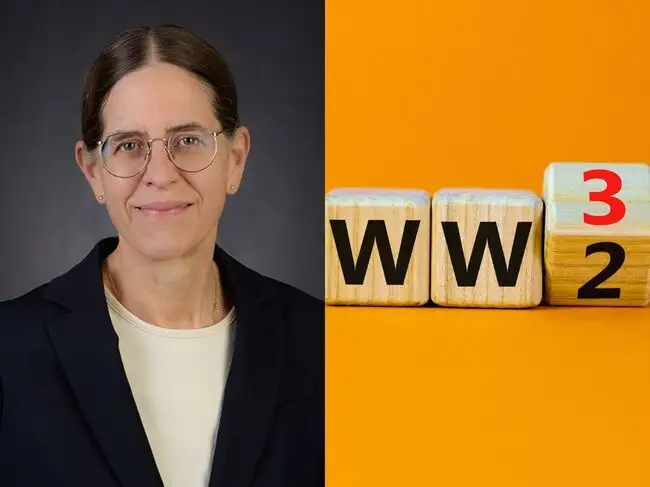
Historian Dr Sarah Paine has warned that the world could be moving towards another global war as tensions involving Iran, Russia and NATO continue to rise. Describing the international situation as resembling the early stages of a wider conflict, Paine has raised concerns about the risks of military escalation and the limits of nuclear weapons in preventing war.
Her warning comes amid continuing geopolitical tensions and growing concerns about the possibility of conflicts spreading beyond their immediate regions. Paine argues that wars can develop in unpredictable ways, with decisions made during a conflict potentially creating consequences that are difficult for governments to control.
She also sharply criticised the conduct of the Iran War, describing it as “probably one of the most incompetent wars in human history”. Her assessment reflects wider concerns about how military conflicts are initiated, managed and brought to an end.
Why Paine Believes the Iran War Is a Serious Warning
Paine’s criticism of the Iran war centres on the dangers of entering a military confrontation without adequately considering how it could escalate or how it might eventually end.
Wars rarely unfold exactly as political and military leaders expect. Even a conflict that begins with limited objectives can expand as opposing sides respond to attacks, introduce additional military measures or become committed to achieving outcomes that are increasingly difficult to secure.
Her warning highlights the possibility that decisions taken during the Iran conflict could have consequences beyond the immediate battlefield. As tensions rise, other countries may become involved directly or indirectly, increasing the risk of a broader confrontation.
Paine’s assessment also underlines the difficulty of ending a war once it has begun. Governments may face pressure to continue fighting, while military developments and political calculations can make compromise more difficult. This can create conditions in which a conflict continues or expands beyond its original objectives.
Russia, NATO and Nuclear Weapons
Alongside the Iran conflict, Paine has expressed concern about Russia’s actions near NATO territory and the possibility that tensions between Moscow and the military alliance could develop into a wider confrontation.
Russia’s relationship with NATO remains a major source of international security concern. Any escalation involving NATO member states could carry consequences far beyond the countries directly involved, particularly because of the alliance’s collective defence commitments.
Paine’s warning raises questions about whether nuclear weapons can reliably prevent major wars. Although nuclear deterrence is intended to discourage countries from launching attacks by making the potential consequences catastrophic, it does not eliminate the possibility of miscalculation, escalation or conventional military conflict.
The existence of nuclear arsenals also creates additional risks during periods of heightened tension. Military decisions, misunderstandings and rapidly changing battlefield conditions can increase the pressure on governments to respond, making crisis management particularly important.
Her concerns challenge the assumption that nuclear weapons alone can guarantee international stability. Deterrence may influence the calculations of political and military leaders, but it cannot ensure that every conflict will remain limited or that all parties will avoid escalation.
Could Regional Conflicts Develop Into a Global War?
The possibility of a wider conflict is linked to the growing number of security challenges involving major powers and regional actors. Tensions surrounding Iran, Russia and NATO illustrate how separate geopolitical disputes can create overlapping risks for international stability.
A regional war does not automatically become a global conflict. However, the involvement of additional countries, competing security commitments and retaliatory military actions can make an already dangerous situation more difficult to contain.
Paine’s warning draws attention to the importance of understanding these connections. A conflict’s consequences may extend well beyond its original participants, particularly when major powers have strategic interests in the region.
Her description of the situation as resembling World War III reflects concern about the direction of global tensions rather than confirmation that a third world war has begun.
Who Is Dr Sarah Paine?
Dr Sarah Paine is a historian whose work focuses on military history, international relations and the strategic decisions that shape conflicts between states.
Her analysis examines how political objectives, military capabilities and geopolitical rivalries influence the course of wars. She has also studied the relationship between military power and international security, including the risks that arise when governments misjudge the consequences of their decisions.
Through her assessment of the Iran war, Russia’s actions near NATO territory and the role of nuclear weapons, Paine has highlighted the importance of understanding how conflicts can escalate beyond their original boundaries.
Why Her Warning Matters for Global Security
Paine’s remarks point to a central challenge facing governments: preventing regional conflicts from developing into confrontations involving major powers. The Iran war and tensions between Russia and NATO illustrate the risks associated with military escalation in an increasingly interconnected security environment.
Her criticism also raises questions about military planning, political decision-making and the assumptions used to justify the use of force. The difficulty of ending wars once they begin makes decisions taken before and during a conflict especially consequential.
While nuclear weapons remain a major factor in the calculations of powerful states, Paine’s warning suggests that their existence should not be mistaken for a guarantee of peace. Preventing escalation, managing diplomatic crises and recognising the wider consequences of military action remain critical to avoiding a much larger conflict.
For breaking news and live news updates, like us on Facebook or follow us on Twitter and Instagram. Read more on Latest World on thefoxdaily.com.





COMMENTS 0