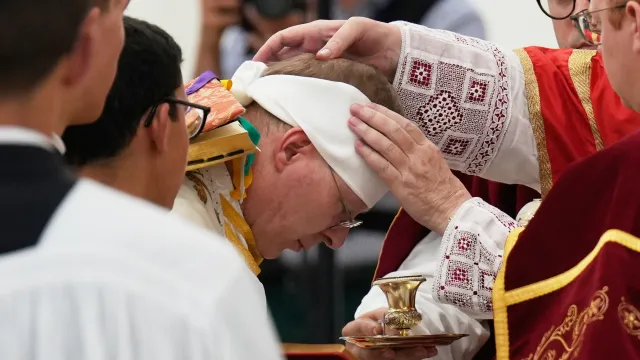
The Catholic Church is once again confronting one of its longest-running internal divisions after the Society of St. Pius X (SSPX), a traditionalist Catholic organization, consecrated four new bishops in Écône, Switzerland, without the authorization of Pope Leo XIV. The ceremony, attended by thousands of faithful and watched online by supporters around the world, represents far more than an internal administrative decision. It strikes at the heart of Catholic ecclesiology, papal authority, and the unity of the global Church.
According to canon law, bishops may not be consecrated without a papal mandate except under extraordinary circumstances recognized by the Church. By proceeding without that approval, the SSPX has revived memories of the 1988 consecrations that led to one of the most serious ruptures between the Vatican and traditionalist Catholics in the modern era.
The latest development comes at a particularly sensitive moment for Pope Leo XIV, WHO inherited ongoing efforts to maintain dialogue with traditionalist communities while preserving ecclesiastical unity. The decision by the SSPX to proceed despite explicit papal warnings has transformed what might have been an internal disagreement into an international religious event with significant theological, legal, and pastoral consequences.
What Happened in Écône?
The episcopal consecration ceremony took place at the SSPX seminary in Écône, Switzerland, a location that has become synonymous with traditionalist Catholicism. Thousands of worshippers gathered for the event, which featured the traditional Latin Mass and was livestreamed globally in multiple languages.
Four priests were consecrated as bishops:
- Pascal Schreiber (Switzerland)
- Michael Goldade (United States)
- Michel Poinsinet de Sivry (France)
- Marc Hanappier (France)
The rite was performed by Bishop Alfonso de Galarreta, himself one of the bishops consecrated without papal approval in 1988.
For the SSPX, the ceremony was presented as a necessary step to preserve what it describes as authentic Catholic tradition. For the Vatican, however, it represents a direct challenge to the authority of the Pope.
Understanding the Society of St. Pius X
The SSPX was founded in 1970 by French Archbishop Marcel Lefebvre following the Second Vatican Council, one of the most transformative events in modern Catholic history.
The organization argues that many post-conciliar reforms departed from centuries of Catholic tradition. Among its principal concerns are:
- The replacement of the universal Latin Mass with vernacular liturgies.
- Greater emphasis on ecumenical dialogue.
- Changes in relations with other religions.
- Modern theological interpretations.
- Liturgical reforms introduced after the Council.
Although the SSPX recognizes the Pope as the head of the Catholic Church, it maintains that extraordinary circumstances justify resistance to certain reforms that it believes endanger the integrity of the faith.
A Timeline of the Vatican-SSPX Dispute
| Year | Major Development |
|---|---|
| 1970 | SSPX founded by Archbishop Marcel Lefebvre. |
| 1975 | Canonical recognition withdrawn by the Vatican. |
| 1988 | Four bishops consecrated without papal approval; Vatican declares a schismatic act. |
| 2009 | Excommunications of the surviving bishops lifted by Pope Benedict XVI as part of reconciliation efforts. |
| 2015–2016 | Pope Francis grants SSPX priests faculties to validly hear confessions, later extending the permission indefinitely. |
| 2026 | SSPX consecrates four additional bishops without approval from Pope Leo XIV. |
This history demonstrates that relations between Rome and the SSPX have alternated between dialogue and confrontation for nearly five decades.
Why Papal Approval Matters in the Catholic Church
Within Catholic theology, bishops are successors to the Apostles and play an essential role in governing dioceses, ordaining priests, and safeguarding Church teaching. Because bishops exercise authority in communion with the Pope, episcopal consecrations require a papal mandate.
This requirement is not merely procedural. It symbolizes the unity of the worldwide Church under the Bishop of Rome.
Consecrating bishops independently is therefore viewed as more than administrative disobedience it is seen as an act that threatens ecclesial communion itself.
What Canon Law Says About Unauthorized Consecrations
Canon law establishes clear rules governing episcopal appointments.
Ordinarily, both the bishop performing the consecration and the person receiving episcopal ordination without papal authorization incur the Church’s most severe ecclesiastical penalty under the applicable provisions of canon law.
Such actions may also be treated as schismatic if they represent a deliberate refusal of submission to the Pope or a rupture of communion with the Church.
Whether every canonical consequence ultimately applies depends on legal interpretation and any future determinations by the Holy See, but the Vatican has consistently regarded unauthorized episcopal consecrations as among the gravest violations of ecclesiastical discipline.
Why the SSPX Says It Acted Anyway
The Society argues that it faces what it calls a “state of necessity.”
Its leadership contends that with only two of its original bishops still living, the organization required additional bishops to continue ordaining priests, administering confirmations, and serving its worldwide apostolate.
The SSPX also insists that the consecrations should not be interpreted as a rejection of papal authority but as an emergency measure designed to preserve traditional Catholic worship.
This argument has remained central to the society’s position since the original consecrations in 1988.
The Continuing Appeal of the Traditional Latin Mass
The dispute cannot be understood without examining the enduring popularity of the Traditional Latin Mass.
Although most Catholics worship according to the post-Vatican II liturgy, a growing number of believers particularly younger Catholics in some regions have expressed renewed interest in older liturgical traditions.
Supporters often cite:
- Greater emphasis on sacred ritual.
- Use of Latin as a universal liturgical language.
- Continuity with centuries of Church history.
- Traditional sacred music.
- A heightened sense of reverence.
This renewed interest has contributed to broader debates within Catholicism about liturgical identity and continuity.
How Large Is the SSPX Today?
Although it remains outside the ordinary canonical structures of the Catholic Church, the SSPX has developed a substantial international presence.
The society states that it operates approximately 800 chapels, schools, seminaries, and apostolates across 77 countries, serving hundreds of thousands of faithful through its educational, charitable, and liturgical activities.
Its digital presence has also expanded significantly, allowing it to reach supporters well beyond its physical communities through livestreamed liturgies, online publications, and educational content.
Comparison: Vatican Position vs SSPX Position
| Issue | Vatican Position | SSPX Position |
|---|---|---|
| Bishop Consecrations | Require papal approval. | Emergency circumstances justify proceeding. |
| Second Vatican Council | Authoritative ecumenical council. | Some teachings require correction or clarification. |
| Latin Mass | Permitted under specific norms. | Should remain central to Catholic worship. |
| Church Authority | Unity under the Pope is essential. | Recognizes the Pope but argues necessity permits exceptional actions. |
What This Means for Catholics Worldwide
For most of the world’s approximately 1.4 billion Catholics, daily parish life will remain unchanged. However, the symbolic implications are substantial.
The event highlights ongoing tensions regarding authority, liturgy, and theological interpretation that continue to influence discussions within the Church.
It also raises pastoral challenges for bishops seeking to minister to Catholics attracted to traditional forms of worship while maintaining ecclesial unity.
Impact on Pope Leo XIV’s Pontificate
The unauthorized consecrations represent one of the earliest major institutional challenges facing Pope Leo XIV.
His response will likely shape perceptions of his leadership among different groups within the Church.
He faces the difficult task of defending canonical discipline without closing the possibility of future reconciliation a balance that has challenged several of his predecessors.
How the Vatican proceeds in the coming months could influence relations with traditionalist communities for years to come.
The Broader Debate Over Tradition and Reform
The SSPX dispute reflects a broader conversation that extends beyond a single organization.
Across global Christianity, many religious communities wrestle with similar questions:
- How should ancient traditions be preserved?
- When should institutions adapt to modern society?
- Who has authority to determine authentic continuity?
- How can unity coexist with legitimate diversity?
These debates continue to shape religious life well beyond Catholicism.
Can Reconciliation Still Happen?
History suggests that dialogue remains possible even after periods of sharp disagreement.
Previous pontificates engaged in years of theological discussions with the SSPX, resulting in limited but meaningful steps toward improved relations, including the recognition of certain sacramental faculties.
Although the latest consecrations have complicated those efforts, both sides continue to express a desire at least in principle for eventual reconciliation, even while disagreeing profoundly about the path forward.
Future Outlook
The consecration of four bishops in Écône is likely to become another defining chapter in the long and complex relationship between the Vatican and the Society of St. Pius X. Whether the event ultimately hardens divisions or eventually leads to renewed negotiations will depend on decisions made by both the Holy See and the SSPX leadership in the months ahead.
For the Vatican, preserving unity while addressing concerns from traditionalist Catholics will remain a delicate balancing act. For the SSPX, expanding its episcopal leadership strengthens its ability to continue its ministry but also intensifies scrutiny of its canonical status.
Beyond the immediate Controversy, the episode underscores a larger reality: debates over tradition, authority, and reform continue to shape the future of one of the world’s oldest religious institutions. As Pope Leo XIV begins his pontificate, how these questions are addressed may influence the direction of the Catholic Church for years to come.
For breaking news and live news updates, like us on Facebook or follow us on Twitter and Instagram. Read more on Latest World on thefoxdaily.com.

COMMENTS 0