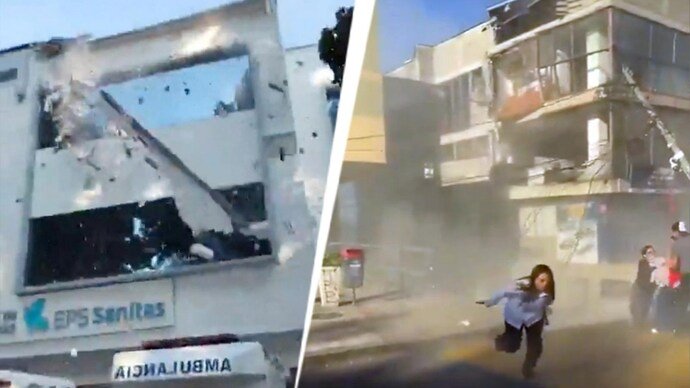
A powerful 7.4-magnitude earthquake struck Colombia on Monday, killing at least 20 people, collapsing buildings and disrupting airport operations. Strong tremors were also felt across the border in Venezuela.
A strong 7.4-magnitude earthquake struck Colombia on Monday, killing at least 20 people and causing multiple buildings to collapse, according to local officials.
The US Geological Survey (USGS) said the earthquake occurred at 12:34 UTC, or around 7:34 a.m. local time, about 5 km east of San Jose del Palmar in Colombia’s Choco department. The quake was recorded at a depth of about 107 km.
The mayor of Pereira said 18 people were killed in the earthquake, while the mayor of Manizales told BLU Radio that two people had died in the city.
The US Tsunami Warning System said there was no tsunami warning after the earthquake struck Colombia’s Pacific coast. The tremor was felt across several parts of Colombia, including areas far from the epicentre, and was also reported across the border in Venezuela.
Buildings collapse in Cali as rescue operations begin
The extent of the damage became clearer as authorities began assessing the impact of the powerful earthquake.
Cali Mayor Alejandro Eder said at least 20 buildings had collapsed in the city and that people were trapped inside some of the structures.
“At this moment we have at least 20 collapsed structures in Cali, with people trapped. We are already on the front lines of this emergency with all the rescue organizations of Cali. I have requested support from the mayor of Bogota and the mayor of Medellin with rescue teams,” Eder said.
He urged residents to remain calm and check their buildings for visible structural damage.
“If you do not feel safe, if you see very large cracks, please, leave the building,” he said, warning residents not to remain inside potentially unsafe structures.
Rescue organisations in Cali were deployed as authorities searched collapsed structures and assessed the condition of buildings following the earthquake.
Choco reports injuries and significant damage
Choco Governor Nubia Carolina Cordoba-Curi said the earthquake caused injuries and significant damage to buildings in the departmental capital, Quibdo.
She said authorities had begun assessing the damage and warned residents about possible aftershocks.
“We have just experienced a major earthquake in the department of Choco. We are concerned about aftershocks. Although the epicenter was near San Jose del Palmar, there are injuries and significant damage to buildings in the capital, Quibdo,” Cordoba-Curi said on X.
The governor added that authorities were carrying out a damage assessment and would issue an official report as more information became available.
The earthquake’s epicentre was near San Jose del Palmar, but its effects were reported across a much wider area.
Airport operations suspended after earthquake damage
The earthquake also disrupted air Travel across parts of Colombia.
The country’s aviation authority reported damage at airports in Pereira, Manizales, Quibdo, Armenia, Cartago and Buenaventura.
Air operations at the affected terminals were suspended while authorities assessed the damage and checked whether airport facilities were safe for passengers and aircraft.
The disruption added to the challenges facing emergency authorities as rescue teams and local officials continued to assess damage across affected areas.
Colombia’s National Unit for Disaster Risk Management said it was coordinating with local authorities to verify reports of damage and assess the situation following the earthquake.
In the capital Bogota, Mayor Carlos Galan said there was no major damage reported in the city.
Tremors felt across Venezuela
The earthquake was also felt across the border in Venezuela.
Reuters witnesses in Tachira state, which borders Colombia, reported feeling the tremor. Shaking was also reported in Barquisimeto, a city in central-western Venezuela.
The earthquake comes less than two months after Venezuela was hit by devastating twin earthquakes in June. Those earthquakes killed more than 6,000 people, with most of the deaths reported along the coast near the capital, Caracas.
Reports also indicated that the Colombian earthquake was felt in several other Venezuelan locations, highlighting the wide reach of the Seismic Activity.
No tsunami warning issued
Despite the earthquake’s magnitude, the US Tsunami Warning System said there was no tsunami warning following the quake.
The earthquake struck Colombia’s Pacific coast, but authorities did not issue a tsunami alert after assessing the event.
Emergency teams instead focused on casualties, collapsed structures, Infrastructure damage and the possibility of further aftershocks.
Officials warn residents about aftershocks
Authorities in Choco warned residents to remain alert for possible aftershocks following the main earthquake.
Officials were assessing buildings and infrastructure to determine the extent of the damage and identify locations requiring emergency assistance.
The warning was particularly important in areas where buildings had already suffered visible damage, as additional shaking could further weaken structures.
Residents were urged to remain cautious and avoid entering buildings showing major cracks or other signs of structural instability.
Colombia is one of South America’s earthquake-prone countries
Colombia is one of South America’s most seismically active countries.
Its location near several tectonic plate boundaries and major fault systems means earthquakes can occur across different parts of the country.
The Colombian Geological Service says the country has recorded more than 100 destructive earthquakes, particularly in the Andean region, the eastern foothills of the Eastern Cordillera and the Pacific region.
The country’s geographical and geological conditions mean authorities regularly monitor seismic activity and maintain Emergency Response systems for major earthquakes.
Colombia has a history of powerful earthquakes
Colombia has experienced several powerful earthquakes in the past.
One of the most destructive was the magnitude 8 earthquake near Tumaco in southwestern Colombia in 1979.
The history of major seismic events highlights the country’s vulnerability to earthquakes and the importance of rapid emergency response following a major tremor.
Rescue teams search collapsed structures
Emergency teams remained focused on searching collapsed structures and rescuing people who may still be trapped.
Authorities across affected cities were also assessing damage to buildings, airports and other infrastructure as more reports came in.
The situation remained fluid, with officials expected to provide further updates as Rescue Operations and damage assessments continued.
The number of casualties and the extent of structural damage could change as emergency teams gain access to affected areas and complete their assessments.
What happened in Colombia
The 7.4-magnitude earthquake struck at around 7:34 a.m. local time on Monday, with the epicentre located about 5 km east of San Jose del Palmar in Choco at a depth of approximately 107 km.
At least 20 people were reported killed, according to local officials, while multiple buildings collapsed in Cali and significant damage was reported in Quibdo.
Airports in Pereira, Manizales, Quibdo, Armenia, Cartago and Buenaventura reported damage and suspended operations while safety checks were carried out.
The tremor was felt in several parts of Colombia and across the border in Venezuela. Despite the strength of the earthquake, the US Tsunami Warning System said there was no tsunami warning.
Emergency response continues
Authorities are continuing to assess the damage caused by the powerful earthquake while rescue teams search collapsed structures for survivors.
The immediate priorities remain rescuing trapped people, treating the injured, checking the structural safety of buildings and assessing damage to critical infrastructure.
Officials are also monitoring the situation for possible aftershocks and advising residents to avoid buildings that appear structurally unsafe.
With damage reported across several Colombian cities and tremors felt in neighbouring Venezuela, emergency agencies remain focused on rescue and recovery operations as the full impact of Monday’s earthquake becomes clearer.
For breaking news and live news updates, like us on Facebook or follow us on Twitter and Instagram. Read more on Latest World on thefoxdaily.com.




COMMENTS 0