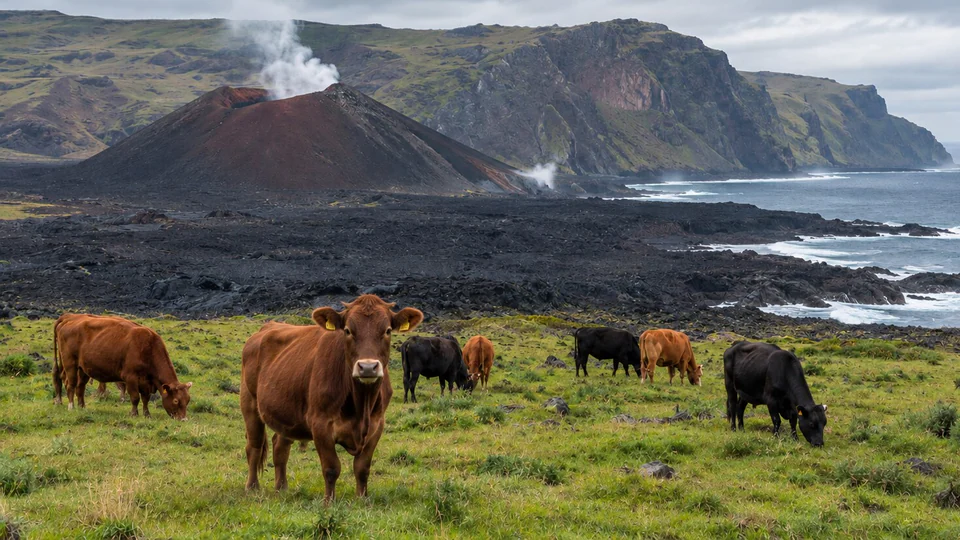
In October 1961, a volcanic eruption forced all 264 residents of Tristan da Cunha, one of the world’s most remote inhabited island communities, to abandon their homes and flee across the South Atlantic. The islanders left behind livestock, pets and much of their settlement, uncertain when they would be able to return. Yet when scientists reached the island in January 1962, they discovered that the eruption had caused less damage than feared and that around 200 cattle were surviving on the plains near the village.
The discovery offered hope for the displaced community while raising concerns about the environmental consequences of leaving domestic animals unattended in a fragile island ecosystem. The expedition’s findings helped pave the way for a gradual return, with most of the islanders resettling on Tristan da Cunha by 1963.
Tristan da Cunha: An Isolated Island Community in the South Atlantic
Tristan da Cunha is a remote island group in the South Atlantic Ocean, far from major population centres. Its main settlement, Edinburgh of the Seven Seas, was home to 264 people when the volcano began showing signs of activity in 1961.
The community’s isolation made the developing emergency particularly difficult. Reaching the island required a long sea journey, and there was no airport to provide a quick route out. When the volcano threatened the settlement, residents had to rely on boats and passing ships to reach safety.
The islanders’ lives were closely connected to farming and livestock. Cattle and other domestic animals formed part of the local agricultural system, making the decision to evacuate especially difficult because the animals could not all be taken along. Leaving them behind meant the community would have to wait until scientists and officials could assess the island before determining what could be recovered.
The crisis would ultimately test not only the resilience of the islanders but also the ability of their livestock and the surrounding environment to withstand a sudden disruption.
Volcanic Tremors Escalate in August and September 1961
The first warning signs appeared in August 1961, when residents began feeling earth tremors. The shaking became more frequent and intense throughout September, signalling that the island’s volcanic system was becoming increasingly active.
By early October, a large lava dome had formed a few hundred feet east of the settlement. With volcanic activity developing close to the village, remaining in place was becoming too dangerous.
The residents made the decision to leave. They travelled by boat to Nightingale Island, another island in the Tristan da Cunha group, where they awaited rescue. A Dutch ship that was expected to arrive the following morning took them aboard.
By early November 1961, the entire population had reached England safely. Although the immediate danger had passed for the islanders, their future remained uncertain. They had left their homes, livelihoods and animals behind, with no clear timetable for returning.
The evacuation was a major disruption for a community whose remoteness made relocation particularly complicated. Finding temporary accommodation abroad was only the first challenge. Before the islanders could contemplate returning, authorities needed to understand the extent of the volcanic damage and determine whether the settlement remained habitable.
Royal Society Sends a Scientific Expedition to the Island
After the islanders reached England, the Royal Society authorised an expedition to investigate the eruption and its effects. The mission was designed to examine the volcano, document geological changes and assess the impact on the island’s plants, animals and agricultural resources.
A 12-member team led by geologist Ian Gass arrived in late January 1962. The group included four geologists, a botanist, a zoologist, a meteorologist and an agriculturist, alongside two Royal Navy officers and two islanders serving as guides.
The team had only seven weeks to study the island and gather enough information to help establish what had happened during the eruption. Its work involved more than examining the lava flows. Scientists also needed to determine how much of the settlement had survived and whether the island’s agricultural resources could support a return.
The findings were more encouraging than the islanders might have expected. Lava had flowed north and east of the settlement and reached the sea, but most of the village remained undamaged. The canning factory, however, had been destroyed.
This assessment was important because the survival of much of the settlement meant that rebuilding might be possible without starting entirely from scratch. The expedition could now provide evidence to guide decisions about restoring the village and bringing the displaced population home.
Around 200 Cattle Survived Without Human Care
One of the expedition’s notable discoveries concerned the animals left behind during the evacuation. Scientists counted approximately 200 cattle on the plains near the settlement, only a few months after the residents had departed. Several large herds were also thriving elsewhere on the island.
The cattle had survived without the regular care they would ordinarily have received from farmers. Their condition offered a measure of reassurance for a community that depended on livestock and had been forced to leave its agricultural resources behind.
The finding did not mean the evacuation had been without consequences for the animals or that all livestock had survived. It showed, however, that a substantial number of cattle had endured the period of abandonment and that herds remained on the island when the scientific team arrived.
For the islanders, this was potentially encouraging news. The presence of surviving cattle suggested that at least part of their livestock base remained intact, even though the settlement and its infrastructure had suffered damage.
But the same discovery raised a different question: what would happen if large numbers of domestic animals continued living without management in the island’s natural environment?
Thriving Livestock Raised Concerns About Island Wildlife
The survival of cattle was not viewed as an entirely positive development. Tristan da Cunha’s wildlife and habitats could be affected by domestic animals left to roam without human supervision.
In a paper published in the journal Oryx in 1962, H. F. I. Elliott noted that cattle, sheep, donkeys, geese and fowls had been left behind during the evacuation. He also warned that rats, feral cats and abandoned livestock could pose risks to the islands’ wildlife.
The concern was that introduced or unmanaged animals could disturb habitats and place additional pressure on native species. Grazing livestock can alter vegetation, while feral predators and rodents can affect wildlife through predation and competition. The extent of these effects depends on local conditions and the species involved.
Elliott warned that damage to the habitat could increase unless suitable control measures were introduced. His observations highlighted an environmental problem that could not be solved simply by confirming that the animals had survived the eruption.
The episode illustrates a broader challenge faced by remote islands. Domestic animals may provide valuable resources for human communities, but when they are left unmanaged, their presence can create ecological problems. On an isolated island, the consequences can be particularly important because native species may be vulnerable to changes in vegetation, predation and competition.
For Tristan da Cunha, the priority was to assess the land and livestock while also considering the long-term condition of the island’s natural environment.
How Scientists’ Findings Helped Prepare for the Islanders’ Return
The Royal Society expedition provided a clearer picture of the island’s condition after the eruption. The finding that most of the settlement remained intact was a significant factor in assessing whether residents could return.
In September 1962, a small resettlement party went back to Tristan da Cunha to begin cleaning up and repairing the village. Its work marked the first stage in restoring normal life after the evacuation.
The return was gradual rather than immediate. The first group of displaced residents arrived in April 1963, followed by approximately 200 more in November. By the end of that year, most of the community had returned home.
The islanders had spent roughly two years away from their homes. Their return depended on more than the passage of time: officials and residents needed evidence that the settlement could be occupied again and that essential repairs were possible.
The expedition’s findings helped reduce uncertainty by documenting the damage and assessing the island’s condition. The survival of much of the village and the presence of substantial numbers of cattle were encouraging, although the destroyed canning factory and other effects of the eruption still presented challenges.
The Volcano Was Still Active When the Team Departed
The return to Tristan da Cunha did not mean that all volcanic activity had stopped. When the scientific team left, gases and vapour were still emerging from the crater, showing that the volcano remained active.
However, the activity was clearly declining, and the team considered another major eruption unlikely at that stage. That assessment helped support the prospect of resettlement, although volcanic hazards can never be eliminated entirely from an active volcanic island.
The episode demonstrated the value of scientific monitoring after an eruption. An initial disaster can leave uncertainty about future activity, damage to infrastructure and the condition of the surrounding environment. Field observations help authorities distinguish between immediate destruction and longer-term risks.
For Tristan da Cunha’s residents, the most important outcome was that the island was considered suitable for a return. The community could begin rebuilding its life in the place it had been forced to leave.
Why the Tristan da Cunha Evacuation Still Matters
The 1961 eruption offers a striking example of how a natural disaster can affect an entire community, even when the physical damage to buildings is less severe than initially feared. For the residents of Tristan da Cunha, the emergency involved displacement, uncertainty about their homes and the challenge of deciding whether it was safe to return.
The story also shows why disaster assessments need to consider more than human safety and structural damage. The scientific team examined geological conditions, settlement damage, livestock and wildlife, revealing how closely these issues can be connected.
The cattle that survived became a symbol of resilience, but their presence also highlighted the environmental consequences of an abrupt evacuation. Animals that remain after people leave can survive and reproduce, yet their long-term effects on habitats may require active management.
Tristan da Cunha’s experience therefore connects several important questions: how isolated communities can be evacuated during a volcanic emergency, how scientists assess the safety of a return, and how abandoned livestock can affect a fragile ecosystem.
Conclusion
In 1961, volcanic activity forced all 264 residents of Tristan da Cunha to leave their remote South Atlantic home. The evacuation took them first to Nightingale Island and then to England, where they waited for news about the settlement they had left behind.
A Royal Society expedition led by Ian Gass arrived in January 1962 and found that the eruption had caused less damage than feared. Most of the village remained intact, although the canning factory had been destroyed. Scientists also counted around 200 cattle near the settlement, while several large herds were thriving elsewhere on the island.
The discovery offered hope for the community but raised concerns about the effects of unmanaged livestock and other introduced animals on local wildlife. A resettlement party returned in September 1962, and most of the displaced residents were back by 1963.
The episode remains a reminder that recovery after a volcanic disaster involves more than waiting for the eruption to subside. It requires careful scientific assessment, attention to the environment and a practical plan for bringing a displaced community home.
For breaking news and live news updates, like us on Facebook or follow us on Twitter and Instagram. Read more on Latest World on thefoxdaily.com.


COMMENTS 0