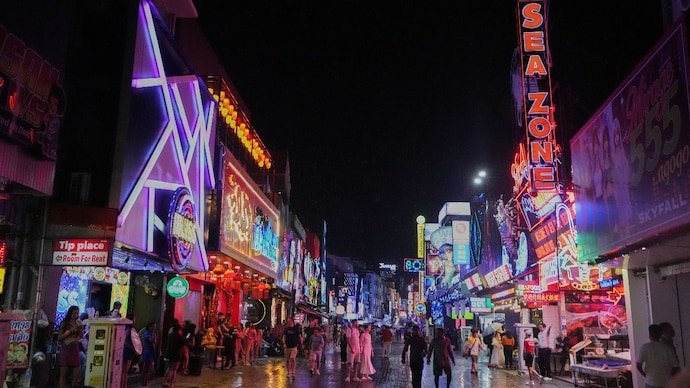
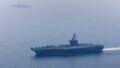
When nearly 5,000 US sailors, Marines and other defence personnel arrived in Thailand after spending 286 days at sea, Pattaya prepared for the kind of shore leave the city has become famous for.
Thai authorities expected the arrival of the USS Abraham Lincoln aircraft carrier and two accompanying warships to place enormous pressure on Pattaya’s nightlife industry. The resort city is internationally known for its bars, clubs and adult-Entertainment venues, and officials moved quickly to prevent the port visit from turning into a major public-order problem.
Police launched a crackdown on sex workers, detained dozens of people and restricted American military personnel from entering some of the city’s most notorious red-light districts. Service members were also warned away from drug stores, cannabis outlets and certain water-sports businesses.
Yet when the sailors finally came ashore, the reality was considerably more ordinary than the stereotypes surrounding a military port call in Pattaya.
They bought socks.
They ate Thai food.
They visited shopping malls, ordered fresh meals, got massages, went to bars and nightclubs and, after months aboard a warship, simply enjoyed being on solid ground.
There were a few drunken incidents, including a reported fight between two sailors, but Thai officials said the four-day visit was largely peaceful. For a city accustomed to being associated with nightlife, the visit turned into a surprisingly subdued demonstration of what thousands of exhausted sailors actually wanted after almost a year at sea.
Why Pattaya prepared for the US Navy arrival
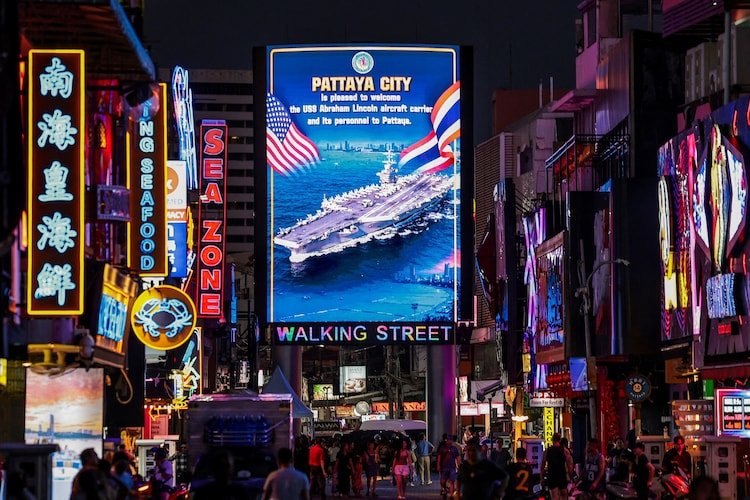
The USS Abraham Lincoln-led carrier strike group docked in Thailand on September 2 for a four-day port visit, bringing an estimated 5,000 American personnel into Pattaya.
The city was a logical choice for a large military port call. Pattaya has extensive hotel capacity, restaurants, shopping centres, entertainment venues and a long history of receiving international visitors and military personnel.
But it also has a second reputation.
The city became internationally associated with prostitution and adult entertainment during the Vietnam War era, when American service members used Thailand as a destination for rest and recreation. Over decades, that association helped shape Pattaya’s tourism Economy and its global image.
Thai officials therefore anticipated that thousands of sailors coming ashore after months at sea could create an unusually intense demand for the city’s adult-entertainment industry.
The response was a major pre-emptive security operation.
Thai authorities crack down on Pattaya’s sex industry
Police detained at least 40 people as part of the crackdown before and during the American port visit.
Officials also introduced restrictions on where US service members could go. The restrictions included Soi 6, one of Pattaya’s best-known red-light districts, as well as some establishments linked to cannabis, drugs and water sports.
The objective was to reduce the risk of Crime, exploitation, public disorder and confrontations involving large numbers of intoxicated visitors.
Authorities also increased police visibility around nightlife areas. Officers were deployed in greater numbers than usual, while volunteers and other personnel helped monitor the streets.
The response reflected both the size of the visiting force and Pattaya’s understanding of the expectations surrounding an American naval port call.
The city’s reputation dates back to the Vietnam War
Pattaya was once a relatively small fishing community. Its transformation into a major tourism destination was partly driven by the arrival of American servicemen during the Vietnam War.
US military personnel looking for recreation during periods of leave helped turn the coastal settlement into a leisure destination. Hotels, bars, restaurants and entertainment businesses expanded as more visitors arrived.
The economic transformation eventually made Pattaya one of Thailand’s best-known resort cities.
But the same history also contributed to its reputation as a centre of sex tourism.
Although prostitution is officially illegal in Thailand, an extensive adult-entertainment economy has operated openly in Pattaya for decades.
That history explains why authorities considered the arrival of the Lincoln strike group a special security challenge.
But the sailors had more ordinary priorities
The biggest surprise of the port visit was how much of the sailors’ attention went toward everyday comforts.
After months aboard a carrier, the appeal of shopping malls and ordinary restaurants was apparently stronger than many outsiders expected.
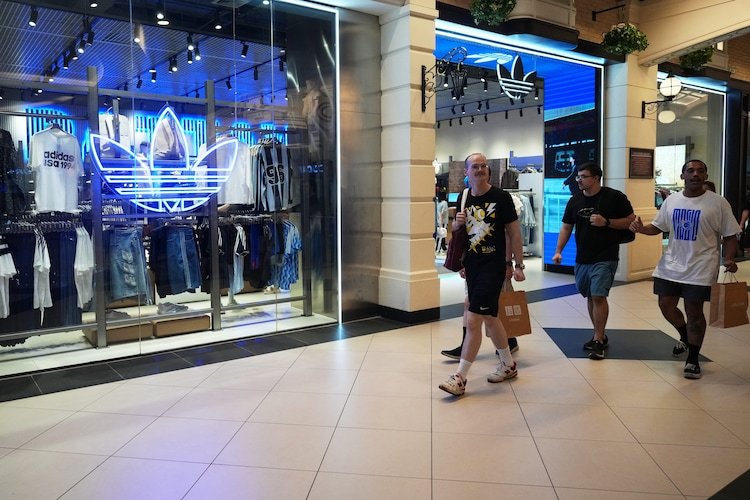
American personnel were seen heading to shopping centres, restaurants and stores across Pattaya, buying clothing, shoes, gifts and basic items that had become scarce aboard ship.
For some, the simple objective was replacing everyday necessities.
One sailor reportedly summed it up after purchasing a pair of socks: “It’s the simple stuff like new socks.”
After 286 days at sea, that simple purchase represented something larger. Shore leave was not necessarily about excess. For many sailors, it was about getting things they could not easily access while living aboard a crowded warship for most of a year.
Fresh food became a major attraction
Food was another major priority.
Several service members told media outlets that they were eager to eat fresh meals after a long period of relatively repetitive shipboard food.
One sailor described developing a new appreciation for Thai cuisine after months of monotonous meals aboard the carrier.
Another said she was particularly interested in having something green and fresh, highlighting how ordinary foods can become highly desirable after extended periods at sea.
Thai restaurants and food outlets therefore benefited directly from the influx.
For sailors whose daily meals are constrained by what can be stored and prepared aboard a carrier, fresh vegetables, local dishes and restaurant food can become one of the biggest attractions of a port visit.
Shopping malls saw a surge in spending
The arrival of thousands of US service members also provided a welcome boost to Pattaya’s retail sector.
Some retailers reportedly saw their daily sales increase dramatically during the visit.
An American Eagle outlet, for example, reportedly saw daily sales rise from around 70,000 baht to as much as 200,000 baht.
Other brands, including Nike, Victoria’s Secret and Starbucks, were also reported to have benefited from the increased traffic.
Service members were spending on clothing, footwear, food, gifts, souvenirs and other everyday purchases.
The economic effect illustrates how a military port call can become a temporary tourism boom for a destination.
Thousands of visitors arriving simultaneously create a concentrated burst of demand that reaches far beyond bars and nightclubs.
Pattaya’s businesses needed the boost
The timing was particularly useful for local businesses because Pattaya had been dealing with weaker tourism conditions.
The outbreak of the US-Iran conflict had contributed to disruptions in international travel and affected tourism flows, according to local reports cited during the port visit.
The arrival of nearly 5,000 American personnel therefore created an immediate injection of spending into restaurants, retail outlets and entertainment businesses.
For local merchants, the military visitors were not simply sailors on leave. They were thousands of customers arriving at the same time with disposable income and a very specific need for food, clothing and entertainment.
Walking Street still welcomed the sailors
Although American personnel were restricted from some of Pattaya’s red-light areas, Walking Street remained open and became one of the busiest locations associated with the port call.
The famous nightlife strip is lined with bars, clubs and adult-entertainment establishments, and businesses there made significant efforts to attract American customers.
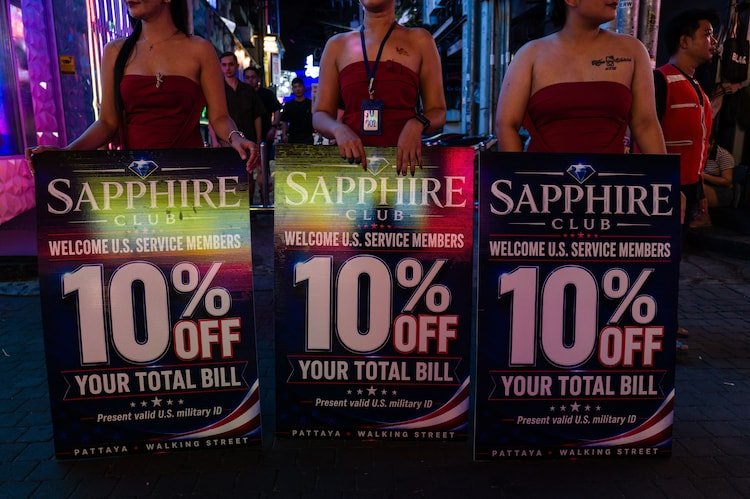
Some venues advertised discounts for people showing US military identification, while promotional staff distributed flyers and approached service members along the street.
The atmosphere reflected the city’s attempt to balance commercial opportunity with police supervision.
Even with the restrictions elsewhere in Pattaya, nightlife businesses clearly expected the American visitors to spend money.
Some sailors did head to bars and clubs
The quieter reality of the port visit should not be confused with an absence of nightlife.
Many sailors and Marines did visit bars and nightclubs, particularly around Walking Street.
Some service members were seen drinking beer and taking shots in venues that were heavily promoting themselves to the visiting military population.
The city’s nightlife businesses also deployed promotional teams to increase traffic from the ships.
Police maintained a heavier presence in the area, in part because large groups of intoxicated tourists can create public-order problems even when there is no major criminal activity.
The combination of alcohol, crowds and unfamiliar surroundings was therefore monitored closely.
Police were everywhere in the nightlife zone
Thai authorities reportedly placed additional police officers around Pattaya’s entertainment areas to keep an eye on the situation.
The increased presence became particularly noticeable as some sailors began struggling with the effects of prolonged drinking.
One service member was reportedly helped away from a nightlife area in a golf cart by colleagues and police after becoming too intoxicated to walk properly.
In another incident, police described a drunken altercation involving two sailors as “trivial.” The sailors were reportedly sent back to the Abraham Lincoln without being formally arrested or charged.
Those incidents were notable mainly because the rest of the visit remained relatively calm.
The port visit was surprisingly peaceful
For a city hosting thousands of military personnel, the overall lack of major incidents was striking.
Pattaya police chief Anek Srathongyoo later said there had been no other notable incidents beyond the reported disturbances.
The outcome was seen by some local residents as one of the better-behaved groups of American service members to visit the city in recent memory.
Several factors likely contributed to that result.
Strict restrictions were introduced before the port call. Police were deployed in larger numbers. Service members were briefed about off-limits areas. And many of the sailors had spent so long at sea that exhaustion may have reduced their appetite for prolonged partying.
286 days at sea changed what shore leave meant
The length of the deployment is central to understanding the behaviour of the sailors.
Spending 286 days aboard a carrier means living within a highly structured Environment for much of the year. Personal space is limited, routines are repetitive and access to fresh food, ordinary shopping and private accommodation is restricted.
After such a deployment, shore leave can become less about adventure and more about recovery.
For some personnel, that meant dinner in a restaurant. For others, it meant buying new clothes, getting a manicure or massage, sleeping in a hotel or simply walking around a shopping centre.
One sailor’s comment that stepping ashore felt like a weight being lifted captured the psychological importance of the break.
The port visit was a rare opportunity to temporarily leave the controlled environment of the ship and experience ordinary civilian life.
Some sailors wanted a night away from the ship
Not everyone spent the entire visit in shopping malls.
Some service members reportedly booked hotel rooms in Pattaya, including accommodations connected with major international hotel and entertainment brands.
The motivation was not necessarily nightlife.
After months aboard the Abraham Lincoln, simply having a private room, a normal bed and uninterrupted access to civilian amenities could be attractive.
The distinction is important because military deployments produce a level of fatigue that is difficult to capture in the stereotype of young sailors on leave.
For someone who has been living aboard a warship for months, the chance to close a hotel room door and sleep can be more appealing than spending the night in a nightclub.
Why the sailors were called the best behaved
Pattaya’s local authorities had prepared for the possibility of large-scale disorder but instead encountered relatively limited problems.
The restrictions imposed on the sailors played an obvious role.
Service members were prohibited from certain locations, while police increased patrols around the areas they were permitted to visit.
But behaviour also appeared to be shaped by the realities of the deployment.
Some bar workers told journalists that the sailors seemed cautious about interacting with adult-entertainment workers.
That caution could reflect the rules imposed by their command as well as the awareness that misconduct during an overseas port call can have consequences for military personnel.
Walking Street became a carefully watched destination
Walking Street presents an interesting contrast with the rest of Pattaya’s response.
Authorities sought to limit access to several red-light districts, but one of the city’s largest entertainment zones remained active.
Businesses there openly marketed themselves to American military customers, while police watched closely for signs of disorder.
The result was a highly managed form of nightlife.
The city wanted to benefit from the visitors’ spending while avoiding the kind of incidents that could damage Pattaya’s reputation or strain relations between Thai authorities and the US military.
For local businesses, that meant taking advantage of the opportunity while operating under unusually heavy scrutiny.
Why alcohol was a concern
Drinking is a routine part of nightlife in Pattaya, but the age profile of the American visitors created an additional complication.
Some of the sailors and Marines were under the legal drinking age in the United States but could legally drink in Thailand under local rules.
That difference can create unusual situations for visiting military personnel, particularly when many young service members arrive in a tourism centre known for nightlife at the same time.
Thai authorities consequently had an incentive to monitor alcohol-related activity carefully.
The reported incidents suggest that excessive drinking occurred in isolated cases, but it did not develop into widespread disorder.
Pattaya’s military heritage remains visible
The US Navy‘s relationship with Thailand has a long history.
During the Vietnam War, American military personnel played a major role in the growth of several Thai destinations, with Pattaya becoming particularly associated with rest and recreation.
Today’s naval port calls therefore carry a historical dimension.
The city that once grew around American military tourism is now much larger and far more commercially diverse, but the military connection remains part of its identity.
The arrival of the Abraham Lincoln brought that history back into focus while also showing how much Pattaya itself has changed.
The economic impact went beyond nightlife
One of the clearest lessons from the visit was the breadth of economic activity generated by the sailors.
Restaurants, shopping malls, hotels, cafés, clothing stores and souvenir businesses all benefited.
That is significant because it challenges the assumption that military tourism in Pattaya is primarily connected to the adult-entertainment economy.
The experience of the four-day visit suggested a much broader consumer pattern.
Thousands of young adults with limited access to civilian goods for months suddenly had the opportunity to shop, eat out and spend money on personal items.
The result was a short but concentrated economic surge across multiple sectors.
What the sailors bought tells its own story
The most interesting aspect of the spending patterns may have been how mundane many purchases were.
New socks, clothes and shoes do not fit the stereotype of a dramatic overseas military adventure. But they are exactly the kinds of things that become important during an extended deployment.
The same applies to fresh food and basic personal-care services.
For someone living aboard a ship for most of a year, a salad, a massage, new clothes or a quiet hotel room can represent a significant improvement in quality of life for a few hours.
That helps explain why the port call appeared quieter than authorities had initially feared.
The American sailors and the Pattaya economy
| Activity | Reported impact |
|---|---|
| Shopping | Strong demand for clothes, shoes, socks, gifts and souvenirs |
| Food and restaurants | High demand for Thai and fresh food after months at sea |
| Hotels | Some personnel booked rooms for a night or two away from the ship |
| Bars and nightclubs | Substantial interest, particularly in Walking Street |
| Personal care | Some sailors sought manicures, pedicures and massages |
| Retail sales | One American Eagle outlet reportedly increased daily sales from about 70,000 to 200,000 baht |
| Police operations | Additional officers and volunteers were deployed to monitor nightlife areas |
| Sex industry | Authorities detained at least 40 people and restricted access to some areas |
Why the port call did not become a major security incident
It would be misleading to attribute the peaceful outcome to a single factor.
The Thai authorities prepared extensively, imposing restrictions and increasing police presence. The US military also placed limits on where personnel could go.
But the sailors’ own condition was equally important.
After 286 days of deployment, many personnel were reportedly more interested in resting, eating and shopping than pursuing an extended party.
That combination of command restrictions and simple fatigue appears to have helped keep the situation manageable.
The psychological side of extended deployments
Military deployments are usually discussed in terms of operations, missions and readiness. Shore leave reveals another dimension: the psychological importance of returning temporarily to ordinary life.
Extended periods aboard a carrier can create intense fatigue and a sense of confinement.
Going ashore offers sensory and social variety that is difficult to reproduce on a ship.
For some sailors, the experience is about reconnecting with ordinary routines. Buying clothes, eating fresh food or spending a night in a hotel restores a sense of normality.
That context helps explain why even seemingly trivial purchases became memorable.
“Simple stuff” became the biggest luxury
The sailor who highlighted new socks captured the larger story of the Pattaya visit.
Luxury is relative to circumstances.
After nearly ten months at sea, access to ordinary consumer goods can itself feel luxurious. A shopping mall becomes an escape. A fresh salad becomes something worth celebrating. A quiet hotel room becomes a reward.
That experience helps explain why Pattaya’s shopping districts were just as important to the sailors as its famous nightlife.
Pattaya’s image met a different reality
The city expected the arrival of thousands of American military personnel to reinforce its traditional identity as a party destination.
Instead, the port call produced a more complicated picture.
Yes, sailors drank at bars and visited clubs. Yes, nightlife businesses competed aggressively for their money. And yes, police had to deal with a few intoxication-related incidents.
But much of the spending and activity was remarkably ordinary.
For four days, Pattaya became a giant shopping and dining destination for people who had spent most of a year without easy access to civilian life.
What happens after the USS Abraham Lincoln leaves?
As the Abraham Lincoln and its escorts left Thailand on September 6, the temporary economic boom also came to an end.
Retailers, restaurants and hotels returned to normal visitor levels, while police operations surrounding the military port call were scaled back.
The carrier group then began the next stage of its journey, eventually returning toward its home base in San Diego, California.
For the sailors, however, the Pattaya stop was only a break in a much longer deployment.
The contrast between the four-day visit and the 286 days at sea may be the most important part of the story. What looked from the outside like a giant party was, for many service members, simply a brief chance to rest and feel normal again.
Why the Pattaya visit matters beyond one port call
The episode demonstrates the complicated relationship between military tourism, local economies and public expectations.
A city like Pattaya can benefit enormously from thousands of visitors arriving at once, but the same visitors can also create security, public-order and reputational challenges.
Thai authorities tried to manage that tension through restrictions and policing rather than attempting to shut the city down.
The approach appears to have worked reasonably well. Pattaya collected significant tourist spending, while serious incidents remained limited.
For the US military, the port call also demonstrated the value of controlled shore leave after an unusually long deployment.
Shopping for socks became the story of Pattaya
The arrival of nearly 5,000 American sailors in Pattaya triggered expectations of packed bars, heavy drinking and pressure on the city’s infamous sex industry. Thai authorities responded with a major crackdown, detained dozens of people and restricted service members from several areas.
But the reality was more mundane and arguably more revealing.
After 286 days at sea, many sailors simply wanted fresh food, clean clothes, a massage, a night away from the ship or a trip to a shopping mall. Some went to bars and clubs, especially along Walking Street, but the four-day port visit remained largely peaceful apart from a handful of drunken incidents.
The sailors’ spending also offered Pattaya a meaningful economic boost, with retailers, restaurants, hotels and entertainment businesses benefiting from the sudden influx of customers.
The episode is a reminder that life on a long military deployment changes what people value. After months confined to a carrier, a fresh meal can feel special, a quiet hotel room can feel luxurious and a new pair of socks can become the perfect souvenir.
Pattaya expected thousands of sailors ready to party. What it got was something more ordinary: thousands of exhausted people happy to be on land.
For breaking news and live news updates, like us on Facebook or follow us on Twitter and Instagram. Read more on Latest World on thefoxdaily.com.



COMMENTS 0