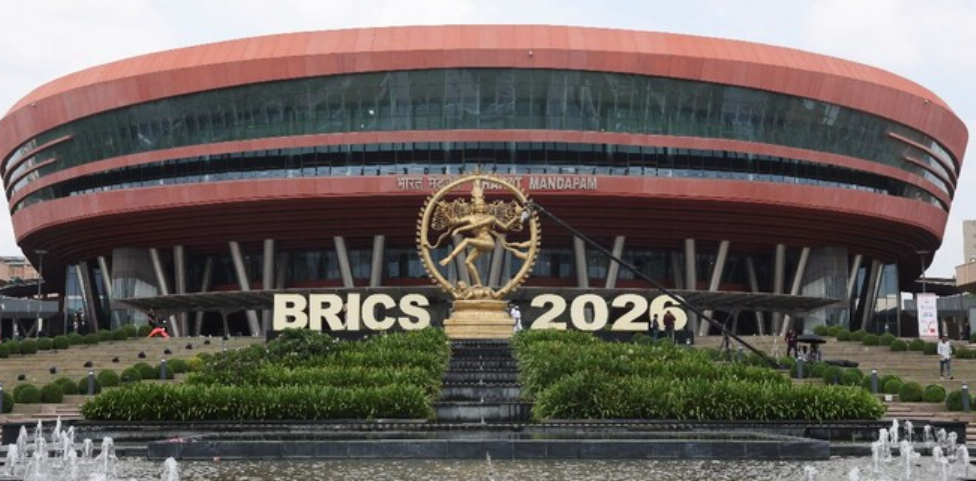
BRICS currency discussions are once again drawing attention as member countries continue exploring ways to increase trade in local currencies, strengthen cross-border payment systems and reduce transaction costs. However, India has clarified that the bloc is not currently considering a proposal to create a common BRICS currency.
Sudhakar Dalela, Secretary (Economic Relations) in India’s Ministry of External Affairs, said on Saturday that there is no proposal for a BRICS currency “as of now.” His remarks came during the 2026 BRICS Summit in New Delhi, where discussions on trade, payments and financial cooperation remain key priorities.
The clarification separates two ideas that are often treated as the same: creating a shared BRICS currency and allowing member countries to settle bilateral trade using their existing national currencies. While the first is not currently under consideration, the second has been discussed within BRICS for some time.
BRICS Currency Proposal Not Currently Under Consideration
Speculation about a possible common BRICS currency has grown in recent years as the economic grouping has expanded and member countries have sought to reduce dependence on the US dollar for international trade.
India, however, has made its position clear at the 2026 summit. According to Dalela, there is currently no proposal within BRICS to establish a shared currency.
This means the bloc’s immediate financial agenda is focused on more practical mechanisms, particularly improving payment connectivity and enabling greater use of national currencies in bilateral transactions.
A common currency would require far deeper economic and monetary coordination among member countries. Local-currency settlement, by comparison, can be implemented through existing financial systems and bilateral arrangements without creating a new monetary institution.
What Is Local-Currency Trade?
Local-currency trade allows two countries to conduct transactions using their own national currencies rather than automatically converting the value of the trade into US dollars.
For example, an Indian company importing goods from another BRICS country could potentially settle the transaction in Indian rupees and the partner country’s currency, depending on the payment arrangement between the two countries.
The approach can reduce the number of currency conversions involved in a transaction. It may also lower certain costs associated with international payments and reduce exposure to fluctuations in the US dollar.
However, local-currency settlement does not mean that the US dollar disappears from global trade. Businesses and financial institutions still need mechanisms to manage exchange rates, liquidity and imbalances between currencies.
India Calls Local-Currency Settlement a Practical Mechanism
India has presented local-currency settlement as a practical way to improve bilateral trade rather than as a complete replacement for the existing global financial system.
Dalela said discussions on local-currency trade settlement have been underway within BRICS for some time and are not a new subject. He also emphasized that such arrangements should complement global payment and settlement systems.
This distinction is important. India’s approach appears to favor gradual improvements to cross-border payments instead of immediately pursuing a major restructuring of the international monetary system.
UPI Could Play a Role in BRICS Payment Connectivity
India has also highlighted its digital payment infrastructure as a potential foundation for deeper payment cooperation among BRICS members and partner countries.
Commerce and Industry Minister Piyush Goyal called on BRICS countries to explore linking their payment systems and increasing trade in local currencies. He specifically highlighted the Unified Payments Interface, or UPI, as an example of India’s digital public infrastructure.
UPI is already accepted in several countries outside India, and greater interoperability between payment systems could make cross-border transactions faster and more convenient.
For BRICS, stronger payment connectivity could eventually become more important than the creation of a common currency because it can address one of the practical problems faced by businesses: the cost and complexity of international payments.
New Delhi Declaration Supports Local-Currency Settlement
The New Delhi Declaration adopted during the 2026 BRICS Summit also recognized ongoing discussions about promoting trade settlements and investments using the local currencies of BRICS countries.
The declaration acknowledged that national priorities differ and that there is no single approach that will necessarily work for every member.
This language reflects the economic diversity of the expanded BRICS group. Its members have different monetary policies, exchange-rate systems, financial markets and levels of economic development.
| Issue | Current BRICS Position |
|---|---|
| Common BRICS currency | No proposal currently under consideration |
| Local-currency trade | Discussions are continuing |
| Cross-border payments | BRICS is exploring stronger cooperation |
| Payment connectivity | India supports linking payment systems |
| US dollar dependence | Reducing reliance is part of wider discussions |
Why the BRICS Currency Debate Matters
The debate over a potential BRICS currency is closely connected to the broader discussion around de-dollarisation.
The US dollar remains the dominant currency in international finance, trade and reserves. A reduction in dollar usage could theoretically give emerging economies greater flexibility in conducting transactions without relying as heavily on US financial infrastructure.
For BRICS countries, increased use of local currencies could also reduce some risks associated with sudden movements in the dollar exchange rate.
At the same time, replacing the dollar on a large scale would be extremely complicated. A currency used globally needs deep financial markets, substantial liquidity, broad investor confidence and institutions capable of supporting international transactions.
That is why local-currency settlement is a more immediate and achievable objective than creating a new BRICS-wide currency.
Why a Common BRICS Currency Would Be Difficult
A common currency would require countries with very different economies and monetary policies to coordinate closely.
BRICS members include major commodity exporters, manufacturing economies, large consumer markets and countries facing very different inflation, interest-rate and exchange-rate conditions.
A shared currency would therefore raise difficult questions about who would control monetary policy, how exchange rates would be managed and how countries would respond to economic shocks affecting individual members.
There would also need to be a highly developed financial infrastructure supporting the currency, including clearing systems, liquidity arrangements and mechanisms for resolving payment disputes.
By comparison, increasing bilateral settlements in national currencies allows countries to cooperate without surrendering control over their own monetary policies.
US Concerns Over BRICS De-Dollarisation
The possibility of BRICS countries creating a currency that could challenge the dollar has attracted considerable attention in Washington.
Former US President Donald Trump had previously warned BRICS countries against creating a common currency or supporting another currency as an alternative to the US dollar. He threatened the possibility of very high tariffs against countries that pursued such a move.
The latest Indian clarification is therefore significant because it indicates that the bloc’s current agenda is not centered on launching a shared currency.
Instead, BRICS appears to be focusing on incremental changes to how its members conduct trade and payments.
BRICS Has Become a Much Larger Economic Group
The financial discussion has gained greater importance because BRICS has expanded substantially since its original formation.
The grouping originally consisted of Brazil, Russia, India, China and South Africa. Its membership later expanded to include Egypt, Ethiopia, Iran, the United Arab Emirates and Saudi Arabia, with Indonesia joining in 2025.
Several additional countries have also become BRICS partner countries, broadening the bloc’s economic and diplomatic reach.
The expanded membership gives BRICS greater collective economic weight but also makes agreement on complicated financial issues more challenging.
Different Economies, Different Priorities
BRICS members do not share identical economic interests. Some are major energy exporters, while others are large importers. Some have highly developed financial systems, while others have smaller capital markets.
These differences make a single monetary framework difficult to implement. They also explain why the bloc’s declaration emphasizes national priorities and rejects a one-size-fits-all approach.
Local Currencies Could Reduce Some Trade Costs
One of the strongest arguments for local-currency settlement is the potential reduction in transaction costs.
Traditional international trade often involves currency conversion through major global currencies. Each additional conversion can introduce fees, exchange-rate risks and settlement complexity.
If businesses can directly settle more transactions using national currencies, some of these costs could potentially be reduced.
However, the success of local-currency trade depends heavily on liquidity. If businesses receive a currency that they do not need for their own operations, they still require a reliable market in which to convert or use that currency.
Payment Systems May Be More Important Than a BRICS Currency
The most practical development emerging from the current BRICS discussions may therefore be payment-system interoperability rather than a new currency.
Connecting national payment networks could make it easier for businesses and consumers to transfer money across borders while reducing dependence on traditional correspondent banking arrangements.
India’s UPI model demonstrates how digital payment infrastructure can support large-scale domestic transactions. Extending interoperability internationally, however, requires agreements on technical standards, data security, foreign-exchange settlement, regulation and consumer protection.
If BRICS can make meaningful progress on these areas, the bloc could gradually create a more integrated financial ecosystem without launching a common currency.
What BRICS Members Will Need to Solve
- Currency liquidity: Businesses need accessible markets for converting and using local currencies.
- Payment interoperability: National payment systems must communicate efficiently across borders.
- Exchange-rate risk: Companies need tools to manage currency fluctuations.
- Regulatory coordination: Financial rules and compliance requirements differ between countries.
- Trade imbalances: Countries must determine how persistent surpluses and deficits will be settled.
- Trust and infrastructure: Cross-border systems require strong security, transparency and institutional cooperation.
BRICS Currency: What to Watch Next
The most important developments will likely come from practical financial cooperation rather than announcements of a new common currency.
Markets and businesses will be watching for progress on linking payment systems, increasing local-currency settlements and improving cross-border financial infrastructure.
India’s position also suggests that BRICS may continue pursuing a gradual approach. Instead of attempting to replace the dollar overnight, members can expand the use of their own currencies wherever bilateral trade conditions make it commercially viable.
Conclusion: BRICS Pushes Local Currencies Without a Common Currency Plan
The latest BRICS discussions provide an important clarification: there is currently no proposal for a common BRICS currency. Instead, the bloc is continuing to explore local-currency trade settlements, stronger payment connectivity and lower transaction costs.
India’s emphasis on practical cooperation reflects the significant challenges involved in creating a shared currency among economies with different monetary systems and priorities. Local-currency settlement offers a more gradual route toward reducing dependence on the US dollar while allowing individual countries to retain control over their currencies.
For now, the BRICS financial agenda is therefore less about launching a new currency and more about building the infrastructure that could make cross-border trade in national currencies easier. If payment systems become more connected and local-currency markets become deeper, BRICS could gradually reduce some of the costs associated with dollar-based trade without needing a single shared currency.
For breaking news and live news updates, like us on Facebook or follow us on Twitter and Instagram. Read more on Latest Business on thefoxdaily.com.






COMMENTS 0