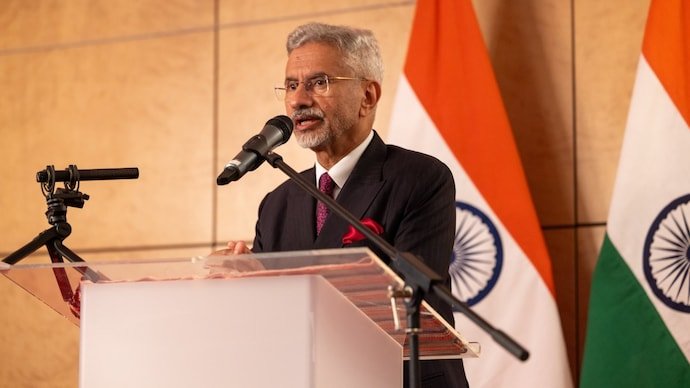
External Affairs Minister S Jaishankar held wide-ranging talks with Russian Foreign Minister Sergey Lavrov in Moscow on Tuesday, with the two sides reviewing bilateral cooperation as well as major international issues including Ukraine, Iran and Afghanistan.
The meeting came during Jaishankar’s two-day visit to Russia and ahead of Russian President Vladimir Putin’s expected trip to New Delhi for the BRICS leaders’ summit on September 12-13. The timing gives the talks added importance as India and Russia seek to maintain close strategic engagement while expanding economic cooperation and coordinating positions in major multilateral forums.
Jaishankar described his meeting with Lavrov as a “wide-ranging conversation”, saying the discussions covered bilateral cooperation, regional hotspots, global challenges and multilateral issues.
Russian state news agency TASS, citing the Russian Foreign Ministry, reported that the two foreign ministers coordinated their approaches to developments involving Ukraine, Iran and Afghanistan. They also discussed cooperation through organisations including the United Nations, Shanghai Cooperation Organisation, BRICS and the Group of Twenty.
Ukraine, Iran and Afghanistan feature in India-Russia talks
The inclusion of several major regional flashpoints underlines the breadth of the India-Russia relationship.
The Ukraine conflict remains one of the most important issues affecting the international system and has had wider consequences for energy markets, trade, Food security and relations between Russia and Western countries.
India has maintained its own diplomatic position on the conflict while continuing its engagement with Moscow and emphasising dialogue and diplomacy as the preferred route to resolving disputes. Russia, meanwhile, remains deeply involved in the conflict and continues to face extensive international pressure.
Iran was another important subject of discussion. Developments in West Asia have implications for regional security, energy supplies and global diplomacy, making the issue relevant to both India and Russia.
Afghanistan also remains a significant regional concern. Political stability, security and developments in the country affect the wider security environment across Central and South Asia.
By discussing all three issues, India and Russia were able to use their bilateral diplomatic channel to exchange views on developments extending well beyond their immediate relationship.
India and Russia want closer coordination in BRICS
The Moscow discussions also focused on multilateral cooperation, particularly through BRICS, the Shanghai Cooperation Organisation and the United Nations.
Russia and India have long worked together in several international forums, although their priorities do not always coincide on every issue. Regular consultations allow the two countries to identify areas where their positions overlap and coordinate when they share common interests.
The upcoming BRICS summit in New Delhi provides a particularly important setting for that coordination.
With Putin expected to visit India for the September summit, Jaishankar’s Moscow meetings can help prepare the ground for discussions between the two countries’ leaderships. A summit-level meeting would provide an opportunity to review both bilateral priorities and major international developments.
TASS reported that the two sides reaffirmed their commitment to close coordination within the United Nations, SCO, BRICS and G20. The Russian Foreign Ministry also said the ministers agreed to strengthen trust-based dialogue at all levels.
Economic ties are becoming a bigger part of the relationship
While security and geopolitical issues remain central to India-Russia relations, economic cooperation was another major theme of Jaishankar’s Moscow visit.
Before meeting Lavrov, Jaishankar called on President Vladimir Putin. Their discussions included bilateral economic ties, with particular attention to trade, energy, fertilisers and nuclear cooperation.
Jaishankar also co-chaired a meeting of the India-Russia Inter-Governmental Commission on Trade, Economic, Scientific, Technological and Cultural Cooperation with Russian First Deputy Prime Minister Denis Manturov.
The focus on economic issues reflects an effort by both countries to broaden their relationship beyond traditional defence cooperation.
Trade and energy have become particularly important areas of India-Russia engagement. Fertilisers are also strategically relevant to India because agricultural production depends heavily on reliable access to key inputs.
Nuclear cooperation, meanwhile, represents a longer-term component of the relationship and involves highly strategic infrastructure and energy interests.
Why the Putin meeting matters
Jaishankar’s meeting with Putin gave the visit a direct leadership-level dimension.
Foreign ministers routinely handle diplomatic coordination, but discussions between a senior Indian minister and the Russian president can help establish priorities for the broader relationship and prepare the ground for future high-level meetings.
The expected Putin visit to New Delhi makes the timing particularly relevant. The BRICS summit will bring together leaders from major emerging economies, giving India and Russia an opportunity to discuss bilateral issues alongside wider questions about global governance and international cooperation.
The economic agenda discussed during Jaishankar’s meeting with Putin is also likely to remain relevant at the leadership level. Trade, energy, fertilisers and nuclear cooperation are areas where both countries have concrete interests rather than purely diplomatic objectives.
India-Russia relations extend beyond traditional strategic cooperation
India and Russia have maintained a longstanding strategic relationship, with defence cooperation historically serving as one of its most visible pillars.
However, the Moscow discussions demonstrate that the relationship has a much wider agenda. Energy, trade, fertilisers, nuclear cooperation, science and technology and multilateral coordination are increasingly important parts of the engagement.
The expansion of economic ties is especially significant because geopolitical changes have reshaped international trade and supply chains.
India has sought to maintain stable relations with Russia while simultaneously expanding its partnerships with the United States, Europe, Japan and other countries. That requires New Delhi to manage multiple relationships without allowing one partnership to determine all aspects of its foreign policy.
Russia, for its part, continues to view India as an important partner in Asia and within multilateral groupings. Maintaining regular political dialogue helps both countries preserve a degree of strategic flexibility in a changing international environment.
The Ukraine issue creates a delicate diplomatic balance
Ukraine remains one of the more sensitive subjects in India-Russia discussions.
India’s relationship with Russia has continued despite the war, but New Delhi has also maintained its own independent position on the conflict. India has repeatedly advocated dialogue and diplomacy while keeping communication open with all major parties.
For Moscow, India’s continued engagement is important at a time when Russia faces substantial pressure from Western countries.
For New Delhi, maintaining communication with Moscow provides an additional diplomatic channel and protects longstanding bilateral interests, particularly in areas such as energy and defence.
The Jaishankar-Lavrov discussions therefore have significance beyond simply exchanging assessments of the war. They allow India to communicate its concerns directly while maintaining a broader relationship that includes areas where cooperation continues.
Why Iran is important to both India and Russia
Iran’s inclusion in the talks also reflects the wider geopolitical importance of West Asia.
India has substantial interests in the region, including energy security, trade connectivity and the safety of its citizens and commercial interests. Russia is also an important regional actor and maintains close relations with Iran.
Developments involving Iran can affect energy prices, shipping routes and regional security well beyond the Middle East. That makes coordination and information exchange between India and Russia particularly relevant when tensions rise.
The discussions did not indicate that India and Russia had adopted identical positions on every aspect of the issue. Rather, the talks provided a forum for the two governments to coordinate approaches and discuss developments affecting their respective interests.
Afghanistan remains a shared regional concern
Afghanistan is another issue where geography makes developments particularly important to India and Russia.
Instability in Afghanistan can have implications for terrorism, narcotics trafficking, migration and wider security conditions across the region. Both countries therefore have an interest in monitoring developments and maintaining diplomatic channels on the issue.
Discussion of Afghanistan alongside Iran and Ukraine shows how the India-Russia relationship increasingly functions as a platform for consultations on several regional security questions rather than focusing exclusively on bilateral matters.
What the Moscow talks mean for the upcoming BRICS summit
The timing of Jaishankar’s visit makes the BRICS summit an important backdrop to the current diplomatic activity.
India will host the BRICS leaders’ meeting in New Delhi on September 12-13, bringing together leaders of a group that has become increasingly significant in discussions about global economic governance and the developing international order.
Russia’s participation is important to Moscow and New Delhi alike. For India, the summit provides an opportunity to strengthen its role as a convening power while balancing the interests of multiple major economies. For Russia, BRICS remains an important platform for maintaining international partnerships and promoting cooperation outside traditional Western-led institutions.
Jaishankar’s consultations in Moscow therefore serve both bilateral and multilateral purposes. They allow India to discuss immediate bilateral priorities while also preparing for broader conversations likely to take place during the summit.
What could come next in India-Russia relations?
The next major milestone will be the expected visit of President Putin to New Delhi for the BRICS summit. A meeting between the Indian and Russian leaderships could provide an opportunity to review progress on the economic agenda discussed during Jaishankar’s visit.
Trade, energy, fertilisers and nuclear cooperation are likely to remain important because they involve tangible economic and strategic interests. Continued dialogue on Ukraine, Iran and Afghanistan could also help the two governments understand where their positions converge and where they differ.
The broader challenge for India will be maintaining its strategic autonomy while managing relationships with Russia, the United States, Europe and other major powers at a time of significant geopolitical competition.
For Russia, maintaining strong ties with India offers an important Asian partnership and a channel for economic and diplomatic engagement.
Jaishankar-Lavrov meeting underlines depth of India-Russia engagement
Jaishankar’s Moscow visit has brought together the main strands of the contemporary India-Russia relationship: bilateral economic cooperation, strategic dialogue, regional security and coordination in multilateral organisations.
The talks with Lavrov covered Ukraine, Iran, Afghanistan and wider global challenges, while Jaishankar’s discussions with Putin and Russian officials focused on strengthening practical economic ties.
The immediate outcome is less about a single breakthrough than about maintaining a broad diplomatic channel at a time when the international environment remains unsettled.
With the BRICS summit approaching in New Delhi and Putin’s expected visit on the horizon, the Moscow discussions provide an important foundation for the next stage of India-Russia engagement. The priority for both countries will be to convert political understanding into deeper economic cooperation while continuing to coordinate where their interests overlap on major global and regional issues.
For breaking news and live news updates, like us on Facebook or follow us on Twitter and Instagram. Read more on Latest World on thefoxdaily.com.




COMMENTS 0