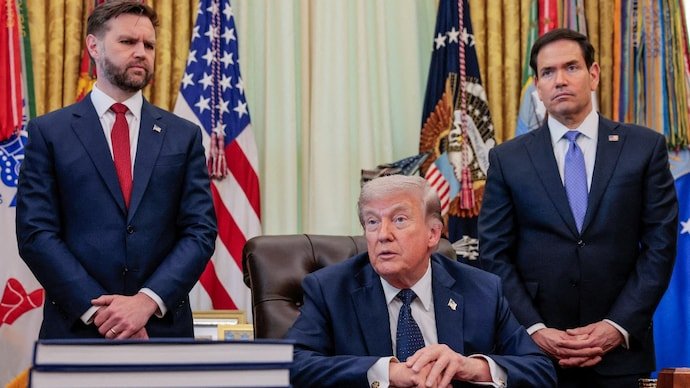
The Trump administration has projected confidence that its latest diplomatic efforts with Iran could reduce tensions after months of military confrontation. Publicly, senior officials insist there is complete unity behind President Donald Trump‘s strategy. Yet as Vice President JD Vance and Secretary of State Marco Rubio traveled across Europe and the Middle East defending Washington’s approach, their messaging highlighted noticeably different priorities.
Vance emphasized Diplomacy, long-term stability and economic engagement. Rubio focused on deterrence, military strength and reassuring America’s traditional allies in the Gulf and Israel. While both support preventing Iran from acquiring nuclear weapons, the way they describe achieving that goal reflects two distinct schools of conservative foreign policy.
The contrast has generated discussion far beyond the immediate Iran negotiations because both leaders are widely viewed as potential Republican presidential candidates in 2028. Their comments therefore offer an early glimpse into what the Republican Party‘s foreign Policy Debate could look like after the Trump era.
Understanding the Search Intent
People searching for this topic are not simply looking for quotes from JD Vance or Marco Rubio. They want to understand:
- Why their statements appear different.
- Whether divisions exist inside Trump’s administration.
- How these differences affect negotiations with Iran.
- What the contrasting approaches mean for Israel and Gulf allies.
- Whether this signals an early contest for Republican leadership after Trump.
Why the Iran Negotiations Matter Globally
Iran remains one of the world’s most strategically important countries. It sits along vital energy routes, influences conflicts across Iraq, Syria, Lebanon and Yemen, and occupies a central position in global discussions over nuclear proliferation.
Any shift in US-Iran Relations affects oil markets, regional security, international shipping through the Strait of Hormuz, Sanctions policy and diplomatic relations across the Middle East.
That is why every statement made by senior US officials receives close scrutiny from allies, adversaries and financial markets alike.
The Same Goal, Different Language
Neither JD Vance nor Marco Rubio has questioned President Trump’s stated objective of ensuring Iran never develops a nuclear weapon.
Where they differ is in how they believe lasting stability should be achieved.
Vance has consistently framed diplomacy as a practical tool rather than a concession. During meetings in Europe, he portrayed negotiations as an opportunity to gradually reduce decades of hostility while encouraging regional economic cooperation.
Rubio, meanwhile, has approached the issue from a security-first perspective. His speeches have stressed deterrence, military preparedness and maintaining pressure until Iran demonstrates lasting compliance with any future agreement.
These differences are subtle but politically significant.
JD Vance Represents a New Republican Foreign Policy
Before becoming Vice President, JD Vance frequently questioned America’s long military engagements overseas.
His political philosophy argues that Washington should avoid costly interventions unless they directly advance core American interests.
This approach has several defining characteristics:
- Greater reliance on diplomacy.
- Reduced appetite for prolonged military involvement.
- Economic engagement where possible.
- Burden-sharing with regional partners.
- Focus on domestic priorities alongside national security.
His comments regarding Iran reflect this broader worldview.
Rather than portraying diplomacy as weakness, Vance argues that successful negotiations backed by military strength can produce more sustainable outcomes than endless confrontation.
Marco Rubio Embodies Traditional Republican Hawkishness
Marco Rubio’s foreign policy career has been built around a more interventionist philosophy.
Throughout his years in the Senate, he consistently supported strong sanctions, military readiness and robust alliances with democratic partners.
His position on Iran follows that same pattern.
Rubio believes diplomacy should occur only from a position of overwhelming leverage. His repeated emphasis on protecting Israel and reassuring Gulf allies reflects decades of Republican foreign policy thinking that prioritizes deterrence above accommodation.
For Rubio, negotiations are acceptable but only if they strengthen America’s strategic position.
Israel Highlights the Biggest Difference
The sharpest contrast between the two officials emerged over Israel’s military operations in Lebanon.
JD Vance publicly warned that attacks on civilian infrastructure risked undermining wider regional diplomacy.
Marco Rubio instead defended Israel’s actions as legitimate responses to ongoing security threats.
This distinction matters because it illustrates how each leader balances military necessity with diplomatic objectives.
Neither questioned America’s alliance with Israel, but they differed in their emphasis.
Historical Context: Republican Foreign Policy Has Never Been Monolithic
The current debate is not unprecedented.
For decades, Republican administrations have contained multiple foreign policy traditions operating simultaneously.
| Foreign Policy School | Core Philosophy | Representative Approach |
|---|---|---|
| Traditional Hawkish | Military strength and deterrence | Pressure adversaries through sanctions and alliances |
| America First | Avoid prolonged foreign conflicts | Prioritize domestic interests while maintaining strong defence |
| Pragmatic Conservative | Combine diplomacy with strategic leverage | Negotiation backed by military capability |
Many analysts believe Vance and Rubio now represent two evolving branches of these traditions.
Why Gulf Countries Are Watching Closely
The Gulf states have welcomed stronger US engagement but remain cautious about any agreement that could increase Iran’s regional influence.
Countries such as Saudi Arabia, the United Arab Emirates, Bahrain and Kuwait have spent years strengthening their defence cooperation with Washington.
Rubio’s messaging directly addressed these concerns by emphasizing America’s continued security commitments.
Vance, meanwhile, sought to reassure partners that diplomacy could reduce long-term instability without sacrificing regional security.
Each message was tailored to a different audience.
The White House Says There Is No Division
Administration officials have firmly rejected suggestions of internal disagreement.
The White House maintains that all senior officials are executing President Trump’s strategy rather than pursuing competing agendas.
That explanation is plausible.
Large administrations often deploy different officials to emphasize different aspects of the same policy depending on the audience they are addressing.
Diplomatic flexibility should not automatically be interpreted as policy conflict.
Why Markets Care About the Tone of Diplomacy
Financial markets closely monitor developments involving Iran because of their direct impact on global energy supplies.
Optimistic diplomatic messaging often reduces fears of supply disruptions, helping stabilize oil prices.
Conversely, more confrontational rhetoric can increase uncertainty, particularly if investors believe military escalation is becoming more likely.
This explains why speeches by senior US officials often receive as much attention from investors as they do from diplomats.
Could This Shape the 2028 Republican Primary?
Although the next presidential election remains years away, political observers are already examining how leading Republican figures distinguish themselves.
Foreign policy frequently becomes an important test of leadership during presidential campaigns.
If JD Vance and Marco Rubio eventually compete for the Republican nomination, their current messaging on Iran could become part of a much broader debate over America’s role in the world.
Voters may ultimately face a choice between:
- A more restrained, diplomacy-focused conservative foreign policy.
- A traditional security-first approach emphasizing deterrence and military strength.
Both approaches exist comfortably within today’s Republican coalition.
What This Means for US-Iran Relations
The success of the current negotiations will depend less on rhetorical differences and more on whether both governments can agree on practical issues such as sanctions, nuclear oversight, regional security and verification mechanisms.
Even if negotiations succeed, implementation is likely to remain challenging because decades of mistrust cannot disappear overnight.
Conversely, failure could return both countries to a cycle of sanctions, military pressure and proxy confrontation.
Expert Insight: Different Voices Can Strengthen Diplomacy
One overlooked aspect of modern diplomacy is that governments sometimes benefit from allowing different officials to communicate with different audiences.
An optimistic message may encourage negotiations, while a tougher message reassures nervous allies that core security commitments remain unchanged.
Seen through that lens, the contrasting statements from Vance and Rubio may represent strategic communication rather than genuine policy disagreement.
The ultimate measure will not be their rhetoric but the final shape of any agreement with Iran.
Future Outlook
Negotiations with Iran remain fluid, and much will depend on whether both sides can translate preliminary understandings into a durable framework.
Inside Washington, JD Vance and Marco Rubio are likely to remain influential voices shaping America’s Middle East policy. Their contrasting styles may continue to generate headlines, but both remain committed to the administration’s central objective of preventing Iran from acquiring nuclear weapons.
Looking beyond the immediate negotiations, their differing approaches could also foreshadow the broader foreign policy debate that will define the Republican Party after Donald Trump. Whether the future belongs to diplomacy-first conservatives or traditional hawks may become one of the defining political questions leading into the 2028 presidential race.
Conclusion
The apparent contrast between JD Vance’s optimistic diplomacy and Marco Rubio’s more assertive security-focused messaging has sparked discussion about the future direction of American foreign policy. While the White House insists both officials are fully aligned behind President Trump’s strategy, their public remarks reflect two long-standing conservative traditions that prioritize different paths toward the same objective.
For now, the administration continues to present a united front on preventing Iran from developing nuclear weapons. Yet as negotiations evolve and the political landscape shifts toward the post-Trump era, the differing styles of Vance and Rubio may become increasingly important not only for US diplomacy in the Middle East but also for the future leadership of the Republican Party.
For breaking news and live news updates, like us on Facebook or follow us on Twitter and Instagram. Read more on Latest World on thefoxdaily.com.





COMMENTS 0