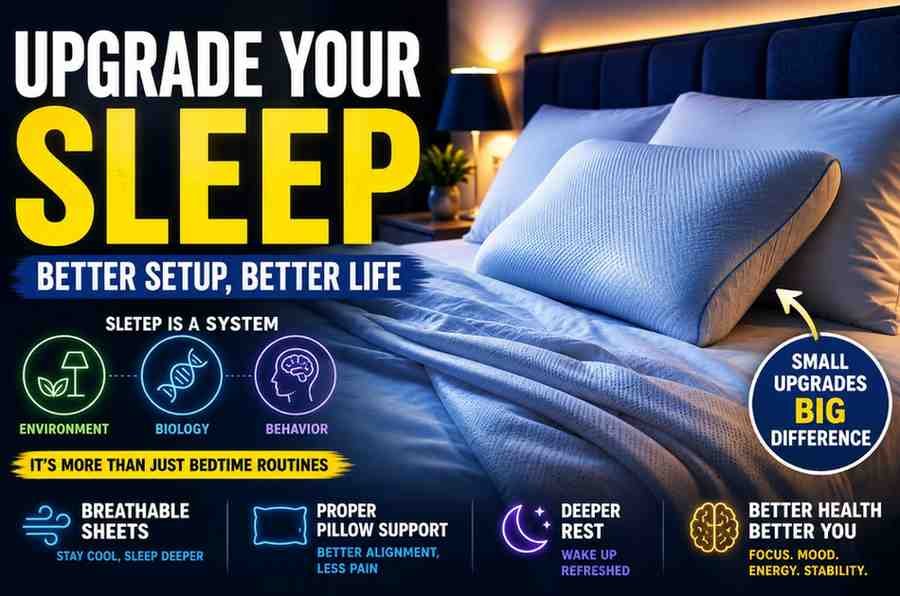
What if your bad sleep isn’t about stress or your phone but your bed itself? Most people focus on bedtime routines, caffeine intake, or screen time. But what happens after you lie down is just as critical. Your mattress, pillow, sheets, sleep position, and even room environment quietly determine whether you wake up refreshed or exhausted.
Who is this guide for? Anyone struggling with sleep quality, fatigue, or discomfort at night. What does it cover? The science and strategy behind optimizing your sleep environment. When does it matter? Every single night. Where? In your bedroom—the most underrated performance space in your life. Why does it matter? Because sleep directly impacts your brain, heart, metabolism, and emotional health. How can you improve it? By mastering the fundamentals of “bed basics.”
This is not just a list of tips—it’s a complete system to upgrade your sleep quality.
Why Your Bed Setup Matters More Than You Think
Sleep is not passive. Your brain cycles through multiple stages, your body repairs tissues, regulates hormones, and consolidates memory. If your sleep environment is uncomfortable or misaligned, your body cannot perform these functions efficiently.
Think of your bed as a tool. A poor tool produces poor results—no matter how hard you try.
Choosing the Right Mattress: The Foundation of Good Sleep
There is no universal “best mattress.” The right choice depends on your body type, sleep position, and health conditions.
Key Principle
Your mattress should be firm enough to support your spine but soft enough to adapt to your body.
Types of Mattresses Explained
| Type | Best For | Watch Out For |
|---|---|---|
| Innerspring | Traditional feel, budget-friendly | Coil quality matters more than count |
| Memory Foam | Joint pain, body contouring | Can trap heat |
| Air Mattress (Adjustable) | Custom firmness, couples | Mechanical reliability |
Pro Insight: The biggest mistake people make is choosing based on marketing instead of comfort. Testing a mattress for several nights is far more valuable than reading specs.
Sheets and Fabrics: The Hidden Temperature Controllers
Your body temperature naturally drops during sleep. If your bedding traps heat, your sleep gets disrupted even if you don’t fully wake up.
- Ideal thread count: 200 400 for breathability
- Best materials: Cotton and linen
- Avoid: Heavy synthetic blends that trap heat
Simple rule: If you wake up sweaty, your sheets—not your sleep—are the problem.
Clean Sheets, Better Sleep: Psychology Meets Hygiene
Fresh sheets do more than feel good—they influence your brain. A clean, organized bed signals relaxation and comfort.
Washing your sheets weekly:
- Removes sweat, oils, and allergens
- Improves skin health
- Enhances sleep comfort
Unexpected insight: Cleanliness creates a subconscious sense of control, which reduces anxiety at bedtime.
The Right Pillow: Small Change, Big Impact
A poor pillow can silently ruin your sleep by misaligning your neck and spine.
A good pillow should:
- Support your neck alignment
- Match your sleep position
- Maintain its shape over time
If your pillow doesn’t bounce back when folded, it’s time to replace it.
Sleep Positions: What Your Body Actually Needs
Side Sleeping (Best Overall)
- Reduces snoring
- Supports spine alignment
- Improves long duration sleep
Back Sleeping
- Neutral spine position
- May worsen snoring
- Can contribute to breathing issues
Stomach Sleeping
- Least recommended
- Strains neck and lower back
Pro Tip: Add a pillow between your legs (side sleeping) or under your knees (back sleeping) to improve spinal alignment.
White Noise: The Underrated Sleep Hack
Your brain remains partially alert during sleep, scanning for disturbances. Sudden sounds like doors or conversations can disrupt your sleep cycles.
White noise works by masking these disruptions.
- Fan or air conditioner
- Rain sounds
- White noise apps
Consistency is key—the brain relaxes when sound patterns are predictable.
The Science of Sleep Cycles (Why Sleep Quality Beats Quantity)
Sleep is divided into two main types:
Non-REM Sleep
- Deep physical recovery
- Slower brain activity
- Memory consolidation
REM Sleep
- Dreaming stage
- High brain activity
- Emotional processing
You cycle through these stages 3–5 times per night. Disruptions like noise, discomfort, or poor bedding interrupt these cycles, reducing sleep quality even if you spend enough time in bed.
Temperature: The Silent Sleep Killer
Your body temperature drops before sleep. If your room is too warm, this natural process gets blocked.
Ideal sleep environment:
- Cool room temperature
- Breathable bedding
- Light sleepwear
Counterintuitive tip: Wearing light socks can actually help some people fall asleep faster by improving circulation.
What You Wear to Bed Matters
Clothing affects temperature regulation and comfort.
- Cotton: Breathable and soft
- Flannel: Warm but not summer friendly
- Silk: Comfortable but high maintenance
Loose-fitting clothes generally promote better sleep than tight ones.
The Psychology of “Making Your Bed”
This might sound trivial, but making your bed can improve sleep quality. Why? Because it creates a sense of order.
Your brain associates your bed with rest not chaos.
Small habit, big impact.
Comparison: Poor Sleep Setup vs Optimized Sleep Setup
| Poor Sleep Setup | Optimized Sleep Setup |
|---|---|
| Uncomfortable mattress | Body supportive mattress |
| Heat-trapping sheets | Breathable fabrics |
| Wrong pillow | Aligned neck support |
| Noise disruptions | White noise consistency |
| Irregular comfort | Predictable relaxation |
Unique Insight: Sleep Is a System, Not a Single Habit
Most people try to fix sleep with one change like reducing screen time. But sleep quality is the result of multiple factors working together.
Think of it as a system:
- Environment (bed, room, noise)
- Biology (sleep cycles, temperature)
- Behavior (routine, habits)
If one part fails, the system underperforms.
Real-World Impact: Why Better Sleep Changes Everything
Improving your sleep doesn’t just make you less tired—it transforms your life.
- Better focus and productivity
- Improved mood and emotional stability
- Stronger immune system
- Lower risk of chronic diseases
Sleep is not a luxury it’s a biological necessity.
Future Insight: The Rise of “Sleep Optimization”
We are entering an era where sleep is treated like fitness. People are investing in:
- Smart mattresses
- Sleep tracking devices
- Optimized bedroom environments
The future of health is not just about diet and exercise it’s about how well you sleep.
Conclusion: Build a Bed That Works for You
Getting better sleep is not about one magic trick. It’s about aligning your environment with your body’s natural needs.
From choosing the right mattress to understanding sleep cycles, every detail matters.
The takeaway is simple: If you want better days, start with better nights.
Because the quality of your sleep quietly shapes the quality of your life.
For breaking news and live news updates, like us on Facebook or follow us on Twitter and Instagram. Read more on Latest Health on thefoxdaily.com.






COMMENTS 0