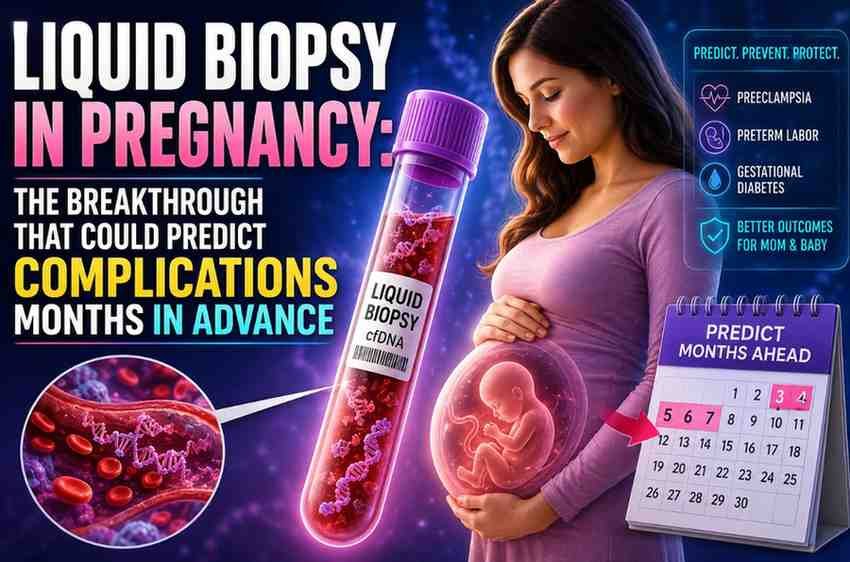
Every year, roughly 15 million babies are born prematurely. Preeclampsia a dangerous high blood pressure disorder of pregnancy kills an estimated 46,000 mothers and 500,000 newborns annually. Gestational diabetes affects one in six pregnancies globally. And yet for most of these life threatening conditions, medicine has historically operated on a frustrating delay: doctors diagnose the problem only after symptoms appear, by which point the damage to mother and baby has already begun.
That could be about to change. A rapidly maturing technology called liquid biopsy already transforming early cancer detection is now being applied to pregnancy monitoring with remarkable results. By analyzing tiny fragments of DNA, RNA, and other biological signals shed into a mother’s bloodstream, scientists are developing tests that can predict preeclampsia, preterm birth, fetal growth restriction, and gestational diabetes months before any clinical sign emerges. The implications for maternal health are enormous and the science is advancing faster than most people realize.
What Is Liquid Biopsy, and Why Does It Matter for Pregnancy?
The term “liquid biopsy” refers to the analysis of biological markers circulating freely in body fluids most commonly blood without the need for invasive procedures like tissue sampling, amniocentesis, or surgery. The technique was originally developed to detect and monitor cancer, but the underlying biology makes it exceptionally well suited to pregnancy monitoring as well.
During pregnancy, the placenta continuously sheds genetic material into the mother’s bloodstream. This creates a remarkable, real time biological window: cell-free DNA (cfDNA) from both mother and fetus, cell free RNA (cfRNA) reflecting active gene expression in the placenta, and tiny molecular packets called extracellular vesicles (EVs) or exosomes carrying proteins, lipids, and signaling molecules. Together, these biomarkers function as a running molecular commentary on how the pregnancy is progressing and when something is going wrong, they change in detectable ways, often weeks or months before symptoms arise.
Traditional prenatal diagnostics such as amniocentesis and chorionic villus sampling (CVS) carry a small but real risk of miscarriage approximately 1 in 100 to 1 in 769 depending on timing and technique and are typically used only when high risk is already suspected. Liquid biopsy, by contrast, requires only a standard blood draw, carries no procedural risk to the fetus, and can in theory be performed as early as the first trimester.
The Three Pillars of Pregnancy Liquid Biopsy: cfDNA, cfRNA, and Extracellular Vesicles
Understanding the different components of liquid biopsy helps explain why researchers are so excited about its potential across several different pregnancy complications simultaneously.
Cell Free DNA (cfDNA)
This is the most clinically established component. Non-invasive prenatal testing (NIPT) already widely used to screen for chromosomal abnormalities like Down syndrome (trisomy 21), Edwards syndrome (trisomy 18), and Patau syndrome (trisomy 13) is itself a form of liquid biopsy that measures cell free fetal DNA in maternal blood. NIPT has demonstrated high sensitivity and specificity for detecting these conditions, and its clinical adoption over the past decade has validated the broader liquid biopsy platform in obstetrics.
More recently, researchers have pushed cfDNA analysis beyond chromosomal screening. A landmark 2025 study published in Nature Medicine developed a computational framework called PEARL (Preeclampsia Early Assessment of Risk from Liquid Biopsy), which analyzes the tissue specific nucleosome profiles embedded in cfDNA sequences. The key finding: women who later developed preeclampsia showed measurable signs of early placental dysfunction and endothelial damage in their cfDNA captured from blood samples taken at just 12 weeks of gestation, months before any clinical symptom appeared. The model achieved 81% sensitivity at 80% specificity for preterm preeclampsia, with external validation confirming 79% sensitivity a performance level that approaches clinical utility.
Cell-Free RNA (cfRNA)
While cfDNA tells you what the genome looks like, cfRNA tells you what it is doing which genes are actively switched on or off at any given moment. This makes it a far more dynamic and real-time reporter of placental health.
A landmark study published in Nature analyzed blood samples from 199 pregnant mothers and identified a panel of 18 genes whose expression patterns, measurable between 5 and 16 weeks of gestation, could predict preeclampsia long before onset. The researchers found that cfRNA changes between normotensive and preeclamptic mothers were marked and stable early in pregnancy, with enrichment in genes specific to neuromuscular, endothelial, and immune tissues precisely the systems implicated in preeclampsia’s pathology.
Expanding on this, researchers at the Carlos Simón Foundation and biotech company iPremom in Spain demonstrated in 2025 that a cfRNA liquid biopsy test could predict both early onset and late-onset preeclampsia five months before clinical diagnosis. Using AI assisted analysis of cfRNA sequencing data, the team identified specific molecular “signatures” in first trimester blood samples that flagged high risk pregnancies with significant accuracy. With regulatory validation reportedly underway, this test could enter clinical practice in the near future offering a genuinely unprecedented opportunity to intervene prophylactically, for instance with low-dose aspirin, which is known to reduce preeclampsia risk when started early in pregnancy.
Extracellular Vesicles (EVs) and Exosomes
Extracellular vesicles are nano sized membrane-bound packets secreted by virtually every cell type. During pregnancy, the placenta releases enormous numbers of EVs and their molecular cargo reflects placental stress, immune signaling, and metabolic status in real time. Research has linked altered EV profiles to preeclampsia, preterm labor, fetal growth restriction, and gestational diabetes.
In gestational diabetes specifically, maternal blood has been shown to contain elevated concentrations of EVs carrying pro-inflammatory molecules including TNF-α, IL-6, and CRP markers of the systemic inflammation and insulin resistance that underlie the condition. Meanwhile, studies of preterm birth have found characteristic changes in EV profiles detectable well before labor begins, including work showing that exosomal microRNAs from vaginal discharge could serve as non-invasive biomarkers for preterm labor prediction.
Key Pregnancy Complications That Liquid Biopsy Could Transform
| Condition | Global Impact | Current Detection | Liquid Biopsy Potential |
|---|---|---|---|
| Preeclampsia | 2–8% of pregnancies; 46,000 maternal deaths/year | After 20 weeks, symptom-based | cfDNA/cfRNA prediction as early as 5–16 weeks |
| Preterm Birth | ~15 million cases/year globally | Cervical length, clinical signs | EV and exosomal miRNA profiling in blood/vaginal fluid |
| Fetal Growth Restriction (FGR) | Affects ~10% of pregnancies | Ultrasound (late detection) | cfDNA placental dysfunction signatures |
| Gestational Diabetes (GDM) | 1 in 6 pregnancies globally | Glucose tolerance test at 24–28 weeks | EV cargo analysis; potential first trimester screening |
| Chromosomal Abnormalities | ~1 in 150 births | NIPT (already clinical) | Already deployed the proof-of-concept for the field |
Why the Placenta Is the Key Organ and Why It’s Been So Hard to Study
One underappreciated reason liquid biopsy is so valuable in obstetrics is that the placenta the organ mediating almost all pregnancy complications is essentially inaccessible to conventional diagnostics. You cannot safely biopsy it repeatedly during pregnancy. Imaging gives structural information but misses molecular dysfunction entirely. And by the time blood pressure spikes or growth curves flatten on ultrasound, the underlying biological failure has typically been building for weeks or months.
The placenta, however, is extraordinarily generous with its molecular exhaust. It sheds cfDNA, cfRNA, and EVs into maternal circulation continuously and in measurable quantities quantities that change systematically as placental health deteriorates. What PEARL and similar frameworks have demonstrated is that these changes are not random noise: they carry structured biological signal that machine learning algorithms can decode into meaningful risk predictions. The fact that women who later developed preeclampsia had less placental DNA and more DNA from damaged blood vessel cells in their early blood samples is not a coincidence it reflects measurable early endothelial injury happening silently in the vascular bed.
Liquid Biopsy vs. Current Prenatal Screening: What Changes?
It is worth being precise about what liquid biopsy adds beyond what already exists, because the distinction is clinically critical. Current first-trimester screening combines blood tests (measuring certain proteins and hormones) with ultrasound measurements to generate a risk score for conditions like preeclampsia. This “combined first-trimester screening” already has meaningful predictive value. So what does liquid biopsy change?
Molecular specificity. Current screening measures proxy biomarkers proteins and hormones whose levels correlate with risk but do not directly reflect placental biology. Liquid biopsy reads the placenta’s own genetic and molecular output, making the signal more mechanistically direct and, in emerging research, more accurate.
Earlier detection windows. cfRNA changes have been detected as early as 5 weeks of gestation in some studies well before conventional screening is even initiated. This extends the intervention window significantly.
Multi condition coverage from a single sample. A single blood draw can theoretically yield information about chromosomal abnormalities, preeclampsia risk, preterm birth likelihood, and gestational diabetes susceptibility simultaneously a profound efficiency gain over the current fragmented screening calendar.
Dynamic monitoring. Unlike a single ultrasound or blood test, serial liquid biopsy sampling could track how risk evolves throughout pregnancy in real time, allowing clinicians to modulate surveillance and intervention intensity as the biological picture changes.
The Crucial Insight Competitors Are Missing: This Is Not Just About Detection
Most coverage of liquid biopsy in pregnancy frames it purely as a diagnostic advance find the problem earlier, treat it sooner. But the deeper transformative potential lies in what early prediction enables on the therapeutic side.
For preeclampsia, there is already a proven intervention: low-dose aspirin started before 16 weeks of gestation reduces the risk of preterm preeclampsia by approximately 62% in high risk women, according to the ASPRE trial. The problem today is that most women identified as high risk are flagged too late after 20 weeks, when aspirin has minimal benefit. A liquid biopsy test that reliably identifies high-risk pregnancies at 8–12 weeks does not just provide information: it opens a therapeutic window that currently closes before most women even get screened.
The same logic applies to fetal growth restriction, where early placental dysfunction identified via cfDNA could trigger closer ultrasound surveillance, dietary optimization, and planned delivery timing adjustments that improve neonatal outcomes. And for preterm birth, early biomarker identification could guide prophylactic progesterone supplementation or cervical cerclage in appropriately selected patients.
Liquid biopsy, in other words, is not just about knowing sooner. It is about acting sooner and the evidence that acting sooner saves lives is already in place. The missing piece has been the early warning system. That is what this technology is building.
Where the Science Stands Today: Honest About the Gaps
Despite the genuine excitement, it is important to be clear-eyed about where liquid biopsy for pregnancy complications currently sits on the path from research to clinical practice. As of 2025, the use of these tests for conditions beyond chromosomal screening remains largely investigational. Most studies have been conducted in relatively small, specific populations; validation in diverse ethnic groups, low-resource settings, and populations with different baseline risk profiles is still needed.
There are also technical challenges. Fetal-specific cfRNA comprises less than 1% of total cfRNA in early first-trimester blood, rising to only about 4% before 18 weeks making reliable signal detection technically demanding. The EV field still lacks standardized methods for isolation and characterization. And translating machine-learning prediction models from research cohorts to real-world clinical workflows requires regulatory approvals, health economic analysis, and clinician training that take years.
Encouragingly, the regulatory pathway is moving. The team behind the cfRNA preeclampsia test at the Carlos Simón Foundation reported in 2025 that validation and regulatory efforts were already underway, with clinical availability anticipated in the near term. The NIPT market itself a liquid biopsy application has already demonstrated that the regulatory and commercial infrastructure for prenatal blood-based testing can scale rapidly when clinical evidence is strong.
What This Means for Pregnant Women Right Now
For a woman currently pregnant or planning a pregnancy, the practical implications are evolving but not yet fully here at least outside specialized research centers. NIPT for chromosomal conditions is widely available and should be discussed with every obstetrician. For preeclampsia, the first-trimester combined screening (blood tests plus ultrasound) remains the current standard, and women identified as high risk should have a conversation with their care provider about low-dose aspirin prophylaxis before 16 weeks.
Over the next three to five years, it is reasonable to expect that cfDNA-based preeclampsia risk screening potentially using PEARL or a derivative framework will become an adjunct to or replacement for existing first-trimester screening in well-resourced settings. cfRNA-based tests may follow if ongoing validation studies confirm the early results. What women should take away now is that the field is moving quickly, that asking their obstetrician about emerging prenatal screening options is worthwhile, and that the era of being told “we’ll just wait and see” for high-stakes pregnancy complications is genuinely coming to an end.
Conclusion: Prenatal Medicine’s Inflection Point
Liquid biopsy is doing for pregnancy what it is doing for cancer: shifting medicine’s posture from reaction to anticipation. The science of reading the placenta’s molecular signals from a simple blood tube detecting dysfunction months before it manifests as high blood pressure, early labor, or a baby failing to grow represents one of the most significant advances in maternal-fetal medicine in decades.
The most important insight from the research accumulated so far is deceptively simple: the biological story of a complicated pregnancy begins long before any doctor can currently read it. Cell-free DNA carrying the fingerprints of early endothelial injury at 12 weeks. Cell-free RNA gene expression signatures predicting preeclampsia at 5 to 16 weeks. Exosomes reflecting placental stress responses before any symptom emerges. The placenta has been trying to tell us what is coming all along. We are finally learning to listen.
The pregnancies that will most benefit from this technology are not just the ones in well-equipped urban hospitals. They are the high-risk pregnancies in resource-limited settings where ultrasound is scarce, specialist referral is slow, and the window for early intervention closes before anyone even knows to look. Getting liquid biopsy to those pregnancies scalably, affordably, and equitably is the defining challenge of the next decade. The science is ready to try.
Key Takeaways
- Liquid biopsy analyzes cell-free DNA, cell-free RNA, and extracellular vesicles in maternal blood to predict pregnancy complications non-invasively.
- The PEARL framework (Nature Medicine, 2025) predicts preterm preeclampsia from cfDNA at 12 weeks with 81% sensitivity at 80% specificity.
- A cfRNA blood test can identify preeclampsia risk up to five months before clinical diagnosis, using AI to detect molecular signatures in first-trimester blood.
- Liquid biopsy could simultaneously screen for preeclampsia, preterm birth, fetal growth restriction, and gestational diabetes from a single blood draw.
- The technology’s greatest value is not just earlier detection it is opening therapeutic windows (e.g., low-dose aspirin) that currently close before most women are screened.
- Clinical use for pregnancy complications beyond chromosomal screening remains largely investigational in 2025, but regulatory pathways are actively advancing.
- NIPT already widely deployed is itself a liquid biopsy, and its commercial success validates the platform’s scalability in prenatal care.
For breaking news and live news updates, like us on Facebook or follow us on Twitter and Instagram. Read more on Latest Health on thefoxdaily.com.






COMMENTS 0