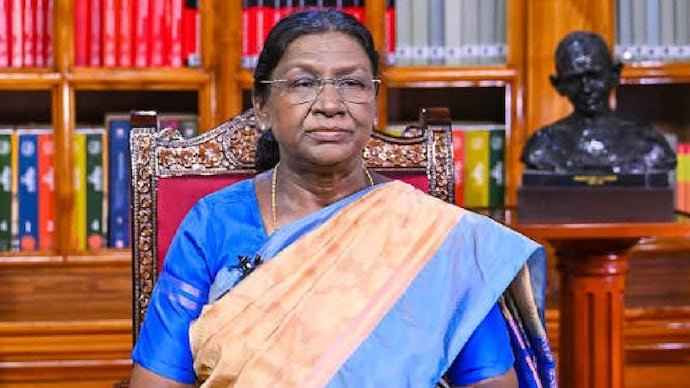
President Droupadi Murmu has amended the rules governing the Inter-State Council to specifically allow the lieutenant governors of Puducherry, Jammu and Kashmir and Delhi to attend meetings of the council when the respective Union territories are under provisions equivalent to President’s Rule. The amendment updates the framework that governs participation in the council when normal elected governments are not functioning under the relevant constitutional or statutory provisions.
The ministry of home affairs notified the amendment on September 9, and it was published on September 18. The change modifies the Inter-State Council Order of 1990, which established the council and laid down its composition and operating framework.
The amendment is significant because it updates a provision that was originally framed around states and the constitutional arrangements that existed at the time. Since the constitutional status and administrative structure of Jammu and Kashmir changed substantially in 2019, the revised provisions bring the three Union territories with legislative assemblies within a more explicit framework for representation at Inter-State Council meetings during periods when their elected institutions are not functioning under the applicable provisions.
What is the Inter-State Council?
The Inter-State Council is a constitutional and federal coordination mechanism intended to provide a forum for discussion between the Union and the states, as well as between different governments on matters of common interest. It was formally established through the Inter-State Council Order issued in May 1990.
Under the original 1990 order, the council included the prime minister, the chief ministers of all states, specified representatives of Union territories and six Union ministers of Cabinet rank. Its composition reflects the council’s broader purpose of providing a platform where issues involving the Union and states can be discussed at the highest political and administrative level.
The council’s structure also recognises that the constitutional status of different territories can affect WHO represents them. The latest amendment addresses one such situation: what happens to representation when a Union territory with an elected assembly comes under a special constitutional or statutory arrangement that places its administration under the lieutenant governor and the Union.
What has changed in the rules?
The latest amendment replaces an earlier proviso that had been inserted into the Inter-State Council Order in July 1990. The earlier provision primarily addressed the attendance of a governor when a proclamation under Article 356 was in force in a state.
The revised provision retains the rule for states. When a proclamation under Article 356 is in force in a state, the governor of that state is to be invited to attend meetings of the Inter-State Council.
At the same time, the amended framework adds specific provisions for Puducherry, Jammu and Kashmir and Delhi. These provisions recognise the different legal mechanisms through which the administration of these Union territories can change when their elected governments are unable to function under the normal constitutional framework.
The result is a more detailed set of rules covering participation in Inter-State Council meetings during periods of exceptional administration.
Provision for Puducherry
For Puducherry, the amendment refers to Section 51 of the Government of Union Territories Act, 1963. When an order under this provision is in force, the lieutenant governor of the Union territory of Puducherry will be invited to attend meetings of the Inter-State Council.
This provision is designed around the statutory framework applicable to Puducherry as a Union territory with a legislative assembly. The arrangement distinguishes the role of the lieutenant governor from that of a state governor and provides a specific basis for participation when the special administrative provision is activated.
Puducherry has an elected legislative assembly and council of ministers under its Union territory framework. At the same time, the lieutenant governor represents the Union in the administration of the territory. The amended Inter-State Council rules therefore identify the lieutenant governor as the representative to be invited when the specified statutory order is in force.
Jammu and Kashmir gets a separate provision
The amendment also introduces a specific provision for the Union territory of Jammu and Kashmir. It refers to Section 73 of the Jammu and Kashmir Reorganisation Act, 2019.
Under the revised Inter-State Council framework, when an order issued by the president under Section 73 of the Jammu and Kashmir Reorganisation Act is in force in relation to the Union territory, the lieutenant governor of Jammu and Kashmir will be invited to attend meetings of the council.
The provision reflects the major constitutional and administrative changes that took place in Jammu and Kashmir after 2019. Before that restructuring, the earlier Inter-State Council rules had referred to an order issued by the governor of the erstwhile state of Jammu and Kashmir under Section 92 of the Constitution of Jammu and Kashmir.
The 2019 reorganisation changed that legal framework. Jammu and Kashmir was reorganised into the Union territories of Jammu and Kashmir and Ladakh following the changes associated with the abrogation of Article 370. The amended Inter-State Council rules now explicitly refer to the legal framework applicable to the Union territory of Jammu and Kashmir rather than relying on the provisions that governed the former state.
Delhi also included in the amended framework
The revised order separately addresses the National Capital Territory of Delhi. It provides that the lieutenant governor of Delhi will be invited to attend Inter-State Council meetings when an order under Article 239AB is in force.
Article 239AB provides a constitutional mechanism for dealing with a situation in which the administration of the National Capital Territory of Delhi cannot be carried on in accordance with the constitutional provisions applicable to it. The amendment therefore connects the Inter-State Council’s membership arrangements with the constitutional status of Delhi during such a period.
This is distinct from the provision applicable to states under Article 356. Delhi is a Union territory with a legislative assembly and has its own constitutional framework under Article 239AA and related provisions. The revised order therefore identifies Article 239AB separately rather than treating Delhi in exactly the same manner as a state.
Why the 1990 rule needed updating
The original Inter-State Council Order was issued in a substantially different constitutional and administrative environment. At that time, the framework for Jammu and Kashmir was different, and the specific administrative arrangements that now apply to Puducherry, Jammu and Kashmir and Delhi had not been incorporated into the council’s rules in their present form.
The July 1990 amendment addressed circumstances involving states and the erstwhile constitutional arrangements of Jammu and Kashmir. However, subsequent changes created a need for more specific provisions dealing with Union territories that have legislative assemblies.
The latest amendment can therefore be understood primarily as an update to the council’s procedural framework. Rather than creating a new institution, it specifies who should be invited to participate when particular constitutional or statutory orders are in force.
How the new provisions work alongside Article 356
The amendment does not remove the existing arrangement for states. Where a proclamation under Article 356 is in force, the governor of the affected state continues to be invited to attend Inter-State Council meetings.
Article 356 deals with situations in which the constitutional machinery of a state has failed and the Union assumes a greater role in the administration of that state. During such periods, the normal functioning of the state government is altered, making the governor the relevant constitutional representative for the purposes specified in the Inter-State Council framework.
The revised order extends a comparable meeting-participation mechanism to Union territories, but it does so through the individual legal provisions applicable to each territory. This distinction is important because the constitutional and statutory arrangements governing a state are not identical to those governing a Union territory with an assembly.
What President’s Rule means in these territories
The expression “President’s Rule” is commonly used to describe periods when the normal elected government is replaced or suspended under a constitutional or statutory mechanism because the relevant constitutional machinery cannot function in the usual manner. The precise legal provision differs depending on whether the jurisdiction is a state or a Union territory.
For states, Article 356 is the central constitutional provision. For the Union territories covered by the amendment, different provisions apply: Section 51 of the Government of Union Territories Act for Puducherry, Section 73 of the Jammu and Kashmir Reorganisation Act for Jammu and Kashmir, and Article 239AB for Delhi.
The distinction matters because the amended Inter-State Council Order does not simply apply the wording of Article 356 to all four jurisdictions. Instead, it identifies the relevant legal mechanism for each territory and specifies that the respective lieutenant governor should be invited when that mechanism is in force.
Why representation at the council matters
The Inter-State Council is designed as a forum for discussions involving the Union and sub-national governments. Its composition is therefore closely linked to the constitutional status of the participants.
When an elected government is functioning normally, representation can take place through the chief minister or another representative specified by the council’s framework. When a special administrative arrangement comes into force, however, the person exercising the relevant constitutional or administrative authority may be different.
The new provisions address that transition directly for Puducherry, Jammu and Kashmir and Delhi. By identifying their lieutenant governors as participants during the specified periods, the amended order establishes a clear procedural route for their attendance.
This also avoids leaving the question of representation to an interpretation of rules that were drafted before the current administrative structures of these territories were established.
Jammu and Kashmir’s 2019 reorganisation is central to the change
One of the clearest reasons for the updated framework is the transformation of Jammu and Kashmir’s constitutional and administrative status in 2019.
Before the reorganisation, Jammu and Kashmir was a state with its own constitutional arrangements and a governor. The Inter-State Council Order’s earlier provision referred to the constitutional framework of the erstwhile state.
Following the 2019 changes, the former state was reorganised into the Union territories of Jammu and Kashmir and Ladakh. Jammu and Kashmir retained a legislative assembly framework, while the lieutenant governor became the constitutional head of the Union territory under the new arrangement.
The amended Inter-State Council rules now reflect that structure by specifically naming the lieutenant governor of Jammu and Kashmir and linking participation to an order under the Jammu and Kashmir Reorganisation Act.
The broader federal context
The amendment comes within the wider framework of relations between the Union government and states and Union territories. The Inter-State Council was created to provide an institutional setting for dialogue on issues that extend beyond the jurisdiction of a single government.
Its composition consequently has practical importance whenever the constitutional status of a participating government changes. The updated rules clarify how representation should work during periods of special administration without changing the basic purpose or composition of the council.
For states, the governor remains the invited representative when Article 356 is in force. For the three Union territories covered by the new provisions, the corresponding lieutenant governors are to be invited when the specified constitutional or statutory orders are in force.
What the amendment does not change
The amendment does not establish a new form of President’s Rule, nor does it alter the constitutional provisions through which such special administrative arrangements can come into force. Instead, it changes the rules governing participation in meetings of the Inter-State Council.
It also does not remove the existing role of chief ministers and other representatives under normal circumstances. The new provisions become relevant specifically when the specified orders or constitutional mechanisms are in force.
The practical effect is therefore procedural but important: the Inter-State Council Order now contains explicit rules for representation from three Union territories with assemblies during periods when their normal elected-government arrangements are suspended or altered under the applicable law.
What the revised framework means going forward
The September amendment brings the Inter-State Council’s rules into closer alignment with India‘s current federal and Union territory structure. The original framework dates from 1990, while the constitutional and administrative landscape has changed significantly since then, particularly with the reorganisation of Jammu and Kashmir in 2019.
By separately identifying Puducherry, Jammu and Kashmir and Delhi, the amended order removes uncertainty over which constitutional representative should be invited to council meetings during the specified periods of special administration.
The change also illustrates how institutional rules created decades ago can require updates when constitutional arrangements evolve. The Inter-State Council continues to serve as a forum involving the Union and states, while its amended participation rules now account more specifically for the distinct position of Union territories with legislative assemblies.
In practical terms, the revised framework retains the existing provision for governors when Article 356 is in force in a state and adds corresponding provisions for the lieutenant governors of Puducherry, Jammu and Kashmir and Delhi under their respective constitutional and statutory mechanisms. The amendment therefore brings the council’s meeting rules in line with the present legal structure governing these jurisdictions.
For breaking news and live news updates, like us on Facebook or follow us on Twitter and Instagram. Read more on Latest India on thefoxdaily.com.

COMMENTS 0