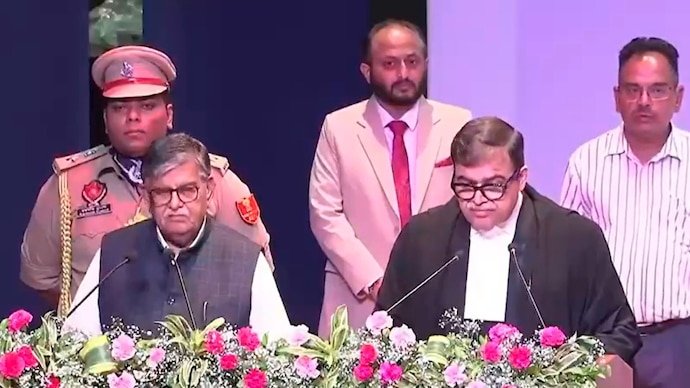
Justice Ashwani Kumar Mishra took oath as the Chief Justice of the Punjab and Haryana High Court on Monday, formally assuming the position amid an escalating disagreement between the Punjab Government and the Centre over the process that led to his appointment.
Justice Mishra, WHO had already been serving as the acting Chief Justice of the high court since June, was formally appointed to the post after the Centre issued the notification on Saturday. The notification came roughly a month after the Supreme Court Collegium recommended his elevation.
His swearing-in ceremony was held at Lok Bhawan and was administered by Punjab Governor Gulab Chand Kataria. The ceremony proceeded despite a last-minute resolution by the Punjab Cabinet seeking to delay the oath until the state’s objections were considered.
Punjab Chief Minister Bhagwant Mann, whose government had opposed the appointment process, stayed away from the ceremony. The absence highlighted the depth of the disagreement over the constitutional and procedural questions raised by the state government.
Justice Mishra formally assumes charge
Justice Ashwani Kumar Mishra had been functioning as the acting Chief Justice of the Punjab and Haryana High Court since June. His elevation now gives him the full authority and designation of Chief Justice of the high court.
The Centre’s formal notification followed the recommendation of the Supreme Court Collegium, which had considered his appointment for the permanent position.
The timing of the notification became politically significant because Punjab had raised objections over the consultation process before the appointment was finalised.
Despite those objections, the constitutional process moved forward, culminating in Monday’s oath-taking ceremony.
Punjab government says its views were ignored
The core of the dispute is Punjab’s claim that the state government’s views were not sought or adequately considered before Justice Mishra’s appointment was finalised.
The Mann government has argued that the appointment and oath should not have proceeded before the state had an opportunity to formally communicate its position.
The Punjab Cabinet described the episode as another instance of the Centre allegedly bypassing the state’s constitutional rights and established procedures.
The government has also argued that the appointment process should have taken into account the state’s concerns before moving to the formal swearing-in.
Punjab’s position has turned what might ordinarily have been a routine judicial appointment into a wider federal dispute between a state government and the Union government.
Emergency Punjab Cabinet meeting before the oath
The dispute intensified on Sunday evening when the Punjab Cabinet convened an emergency meeting to consider the Centre’s decision to move ahead with Justice Mishra’s swearing-in.
After the meeting, the Cabinet passed a resolution asking the Centre to put the appointment and administration of oath on hold until Punjab’s views were obtained and properly considered.
The resolution was strongly worded. The state government described the episode as another example of what it considered the central government’s disregard for the state’s constitutional position.
The Cabinet wanted the oath ceremony delayed rather than allowing the matter to proceed while its objections remained unresolved.
However, the Centre did not halt the process and Justice Mishra took oath the following day.
Bhagwant Mann wrote to President, PM and Governor
Punjab Chief Minister Bhagwant Mann also escalated the issue beyond the Cabinet by writing separately to President Droupadi Murmu, Prime Minister Narendra Modi and Governor Gulab Chand Kataria.
In his communications, Mann raised objections to the process through which Justice Mishra was appointed and argued that Punjab’s views had not been sought before the decision was finalised.
The Chief Minister’s intervention indicates that the state government viewed the matter as more than a disagreement over an individual judicial appointment. It framed the issue as one involving the constitutional relationship between the Union and a state.
By writing to the highest constitutional authorities, Mann sought to place the dispute formally on record before the oath ceremony took place.
Who attended the swearing-in ceremony?
Although Chief Minister Bhagwant Mann was absent, the ceremony was attended by several senior political and administrative figures from Punjab and Haryana.
Among those present were Haryana Governor Ashim Kumar Ghosh, Haryana Chief Minister Nayab Singh Saini, Haryana Assembly Speaker Harvinder Kalyan, Akali MLA Ganieve Kaur Majithia and Punjab Chief Secretary KAP Sinha.
The attendance reflected the institutional importance of the ceremony despite the political controversy surrounding the appointment.
The Punjab and Haryana High Court has jurisdictional significance for both states and Chandigarh, making the appointment of its Chief Justice relevant to the wider judicial administration of the region.
Why Punjab sees a constitutional issue
Punjab’s objection is centred on the consultation process rather than on the judicial credentials of Justice Mishra.
The state government’s position is that its views should have been obtained and considered before the Centre proceeded with the appointment. By moving forward without doing so, Punjab says, the established constitutional procedure was bypassed.
That makes the controversy part of a wider debate about the division of powers between the Union and states and the role of consultation in important institutional appointments.
For the Punjab government, the immediate concern is therefore procedural: whether the state was given the opportunity it was entitled to have before the appointment was finalised.
The Centre, however, has taken the position that sufficient time was available for Punjab to communicate its views.
Centre rejects Punjab’s criticism
Additional Solicitor General of India Satya Pal Jain strongly criticised the Punjab government’s objections.
Jain described the controversy as “most unfortunate and totally uncalled for” and argued that the state had sufficient time to send its views.
His position directly contradicts the Mann government’s claim that Punjab’s concerns were bypassed.
The dispute therefore involves competing interpretations of the procedure: Punjab says it was not properly consulted, while the Centre’s law officer maintains that the state had an adequate opportunity to communicate its position.
The differing accounts also explain why the controversy has intensified even though the judicial appointment itself has now been completed.
Justice Mishra’s appointment comes after a month of acting charge
Justice Mishra had already been overseeing the high court as acting Chief Justice since June.
His formal elevation therefore brings an end to the interim arrangement and provides the institution with a permanent head.
For the judiciary, continuity in the office of Chief Justice is significant because the post involves administrative responsibilities in addition to judicial functions.
The Chief Justice is responsible for managing the functioning of the court, allocation of benches and other administrative matters that affect the efficiency of judicial proceedings.
With Justice Mishra now formally appointed, the court has clarity over its leadership even as the political controversy surrounding the appointment continues.
The Punjab and Haryana High Court’s importance
The Punjab and Haryana High Court serves both Punjab and Haryana and is also the high court for the Union Territory of Chandigarh.
It therefore handles a wide range of constitutional, civil, criminal and administrative matters affecting millions of people across the region.
The office of Chief Justice carries substantial institutional responsibility because the court must manage a large and diverse docket while coordinating its judicial administration across its jurisdiction.
For that reason, the continuation of a leadership dispute between a state government and the Centre could have implications beyond the appointment itself if it begins to affect the relationship between constitutional institutions.
Why the Governor administered the oath
As required for the formal assumption of office, the oath was administered by the Punjab Governor.
Governor Kataria’s role in the ceremony is particularly notable because the state government’s objections were also directed to the constitutional process surrounding the appointment and oath.
The governor consequently found himself at the centre of an institutional disagreement involving the state government, the Union government and the judiciary.
Despite the objections communicated by the Mann government, the governor proceeded with the swearing-in.
Punjab’s absence from the ceremony sends a political message
The absence of Chief Minister Bhagwant Mann from Monday’s ceremony was politically significant.
Chief ministers would ordinarily be expected to participate in important constitutional events held within their states, particularly those involving the head of the state’s principal high court.
Mann’s decision not to attend underscored the fact that his government had not accepted the process that led to Justice Mishra’s appointment.
At the same time, the government did not attempt to prevent the ceremony from taking place after the Centre decided to proceed.
The contrast between the formal ceremony and the political boycott reflects the institutional nature of the disagreement: the appointment went ahead, but Punjab’s objections remained publicly stated.
What happens to Punjab’s objections now?
Justice Mishra’s oath means the immediate appointment process is effectively complete. The outstanding issue is now whether Punjab’s concerns lead to any further constitutional or legal challenge.
The state government’s objections have been formally recorded through the Cabinet resolution and the letters sent by Mann to the President, Prime Minister and Governor.
Whether those objections result in a review of the appointment process or remain a political dispute will depend on the next steps taken by the state and the response from the Centre and relevant constitutional authorities.
For now, there is no indication that Justice Mishra’s functioning as Chief Justice will be suspended as a result of the controversy.
Judicial independence and federal relations
The dispute also raises broader questions about the balance between judicial appointments, executive authority and federal relations.
Appointments to the higher judiciary follow a constitutionally established framework involving the Supreme Court Collegium and the Union government. At the same time, state governments can become involved in consultations relating to high court appointments.
The disagreement in this case centres on whether Punjab’s role in that process was properly respected before the final appointment and oath.
Such disputes can become politically sensitive because they involve not only the functioning of the judiciary but also the relationship between elected state governments and the Union government.
That makes the Justice Mishra appointment more significant than a routine change in judicial leadership.
Why the timing matters politically
The dispute comes against a backdrop of frequent political disagreements between state governments led by opposition parties and the Union government.
Punjab is governed by the Aam Aadmi Party, which is politically opposed to the BJP-led government at the Centre. The disagreement over the appointment has therefore inevitably acquired a political dimension.
However, the procedural questions raised by Punjab are institutional in nature and should be distinguished from the broader political rivalry between the two sides.
The Centre’s rejection of the state’s criticism likewise makes clear that the Union government considers the appointment process to have been valid and complete.
Justice Ashwani Kumar Mishra’s new role
With the oath administered, Justice Ashwani Kumar Mishra now assumes the full responsibilities of Chief Justice of the Punjab and Haryana High Court.
His immediate institutional priorities will include judicial administration, case allocation and ensuring the efficient functioning of the court.
His tenure will also begin under an unusual political spotlight because his appointment itself has become the subject of a dispute between Punjab and the Centre.
For the judiciary, maintaining institutional continuity and independence will remain essential while the political disagreement plays out outside the courtroom.
Key points in the Justice Mishra appointment row
| Issue | Current position |
|---|---|
| New Chief Justice | Justice Ashwani Kumar Mishra |
| Oath date | Monday |
| Oath administered by | Punjab Governor Gulab Chand Kataria |
| Previous role | Acting Chief Justice since June |
| Appointment notification | Issued by the Centre on Saturday |
| Recommendation | Supreme Court Collegium recommendation preceded the notification |
| Punjab government’s objection | State says its views were not obtained and adequately considered |
| Punjab Cabinet action | Passed a resolution seeking a pause before the oath |
| Chief Minister’s response | Bhagwant Mann did not attend the ceremony and wrote to top constitutional authorities |
| Centre’s position | ASG Satya Pal Jain said Punjab had sufficient time to communicate its views |
What the row means for Punjab and the Centre
The immediate outcome is clear: Justice Ashwani Kumar Mishra has taken charge as Chief Justice of the Punjab and Haryana High Court despite Punjab’s objections.
But the underlying dispute has not necessarily ended with the oath.
Punjab maintains that the state was denied its due role in the appointment process, while the Centre argues that there was sufficient opportunity for the state to communicate its views. Those positions remain fundamentally opposed.
The controversy therefore shifts from whether the oath should take place to whether the process that preceded it will face further scrutiny.
Justice Mishra takes charge as constitutional dispute continues
Justice Ashwani Kumar Mishra’s elevation brings a permanent Chief Justice to the Punjab and Haryana High Court after his period as acting Chief Justice. The court now has formal continuity in its leadership, but the appointment has opened a significant disagreement between Punjab and the Union government.
The Mann government wanted the oath delayed until its concerns were considered and accused the Centre of bypassing established procedure. The Centre, through Additional Solicitor General Satya Pal Jain, rejected the criticism and maintained that Punjab had enough time to submit its views.
With Governor Gulab Chand Kataria administering the oath and the ceremony going ahead without Chief Minister Bhagwant Mann, the institutional divide was on full display.
The next phase of the controversy will depend on whether Punjab pursues its objections further and how the Centre responds. For the moment, however, Justice Mishra has formally assumed one of the most important judicial offices in the region, with his tenure beginning against the backdrop of an unresolved debate over federal consultation and constitutional procedure.
For breaking news and live news updates, like us on Facebook or follow us on Twitter and Instagram. Read more on Latest India on thefoxdaily.com.




COMMENTS 0