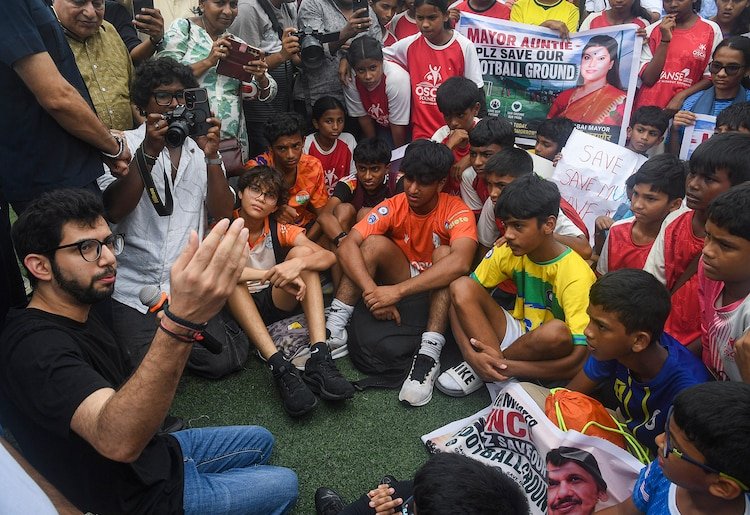
For a city that produces footballers, supports major clubs and has one of India’s most passionate Football cultures, Mumbai has a surprisingly simple problem: finding a proper place to play.
That is why the fight over the Neville D’Souza Football Ground in Bandra Reclamation has become much bigger than a dispute over one parcel of land. Footballers, coaches, parents and supporters fear that changing the reservation of the 8,450-square-metre ground from a playground to a convention and exhibition centre could remove one of the few facilities in Mumbai that gives young players access to a professional-level football environment.
The Brihanmumbai Municipal Corporation has approved the proposed change in land reservation. But the decision has not cleared the way for immediate redevelopment. The Bombay High Court has restrained the BMC and Maharashtra government from taking further steps on the proposal until the matter is considered again.
That legal pause has given Mumbai’s football community time to make its case. Their argument is straightforward: if the city wants better footballers, it needs more than fans, academies and professional clubs. It needs grounds where players can actually play.
What is happening to the Neville D’Souza Football Ground?
The controversy centres on the statutory reservation of the Neville D’Souza Football Ground at Bandra Reclamation.
The BMC general body approved a proposal to change the plot’s reservation from a playground to a convention and exhibition centre. The change would alter the legal designation of the land and potentially open the way for a different form of development.
However, the BMC’s approval is not the end of the process. The proposed reservation change requires further approval from the Maharashtra government, and the Bombay High Court has meanwhile directed the authorities not to take further steps on the matter until the next stage of the legal proceedings.
The court’s intervention followed concerns raised by the Mumbai Football Association and others challenging the proposed change. The court also expressed concern after the civic body appeared to proceed with the proposal despite an earlier assurance that the status quo would be maintained.
The next hearing is therefore important not only for the ground but also for determining whether the proposed land-use change can move forward.
Why footballers say this is not just another playground
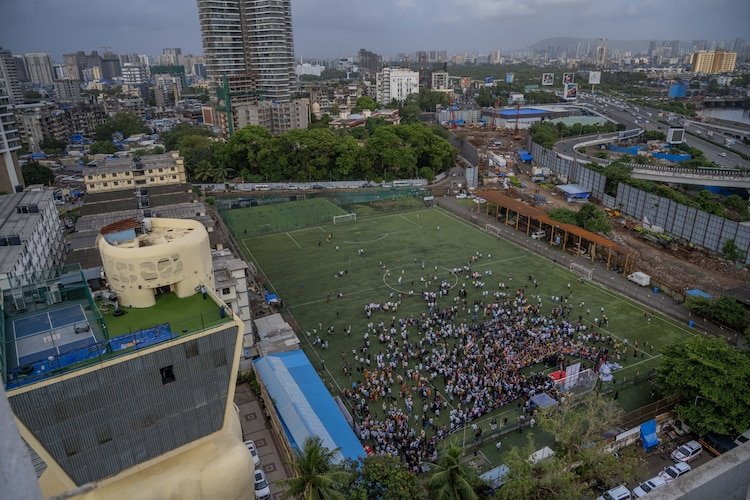
The strongest argument from the football community is about the quality of the facility.
The Neville D’Souza ground in its present form was inaugurated in 2018. It has a FIFA-standard artificial football turf, stands, dressing rooms and facilities associated with a professional football venue.
That combination makes the ground unusual in Mumbai’s grassroots football ecosystem. Many young players train on smaller artificial pitches, school grounds, municipal spaces or traditional maidans. Those venues can be valuable, but they do not necessarily reproduce the environment of competitive professional football.
Tushar Sinha, a Mumbai-based lawyer and football enthusiast WHO has played at the Bandra ground, argues that this distinction matters. He has been involved with Mumbai football since 2013 and grew up near the ground.
For him, the facility represents a bridge between casual football and the professional game.
“For district-level football, there is nothing else like Neville D’Souza ground. If this goes away, there would be nothing left,” Sinha said.
His concern reflects a broader problem in Indian football. A child can have the talent, enthusiasm and ambition to become a professional player, but those qualities cannot substitute for regular access to appropriate training and competition facilities.
A ground that changed the experience of grassroots football
The current football facility is relatively recent, but the land itself has a longer history.
Sinha recalls that when he was growing up, the site was used for exhibitions, fairs and community events. The transformation into a dedicated football venue changed how local players experienced the sport.
Suddenly, young footballers were not merely playing on an open patch of ground. They had access to dressing rooms, stands, a coach’s area and a surface designed for football.
That difference can be significant for children who dream of playing professionally.
For parents, it can also change the perception of sport as a career. When a child trains in a professional-looking facility, competes in organised tournaments and plays in front of spectators, the ambition can feel less like a hobby and more like a genuine sporting pathway.
Sinha recalled young players telling him that they hoped to play for Mumbai City FC one day.
That aspiration is precisely what supporters say should be protected.
Why Mumbai’s other major stadiums are not a simple replacement
One of the arguments made by supporters of retaining the Neville D’Souza ground is that Mumbai already has large sporting venues.
But capacity and accessibility are not the same thing.
Facilities such as the Andheri Sports Complex and DY Patil Stadium can host high-level sporting events, but they are not necessarily available to the large number of district-level players who need regular access to a quality pitch.
A professional stadium being present in a city does not automatically create a grassroots football infrastructure.
This is one of the most important points in the dispute. The debate is not really about whether Mumbai has any football stadiums. It is about whether ordinary young footballers can consistently use suitable facilities for training, league matches and development.
A player who eventually wants to play at a higher level needs repeated exposure to competitive football. A stadium reserved for major events cannot fill the same role as a dedicated ground used regularly by youth teams and local competitions.
The gap between playing football and developing footballers
Mumbai has never lacked football culture. The city has a long tradition of club football, school competitions, local leagues and passionate supporters.
But a large football-playing population does not automatically produce elite players.
The missing link is often infrastructure and competitive opportunity.
Sinha believes the problem can be seen by comparing the number of competitive matches young Indian players get with the exposure available to children in stronger football cultures.
His argument is that children need to play frequently on proper grounds against organised opposition. Without that environment, talented players can spend years playing football without receiving enough competitive experience to make the transition to professional football.
The Neville D’Souza ground is important in this context because it is used for local and district-level competitions, including the Maharashtra State Men’s Senior Football League, Mumbai Premier League and Nandkarni Cup.
It is therefore not simply a place where children practise. It is part of the competitive structure through which players can test themselves.
Why the ground is named after Neville D’Souza
The ground carries the name of one of India’s notable footballers.
Neville D’Souza represented India at the 1956 Melbourne Olympics and scored a hat-trick against Australia. He became the first Asian footballer to score three goals in an Olympic football match.
His name gives the Bandra ground a connection to an earlier generation of Indian football, when the national team was capable of competing on the Olympic stage.
For supporters, retaining the ground is therefore also about preserving part of Mumbai’s Football History.
The symbolism is especially relevant because the current generation is trying to build a stronger professional football culture in a country where the sport has enormous participation but has struggled to consistently produce international-level results.
Footballers, parents and coaches have joined the protests
The proposed change has triggered protests involving footballers, parents, coaches and football supporters.
The Mumbai Football Association has challenged the proposed reservation change in the Bombay High Court. The legal fight has also attracted an unusual group of supporters: lawyers who are themselves football players.
That detail illustrates how deeply the issue has connected with Mumbai’s football community. The opposition is not coming only from political parties or people who watch football from the stands. Some of those involved regularly play in lower-level competitions and understand how difficult it is to find suitable grounds.
The BMC has said the facility serves hundreds of clubs and youth teams, with thousands of sports students using the ground.
For those players, the concern is practical. If the ground disappears, finding another venue with comparable facilities and availability could be difficult.
The Bombay High Court has put the proposal on hold
The legal battle has now become central to the ground’s future.
The Bombay High Court has restrained the BMC from taking further steps to alter the reservation of the ground while it considers the challenge.
The court’s intervention came after the civic body’s approval of the proposal despite an earlier assurance concerning the status quo. During the proceedings, the bench expressed concern over the importance of complying with assurances made before the court.
The court’s order does not permanently protect the ground from a future change in reservation. Instead, it temporarily prevents further action while the legal challenge is considered.
That distinction is important. The proposal has not simply disappeared, but neither has the convention-centre plan become an accomplished fact.
There is also a dispute over the land’s original reservation
The controversy has two competing narratives.
Football supporters argue that the city should protect a functioning sports facility and preserve one of its limited football spaces.
Supporters of the BMC proposal have argued that the land’s original statutory reservation was for a convention centre and that its use as a football ground does not necessarily mean the underlying reservation should permanently remain a playground.
Maharashtra minister and BJP MLA Ashish Shelar has defended this position, saying the history of the land needs to be understood before conclusions are drawn. He has argued that using the plot for football over the years did not necessarily change its original statutory designation.
This is a crucial part of the dispute because the question before the authorities is not simply whether football is popular. It is also whether the land’s reservation should be retained for sports or restored to a different designated use.
Why Aaditya Thackeray and other politicians have entered the fight
The Neville D’Souza ground dispute has quickly become a political issue.
In July, NCP leader Zeeshan Siddique backed efforts to retain the ground and raised the issue in the Maharashtra Assembly. He linked the availability of football grounds to India’s long-standing struggle to develop players capable of competing at the highest level.
Shiv Sena (UBT) leader Aaditya Thackeray, who is also president of the Mumbai Football Association, has taken a prominent role in the campaign to protect the ground.
He led the “Mumbai Maidan Bachao Tiranga Andolan” at the venue and argued that Mumbai needs to preserve its open sporting spaces.
The BJP, however, has rejected the Opposition’s allegations. Shelar has accused opponents of distorting facts about the ownership and intended use of the land and has questioned the historical basis for some of the claims surrounding the site.
The political disagreement means the future of the ground is now being debated on two levels: in court and in the public arena.
The bigger problem: Mumbai’s shortage of usable football space
The Neville D’Souza controversy would probably not have generated the same reaction if Mumbai had an abundance of equivalent football grounds.
That is what makes the issue particularly sensitive.
In a densely developed city, every large open space can face competing demands. Housing, commercial development, exhibitions, public facilities, recreation and sport all require land. Once a functioning sporting ground is converted to another use, replacing it with an equally accessible facility can be much harder than simply announcing a new project elsewhere.
For football, accessibility matters even more because development depends on repetition.
A young player does not become better by occasionally entering a large stadium. Improvement comes from training regularly, playing competitive matches, learning from coaches and facing stronger opponents over many years.
That is why supporters describe Neville D’Souza as a pathway rather than simply a pitch.
What Mumbai risks losing if the ground disappears
If the reservation change eventually goes through and the site is developed for a convention and exhibition centre, the most immediate loss would be a dedicated football facility.
But the consequences could extend further.
- Young players could lose access to a professional-standard playing surface.
- District-level competitions could face pressure to find alternative venues.
- Local clubs and youth teams could have fewer options for organised matches.
- Parents could lose a nearby facility that makes structured sporting development more practical.
- Mumbai’s already limited football infrastructure could become even more concentrated in a small number of major venues.
None of these outcomes means that Indian football’s development would stop without one ground. But the cumulative effect of losing several accessible sporting spaces can be significant.
The real question is not football versus development
The debate is sometimes presented as though Mumbai must choose between football and economic development.
That framing misses the more practical question: if a sporting ground is removed, what equivalent facility replaces it?
A convention and exhibition centre may serve a legitimate public or economic purpose. But a new development cannot automatically replace the social and sporting function of a football ground.
For the football community, the key issue is therefore whether the city can provide another venue with comparable quality, capacity, accessibility and regular availability before giving up an existing one.
That is where the Neville D’Souza dispute becomes a test of urban planning as much as sports policy.
What happens next for Neville D’Souza ground?
The immediate future depends on the Bombay High Court proceedings and the approvals required for the proposed reservation change.
The court has already prevented the authorities from taking further steps for now, keeping the ground available while the legal challenge proceeds. The next hearings will determine how the dispute develops and whether the proposed change can move forward.
Meanwhile, protests and political pressure are likely to continue. Footballers and supporters have made clear that they do not see the ground as surplus land. For them, it is part of the infrastructure needed to build the next generation of Mumbai footballers.
The deeper issue is one that Mumbai has faced repeatedly: how does a city with limited land protect the public spaces that cannot easily be replaced?
Neville D’Souza Football Ground has become a particularly powerful example because it combines football history, grassroots competition and a professional-standard facility in one of India’s most crowded cities.
Whether the land ultimately remains a football ground or moves toward another use will be decided through the legal and planning process. But the campaign to save it has already exposed a problem that goes beyond Bandra: India’s football ambitions require actual places for children to play, train and compete.
For Mumbaikars fighting to save the ground, that is the central point. A city cannot keep asking where its next generation of footballers will come from while steadily reducing the places where those players can learn the game.
For breaking news and live news updates, like us on Facebook or follow us on Twitter and Instagram. Read more on Latest India on thefoxdaily.com.






COMMENTS 0