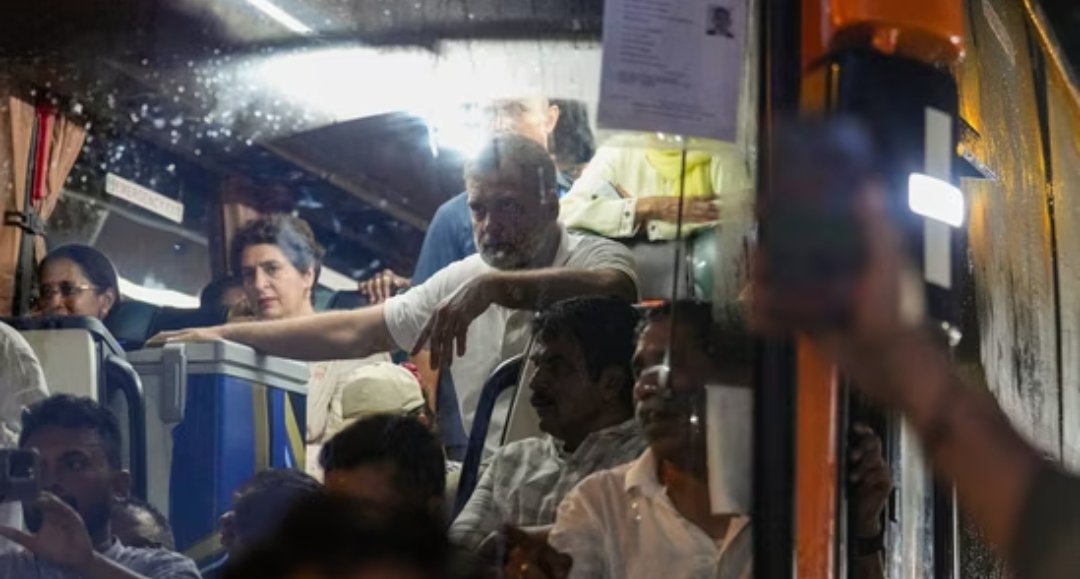
The political battle over the alleged NEET paper leak intensified on Thursday as Leader of the Opposition Rahul Gandhi led a delegation of INDIA bloc Members of Parliament to Gandhi Smriti in New Delhi. The visit was intended to pay tribute to students who allegedly died by suicide amid the examination controversy and to support students injured during recent protests.
However, what was planned as a symbolic tribute quickly became a high-profile political event after police imposed restrictions, erected barricades, and temporarily halted the Opposition convoy. Congress accused the government of preventing elected representatives from expressing solidarity with students, while authorities maintained that security arrangements and prohibitory orders were being enforced in sensitive areas of the national capital.
What Happened at Gandhi Smriti?
Rahul Gandhi and several Opposition leaders gathered before proceeding toward Gandhi Smriti, the memorial dedicated to Mahatma Gandhi. Their stated objective was to honor students affected by the NEET paper leak controversy and highlight concerns over recent police action against demonstrators.
The journey, however, faced multiple interruptions as security personnel deployed barricades and regulated movement under existing public order restrictions.
Despite temporary delays, the Opposition delegation eventually continued toward Gandhi Smriti after discussions with police officials.
Why Rahul Gandhi Chose Gandhi Smriti
According to Congress leaders, the Opposition had initially sought permission to assemble at India Gate but was reportedly denied. They subsequently decided to visit Gandhi Smriti, a site associated with Mahatma Gandhi’s legacy of non-violence and peaceful democratic expression.
Choosing Gandhi Smriti carried symbolic political significance. Congress sought to frame the visit as a peaceful tribute rather than a conventional protest, linking students’ demands with broader themes of democratic rights and accountability.
Heavy Security Across Central Delhi
Authorities implemented extensive security arrangements throughout central Delhi due to ongoing protests and Parliament’s Monsoon Session.
Security measures reportedly included:
- Multiple barricades on key roads.
- Large deployment of Delhi Police personnel.
- Traffic diversions around high-security zones.
- Restricted movement under Section 163 of the Bharatiya Nagarik Suraksha Sanhita (BNSS).
- Additional monitoring near Parliament and government residences.
Officials cited public safety and law-and-order considerations for the restrictions.
Rahul Gandhi’s Allegations
Speaking during the journey, Rahul Gandhi alleged that the government attempted to prevent the Opposition from reaching Gandhi Smriti.
He claimed:
- The request to visit India Gate was refused.
- Barricades blocked movement toward Gandhi Smriti.
- A bus had been positioned to obstruct the convoy.
- The restrictions reflected political nervousness over the student movement.
Congress leaders argued that elected representatives should be free to peacefully express solidarity with citizens without unnecessary administrative obstacles.
Why Students Are Protesting
The demonstrations stem from continuing concerns surrounding the NEET paper leak controversy, which has generated nationwide debate about examination integrity and education governance.
Student groups have raised demands that include:
- Greater transparency in competitive examinations.
- Accountability for alleged examination irregularities.
- Stronger action against those responsible for paper leaks.
- Reforms to strengthen examination security.
- Improved protection of students’ academic futures.
The issue has evolved beyond examination administration into a broader national discussion about trust in public recruitment and entrance examination systems.
Political Leaders Who Joined the March
The delegation represented several parties within the INDIA alliance, highlighting the issue’s growing political significance.
| Leader | Political Role |
|---|---|
| Rahul Gandhi | Leader of Opposition, Lok Sabha |
| Mallikarjun Kharge | Congress President |
| Sonia Gandhi | Congress Parliamentary Party Chairperson |
| P. Chidambaram | Senior Congress Leader |
| KC Venugopal | Congress General Secretary |
| Leaders from NCP (Sharad Pawar), RJD, TMC, CPI and Shiv Sena (UBT) | INDIA Alliance Representatives |
The participation of multiple opposition parties demonstrated a coordinated effort to frame the protests as an issue extending beyond partisan politics.
Understanding Section 163 of the BNSS
Police cited prohibitory orders under Section 163 of the Bharatiya Nagarik Suraksha Sanhita (BNSS) while regulating movement in parts of New Delhi.
Such provisions allow authorities to restrict public assemblies in designated areas when considered necessary for maintaining public order and security.
These restrictions are commonly implemented around Parliament, major government buildings, and high-security zones during periods of heightened political activity.
Why the Protest Has Become Politically Significant
The controversy has gradually transformed from an education-related issue into a broader political debate involving governance, accountability, and democratic rights.
For the Opposition, the protests provide an opportunity to highlight concerns over examination reforms and youth welfare. For the government, maintaining public order while managing demonstrations has become equally important.
As Parliament remains in session, both sides are expected to continue raising the issue through legislative debate and public outreach.
Comparison: Student Demands vs Government Response
| Student Concerns | Government Position |
|---|---|
| Transparent investigation into examination irregularities. | Authorities have stated that investigations are ongoing. |
| Accountability for alleged paper leaks. | Law enforcement agencies continue legal proceedings where applicable. |
| Education system reforms. | Policy discussions are expected during the parliamentary session. |
| Peaceful protest rights. | Security measures remain subject to law-and-order requirements. |
Why Gandhi Smriti Carries Symbolic Importance
Gandhi Smriti is one of India’s most significant historical memorials, marking the place where Mahatma Gandhi spent his final days. Political leaders often visit the site during moments of national importance to emphasize peaceful democratic engagement and constitutional values.
By selecting Gandhi Smriti instead of a conventional protest venue, the Opposition sought to associate the demonstration with Gandhian principles of non-violence and public accountability.
Possible Political Impact
The continuing protests may influence parliamentary discussions on education policy, examination reforms, and youth welfare. As student concerns receive greater national attention, political parties across the spectrum are likely to address the issue more prominently.
The episode also highlights the increasing importance of youth-related issues in India’s political discourse, particularly regarding competitive examinations, employment opportunities, and institutional transparency.
Conclusion
The Opposition’s visit to Gandhi Smriti became far more than a symbolic tribute, evolving into a significant political event amid ongoing student protests over the NEET paper leak controversy. Heavy security, temporary restrictions, and sharp political exchanges underscored the sensitivity of the issue.
As Parliament continues its session, the debate is expected to shift from the streets to legislative discussions, where questions surrounding examination integrity, student welfare, public accountability, and democratic freedoms are likely to remain central. Whether the protests ultimately lead to substantial policy reforms will depend on both political consensus and the outcomes of ongoing investigations, but the issue has already become one of the defining education debates of the year.
For breaking news and live news updates, like us on Facebook or follow us on Twitter and Instagram. Read more on Latest India on thefoxdaily.com.





COMMENTS 0