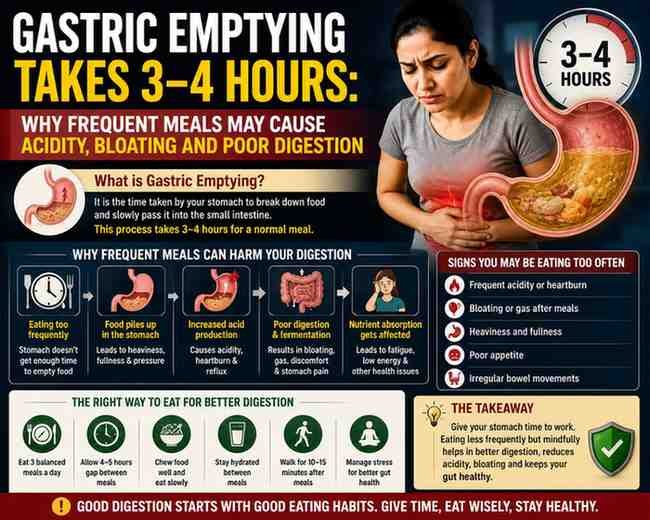
The idea that grazing on small meals all day keeps your metabolism “revved up” has been repeated so often that it sounds like settled science. It isn’t. What’s actually happening: gastric emptying the process by which your stomach moves food into the small intestine typically takes around three to four hours for a standard mixed meal. Why it matters: if you’re eating again before that window closes, your stomach is being asked to process a new meal while the previous one is still working its way through, which can trigger acidity, bloating, and unnecessary metabolic strain. Who this affects: office workers snacking through the day, fitness enthusiasts following outdated “six meals a day” advice, and anyone who assumes more frequent eating automatically means better health. The catch: frequent meals aren’t universally bad — for a specific group of people, they’re genuinely useful. The nuance is where most advice on this topic falls apart.
What Gastric Emptying Actually Means
Gastric emptying is the stomach’s job of breaking food down and releasing it gradually into the small intestine, where the real business of nutrient absorption happens. It isn’t instantaneous. Clinical research on digestion timing shows that a standard meal takes roughly three to four hours to substantially clear the stomach, with the exact duration depending on the meal’s composition liquids move faster than solids, simple carbohydrates faster than protein and fibre, and fattier meals slower than lean ones.
This is the number nutritionists are pointing to when they push back on the “eat every two hours” advice that circulates on social media. If your stomach genuinely needs three-plus hours to process a meal, eating again after ninety minutes doesn’t give your digestive system a chance to finish one job before starting another. Over time, that overlap is what shows up as bloating, that heavy, gassy discomfort, and acidity, the burning sensation linked to excess stomach acid production triggered by near-constant food intake.
Where the “Eat More Often” Advice Came From
The grazing trend didn’t appear out of nowhere. It grew out of a reasonable-sounding theory: eating small amounts frequently would keep blood sugar stable, prevent extreme hunger, and keep the metabolic “furnace” burning steadily instead of surging and crashing. Fitness culture in particular popularised the six-small-meals model in the 2000s and 2010s, promising better fat loss and steadier energy.
The trouble is that the science supporting this theory has aged poorly. Research comparing different meal frequencies has repeatedly found that increasing how often you eat doesn’t meaningfully raise metabolic rate. While digesting food does burn a small number of calories — a phenomenon called the thermic effect of food spreading the same total intake across more meals doesn’t produce a measurable metabolic advantage over eating it across fewer, larger ones. A study following participants over eight weeks found that increasing meal frequency while keeping total calories constant produced no improvement in fat loss or appetite control compared to eating less often.
More striking is research specifically on blood sugar regulation. A randomised crossover study on people with type 2 diabetes found that eating two large meals a substantial breakfast and lunch improved insulin sensitivity and reduced liver fat more effectively than eating six smaller meals with the same total calories. The lead researcher on that study summed up the underlying logic as being consistent with the old proverb about eating breakfast like a king and dinner like a pauper, essentially validating structured, less frequent eating over grazing for that population.
The Acidity and Bloating Connection, Explained
Here’s the mechanism worth understanding: every time you eat, your stomach ramps up acid production and your digestive system releases a cascade of hormones, including insulin, to manage the incoming food. If a new meal or snack arrives before the last one has cleared, your stomach is effectively juggling two digestive processes at once. This can mean:
- Acid buildup near-continuous eating keeps acid secretion elevated for longer stretches, which raises the risk of heartburn and reflux, especially if you’re also eating close to bedtime.
- Bloating and gas undigested or partially digested food sitting alongside newly arrived food can ferment further, producing the uncomfortable, distended feeling many frequent snackers report by mid-afternoon.
- “Glucose stacking” a term used in diabetes care to describe overlapping blood sugar spikes from meals eaten too close together, which can make blood sugar harder to manage rather than easier.
- No real digestive rest your gut, like most organs, functions better with defined periods of activity and rest. Constant grazing removes that rest window entirely.
The Catch: Frequent Meals Aren’t Wrong for Everyone
This is the part of the conversation that often gets flattened into a blanket rule, and it shouldn’t be. Meal frequency isn’t a one-size-fits-all metric — it depends heavily on individual metabolic conditions, medication, and activity levels.
People managing type 1 diabetes or those on insulin therapy, for instance, are frequently advised by diabetes associations to eat smaller, more frequent meals specifically because it helps avoid the dangerous blood sugar swings that come with long gaps between meals. For someone on certain insulin regimens, skipping ahead to a three-meals-only structure without medical guidance could actually increase the risk of hypoglycemia.
Similarly, people with reduced stomach capacity following certain surgeries, or managing conditions like gastroparesis where the stomach empties too slowly are often told to eat smaller amounts more often simply because their body can’t comfortably handle large volumes in one sitting. Athletes with very high energy demands, pregnant individuals in later trimesters (where a growing uterus reduces stomach capacity), and people recovering from illness may also genuinely benefit from more frequent, smaller intake.
The pattern that emerges from the research isn’t “grazing is bad” or “three meals is best.” It’s that meal frequency should match your physiology, not a generic wellness trend. The mismatch between advice and biology is precisely why so many healthy adults who graze “because it’s supposed to be healthier” end up with bloating and acidity instead of the steady energy they were promised.
| Eating Pattern | Who It Tends to Suit | Who It May Not Suit |
|---|---|---|
| Frequent small meals (grazing) | Insulin users, gastroparesis patients, high-energy-demand athletes, later pregnancy | Generally healthy adults seeking better digestion or weight management |
| Three structured meals | Most metabolically healthy adults; those wanting clearer hunger cues and easier calorie tracking | People prone to hypoglycemia on certain medications |
| Two larger meals | Some people with type 2 diabetes (under medical guidance), those who respond well to longer fasting windows | People with high daily energy needs or blood sugar volatility |
Why This Matters More Than It Seems
The bigger issue here isn’t really about meal count. It’s about how easily a plausible-sounding health claim — “eating more often boosts metabolism” — can outlive the evidence that once supported it, simply because it’s repeated often enough. That’s a pattern worth watching for in Nutrition advice generally: claims that sound intuitive (more effort equals more benefit) often spread faster than the more boring, conditional truth (it depends on your physiology).
There’s also a quieter cultural shift buried in this story. A decade ago, the wellness industry’s default advice leaned almost entirely toward eating more frequently. Today, the pendulum has swung toward intermittent fasting, time-restricted eating, and structured meals with defined gaps partly driven by exactly the kind of insulin-sensitivity research cited above. Neither extreme is universally correct, which is precisely the point: digestion is not a trend, it’s a biological process with a fairly predictable timeline, and the best eating pattern is the one that respects that timeline for your specific body.
The Real-World Takeaway
If you’re a generally healthy adult who’s been grazing out of habit rather than medical necessity, the practical implication is straightforward: give your stomach the roughly three-to-four-hour window it needs before loading it up again. That doesn’t mean starving yourself between meals or forcing a rigid three-meal structure if it doesn’t suit your schedule it means being intentional rather than reflexive about when you eat, and noticing whether bloating or acidity tends to show up on days when you snack constantly versus days when you don’t.
For anyone managing diabetes, a digestive disorder, pregnancy, or another condition where eating frequency is part of a treatment plan, this is exactly the kind of decision to make with a doctor or dietitian rather than a wellness headline because in those cases, frequent meals aren’t a mistake; they’re the medically appropriate strategy.
Conclusion: The Real Lesson Isn’t “Fewer Meals,” It’s “Fewer Assumptions”
The science on gastric emptying doesn’t hand out a universal verdict on how often to eat. What it does offer is a useful reality check: your stomach runs on a roughly three-to-four-hour cycle, and working with that rhythm rather than overriding it with constant snacking is likely to reduce bloating and acidity for most healthy adults. As nutrition research continues to move away from one-size-fits-all meal-frequency rules and toward personalised, condition-specific guidance, expect future dietary advice to sound less like a fixed number of meals and more like a question: what does your body’s own digestive timeline actually need?
For breaking news and live news updates, like us on Facebook or follow us on Twitter and Instagram. Read more on Latest Lifestyle on thefoxdaily.com.






COMMENTS 0