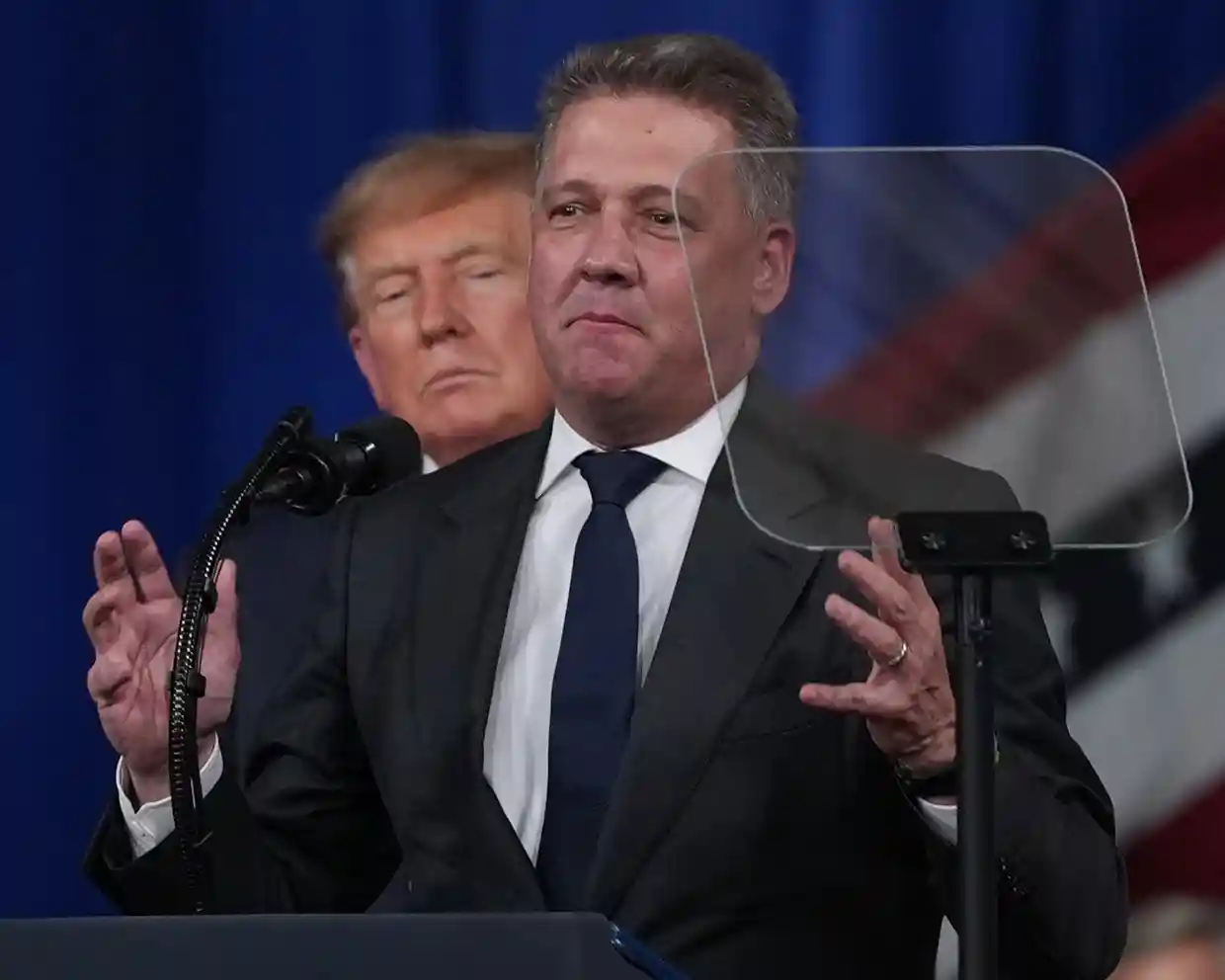
Audi chief executive Gernot Döllner is facing criticism in Germany after appearing alongside US President Donald Trump at a political rally to announce a planned $4 billion investment in Georgia. The appearance has triggered a dispute over corporate political neutrality, Volkswagen’s history and the contrast between Audi’s US expansion plans and potential job cuts at its German operations.
Döllner joined Trump on stage at an event in Perry, near Macon, Georgia, where the pair announced plans for Audi’s first US factory. The proposed facility is expected to create 4,500 jobs and produce large premium sport utility vehicles (SUVs) for the American market.
The announcement has drawn sharp criticism from employee representatives and German political figures, who questioned the decision to make a major corporate investment announcement at a rally during a closely contested US election campaign.
Why Is Audi CEO Gernot Döllner Facing Criticism?
The controversy centres on Döllner’s decision to appear in person at Trump’s rally shortly before the US midterm elections. The event combined a corporate investment announcement with a political speech, prompting critics to question whether Audi’s leadership had compromised the company’s stated commitment to political neutrality.
Daniela Cavallo, chair of the Volkswagen Group works council, criticised the appearance in internal company communications reported by German media. She described Trump’s speech as containing racism, sexism, transphobia and contempt for democracy, and said Döllner’s participation in the event was deeply embarrassing for the company.
Cavallo also argued that the investment announcement had allowed Volkswagen’s management to become part of what she characterised as a propaganda event for a highly controversial political figure.
Her criticism reflects a broader concern among employee representatives: a multinational company’s business decisions can be interpreted as political endorsements when its chief executive appears alongside a political leader at a campaign rally.
German Politicians and Trade Union Leaders Condemn the Appearance
Isabel Cademartori, transport spokesperson for Germany’s Social Democratic Party (SPD), which is part of the country’s ruling coalition, described Döllner’s actions as a disgrace. She also invoked Volkswagen’s history, referring to the company’s origins under Nazi rule.
Volkswagen was established in Nazi Germany in the 1930s as part of the regime’s ambition to develop an affordable car for the German public. The company’s historical connection to the Nazi period remains a sensitive issue in Germany, adding another dimension to criticism of its leadership’s association with a polarising political figure.
Christiane Benner, head of the powerful German trade union IG Metall and deputy chair of Volkswagen’s supervisory board, also condemned Döllner’s appearance. She called it extremely embarrassing, politically unacceptable and unworthy of the company and its employees.
Benner further alleged that the appearance breached Volkswagen’s code of conduct, which she said expressly requires political neutrality in the run-up to elections. Her comments raise questions about how the company interprets and enforces its internal rules when executives participate in high-profile political events.
However, the criticism represents the views of employee representatives and political figures; the supplied information does not establish that a formal finding of misconduct has been made against Döllner.
German Government Declines to Comment
A spokesperson for the German government declined to comment directly on the controversy, describing the investment as a business decision concerning where Volkswagen chooses to invest and where its chief executive appears.
The response leaves the dispute primarily within the company’s corporate governance and labour relations structures. With employee representatives holding influential positions within Volkswagen’s supervisory framework, the issue could become part of a wider debate over management accountability and the company’s public image.
Audi Announces $4 Billion Factory Investment in Georgia
At the rally, Döllner announced that Audi plans to invest $4 billion in a factory in Georgia, marking a major step in the luxury automaker’s effort to expand its manufacturing presence in the United States.
The proposed facility, planned for the Macon area, is expected to create approximately 4,500 jobs and eventually manufacture around 200,000 SUVs annually. Audi intends to produce some of its largest and most premium SUV models at the site for the American market.
Döllner described the project as a long-term investment based on the company’s confidence in the US market. According to the announced plans, construction is expected to begin in 2027, while vehicle production is planned to start in the 2030s.
The project would give Audi a dedicated manufacturing base in the United States. Unlike several other premium carmakers, Audi does not currently operate its own US vehicle factory, leaving it reliant on production facilities elsewhere to supply American customers.
US Tariffs Add Pressure on Audi’s Business Strategy
Trade policy is a significant factor behind Audi’s interest in expanding local production. The company has faced US import tariffs of 15%, which were estimated to have cost it around €1.2 billion in the previous year, according to the supplied report.
Producing vehicles in the United States could help Audi reduce its exposure to import duties on vehicles manufactured abroad. A local factory would also allow the company to build vehicles closer to its American customers, although the overall financial impact will depend on construction costs, operating expenses, demand and the final implementation of the project.
Trump has argued that tariffs on imported cars support the US economy by encouraging companies to manufacture vehicles domestically. Audi’s proposed investment aligns with that broader policy objective, but the announcement’s timing and setting have become a separate source of controversy in Germany.
The factory remains a planned investment rather than an operating facility. Its construction schedule, production targets and employment commitments will need to be realised before the full economic impact can be assessed.
Volkswagen Faces Job Cuts and Factory Closure Concerns in Germany
The controversy has intensified because Volkswagen is simultaneously confronting a difficult restructuring process in its home market. Management and labour representatives have been locked in negotiations over plans that could involve cutting as many as 100,000 jobs and closing factories in Germany.
Volkswagen has attributed the pressure to several factors, including competition from Chinese carmakers, US tariffs and the costly transition towards electric vehicles. These challenges have forced the group to reassess production costs and the long-term viability of some of its German facilities.
Audi’s Neckarsulm plant, which employs approximately 15,000 people, is among four Volkswagen Group sites reported to face possible closure from the beginning of the next decade. The potential threat to domestic employment has made the announcement of a large US investment particularly sensitive for workers and unions.
The contrast is central to the criticism of Döllner. While Audi plans to create thousands of jobs in Georgia, Volkswagen employees in Germany are facing uncertainty over employment and manufacturing capacity.
A company spokesperson said every site must contribute to competitiveness and Audi’s long-term strength. That position reflects management’s emphasis on reducing costs and improving the group’s ability to compete internationally, while unions are seeking to protect jobs and industrial capacity in Germany.
Will the Georgia Investment Need Volkswagen Board Approval?
Benner has pointed out that a major investment such as the proposed Georgia factory would have to go before Volkswagen’s supervisory board. As the board’s deputy chair, she occupies a significant position in the company’s oversight structure.
The board’s role is important because the announcement at the rally does not, by itself, establish that every corporate approval and implementation step has been completed. The investment must proceed through the relevant decision-making processes before the planned facility can become operational.
The episode could therefore have implications beyond the immediate criticism of Döllner’s appearance. It may also sharpen scrutiny of how Volkswagen balances international expansion, political neutrality, employee interests and investment decisions during a period of restructuring.
Why Trump’s Political Standing in Germany Matters
Trump remains a polarising figure in Germany, where his support for the far-right Alternative for Germany (AfD) has drawn criticism from mainstream political parties. The AfD has actively sought Trump’s support, making associations between major German companies and the US president politically sensitive.
Against this backdrop, Döllner’s appearance was not viewed by critics as a routine business announcement. His presence on stage at a campaign rally risked being interpreted as an endorsement of the political setting in which the investment was unveiled, even though the stated purpose was to announce a manufacturing project.
The controversy illustrates the challenge facing international executives who must navigate different political environments while pursuing commercial objectives. An announcement intended to demonstrate investment confidence in the United States can generate reputational concerns in a company’s home market, particularly when domestic workers are facing job insecurity.
Georgia Midterm Elections Add to the Controversy
The rally took place ahead of the November 3 US midterm elections, in which Georgia was described in the supplied report as a potentially decisive state in the contest for control of the Senate.
Democratic Senator Jon Ossoff was facing a re-election challenge from Republican Mike Collins. Georgia had backed Trump in the 2024 presidential election, making the state an important political battleground.
The timing of Audi’s announcement therefore placed the company’s chief executive at a highly visible campaign event during an intense electoral contest. That is unusual for a European corporate leader and helps explain why the appearance attracted attention beyond the commercial details of the factory proposal.
For Audi, the central business objective is to expand its manufacturing footprint in the United States and respond to market and trade pressures. For its critics in Germany, the issue is whether pursuing that objective justified the CEO’s participation in a political rally, particularly while Volkswagen employees at home face uncertainty about their jobs.
What the Audi-Trump Controversy Means for Volkswagen
The dispute exposes the competing pressures facing Volkswagen Group: securing growth in the United States, managing tariff costs, competing with Chinese manufacturers and restructuring its German operations without deepening tensions with workers.
The proposed Georgia factory could eventually strengthen Audi’s position in the American market and create thousands of jobs. At the same time, the announcement’s political setting has prompted questions about corporate neutrality, executive conduct and the relationship between overseas expansion and employment at home.
The immediate controversy centres on Döllner’s appearance, but the wider challenge is how Volkswagen can explain its investment priorities to employees, unions, shareholders and customers across different markets.
Whether the criticism leads to any formal corporate action remains unclear from the available information. The next key developments will include the proposed investment’s progress through Volkswagen’s approval process, the implementation of the Georgia project and the continuing negotiations over jobs and factory capacity in Germany.
For now, the episode highlights how a major investment announcement can become a reputational and governance issue when commercial decisions intersect with electoral politics and domestic employment concerns.
For breaking news and live news updates, like us on Facebook or follow us on Twitter and Instagram. Read more on Latest World on thefoxdaily.com.






COMMENTS 0