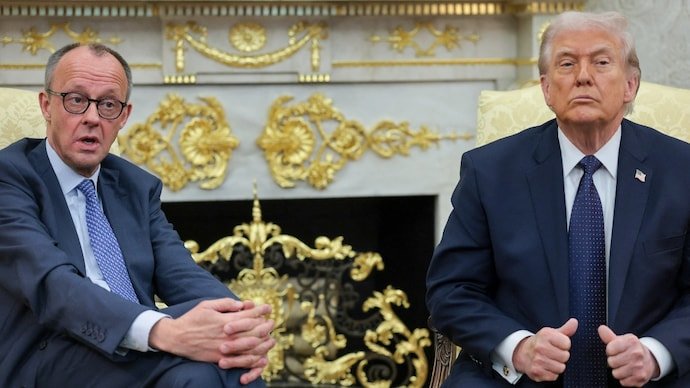
German Chancellor Friedrich Merz is facing renewed political pressure after his centre-right Christian Democratic Union (CDU) suffered defeats in two state elections, including falling below the electoral threshold in Mecklenburg-Western Pomerania and losing its position as the second-largest party in Berlin.
The results have intensified questions about Merz’s authority as he attempts to push through reforms designed to revive Germany‘s sluggish economy. Merz said he would remain in office and continue with his programme despite the setbacks, while members of his governing coalition acknowledged that the results reflected growing public concerns about the federal government’s policies.
The biggest shock came in Mecklenburg-Western Pomerania, where the CDU received less than the 5% of the vote required to win seats in the state parliament. It marked the first time in the history of Germany’s modern federal republic that the CDU had failed to secure representation in a state legislature.
In Berlin, meanwhile, the CDU finished behind the Left Party, leaving the left-wing party in a strong position to attempt to lead the next city government. The CDU could still participate in government depending on coalition negotiations, but the result represented another setback for Merz’s party.
CDU suffers historic defeat in Mecklenburg-Western Pomerania
Merz acknowledged the seriousness of the result in Mecklenburg-Western Pomerania, describing the outcome as a “disaster”. Final results showed the CDU losing more than half of its previous support in the northeastern state.
The failure to cross the 5% threshold was particularly significant because the CDU has traditionally been one of Germany’s major political parties. Its exclusion from the legislature means that voters in the state will now see a parliament without representation from the party at the centre of the federal government.
Mecklenburg-Western Pomerania is not one of Germany’s largest states by population, and the CDU had already been relatively weak there. Nevertheless, the scale and nature of the defeat have political implications beyond the state’s borders because they add to a series of disappointing results for Merz.
The state is also located in Germany’s former communist east, where support for the far-right Alternative for Germany (AfD) has become particularly strong in recent elections.
AfD emerges as strongest party in Mecklenburg-Western Pomerania
The AfD emerged as the strongest political force in Mecklenburg-Western Pomerania. The result reinforces the party’s growing electoral presence in eastern Germany and creates another challenge for Germany’s established parties.
The centre-left Social Democrats, known as the SPD and a junior partner in Merz’s federal coalition, finished relatively close behind. State Premier Manuela Schwesig made opposition to the far right a central theme of her campaign, presenting herself and the SPD as a barrier against the AfD.
That contest contributed to a highly polarised election in which voters were concentrated around competing political camps. The dynamic squeezed several other established parties, including the CDU.
A three-party coalition involving left-leaning parties and led by Schwesig would have enough seats to form a majority in the new state parliament. Coalition negotiations will therefore determine how the election result translates into the next state government.
Berlin result creates another setback for Merz
The second election setback came in Berlin, where the CDU slipped behind the Left Party. The result leaves the Left in a stronger position to seek leadership of the next city government.
However, the CDU’s defeat does not automatically mean it will leave government. Coalition arithmetic and negotiations will determine which parties can form a governing majority.
The result is nevertheless politically important for Merz because Berlin has traditionally been a major national political centre. The CDU’s 2023 victory in the capital had ended a long period in which the party had struggled to win the city’s regional elections.
That victory was the CDU’s first in Berlin in 25 years, making the latest reversal particularly notable for the party’s national leadership.
Why the eastern German results matter for Merz
Neither Berlin nor Mecklenburg-Western Pomerania is sufficient on its own to determine the strength of Merz’s national position. State elections are shaped by local candidates, regional issues and the popularity of state governments, and voters do not necessarily cast their ballots in the same way in federal elections.
Yet the latest results arrive at a difficult moment for the chancellor. Two weeks earlier, the AfD defeated the CDU in Saxony-Anhalt, another eastern German state. That result had already raised questions about Merz’s authority and prompted speculation about whether pressure within the CDU could eventually produce a leadership challenge.
The additional losses make it harder for the chancellor to dismiss the earlier result as an isolated regional setback. They also highlight the difficulty facing the CDU as it attempts to compete with the AfD in eastern Germany while maintaining its position as the dominant centre-right party nationally.
The CDU’s poor performance in Mecklenburg-Western Pomerania is particularly relevant because the party was not merely defeated by another mainstream competitor. It failed to cross the threshold required for parliamentary representation altogether.
Merz faces pressure over economic reforms
The election results also come as Merz’s government works on an ambitious economic reform programme. Germany has struggled with prolonged economic weakness, industrial pressures and concerns about its international competitiveness.
The federal government’s reform agenda includes changes to the pension system, reductions in bureaucracy and tax relief aimed at low- and middle-income families.
Some of these measures could prove politically difficult because reforms to pensions and public spending affect large sections of the population. The government therefore faces a challenge in balancing the need for structural changes with public concerns about household finances, social security and economic uncertainty.
Members of Merz’s coalition have already expressed reservations about aspects of the government’s approach.
Matthias Miersch, head of the Social Democrats’ parliamentary group, said that Germany needs reforms but also argued that the government must take people’s concerns seriously. His comments reflect a broader tension within the coalition between the desire to make structural economic changes and the political need to maintain public support.
Coalition tensions could become more important
Merz leads a national coalition in which the SPD is the junior partner. The performance of the SPD in Mecklenburg-Western Pomerania gives the party additional political space to argue for its priorities, particularly where social protection and the impact of reforms are concerned.
The state election also demonstrated how different political strategies can produce very different outcomes. Schwesig’s campaign focused heavily on preventing the AfD from gaining power, while the CDU was unable to maintain enough support to remain in the state legislature.
At the federal level, Merz must therefore manage two challenges simultaneously: keeping his coalition together while convincing voters that his economic programme can deliver tangible improvements.
For the CDU, the question is not simply whether individual policies are popular. The party must also determine how it can distinguish itself from the AfD without losing voters on the right, while continuing to appeal to moderate and economically conservative voters who have traditionally supported the CDU.
CDU leadership backs Merz for now
Merz was scheduled to hold further meetings with the CDU leadership after the latest election results. His position will depend partly on the level of support he receives from influential regional figures within the party.
The CDU’s eight state governors backed the chancellor the previous week. However, the latest results are likely to renew discussion about whether that support represents firm political backing or simply a temporary effort to prevent internal divisions from becoming public.
There are no further state elections scheduled in Germany for the remainder of the year, giving Merz some time to concentrate on governing and defending his reform programme.
That period will not last indefinitely. Five state elections are scheduled for next year, including three in April. Those contests will provide another series of tests for the CDU and for Merz’s national leadership.
North Rhine-Westphalia will be a major test
One of the most politically significant elections next year will take place in North Rhine-Westphalia, Germany’s most populous state.
The state is led by senior CDU politician Hendrik Wüst, who has frequently been mentioned in political discussions as a possible successor to Merz. That makes the state’s election particularly important for the CDU’s internal balance, although an election result by itself would not determine the party’s national leadership.
The other state elections next year will also offer indications of how voters are responding to the federal government’s policies. None of the five contests, however, will take place in eastern Germany, where the AfD has established some of its strongest support.
That distinction matters because the political dynamics in eastern and western Germany differ considerably. A strong CDU performance in a western state would not necessarily address the party’s difficulties in regions where the AfD has become the leading force.
Calls for unity rather than a leadership change
Some senior CDU figures have argued against treating the latest election results as evidence that replacing Merz would solve the party’s problems.
Education Minister Karin Prien, who is also a deputy CDU leader, said she did not believe changing the party’s leadership would necessarily produce a different outcome. She argued that the CDU needs to discuss how it can regain acceptance and credibility among voters while working with Merz both as chancellor and party leader.
That position points to a broader issue facing the CDU. Leadership changes can alter a party’s public image, but they do not automatically resolve disagreements over economic policy, the party’s approach to the AfD or its appeal in eastern Germany.
The coming months will therefore be important for determining whether the latest defeats lead primarily to policy adjustments, changes in campaign strategy or deeper internal debate over the CDU’s direction.
What the results mean for Germany’s government
The latest state elections do not remove Merz from office, nor do they directly determine the composition of the federal government. Germany’s federal system gives state elections their own political dynamics, and the next federal election is separate from the regional contests.
However, the results can influence the political environment in Berlin. State-level defeats can weaken a national party leader’s authority, strengthen internal rivals and make coalition negotiations more complicated.
For Merz, the immediate challenge is to demonstrate that his government can deliver on its economic agenda while responding to voter concerns highlighted by the regional results.
The CDU’s historic failure to enter the Mecklenburg-Western Pomerania parliament is especially difficult to ignore. At the same time, the party retains substantial political influence nationally and remains central to Germany’s federal government.
The next phase will therefore be less about one regional election result and more about whether Merz can maintain support inside the CDU, preserve his governing coalition and build public confidence in his reform programme.
A difficult road ahead for Merz and the CDU
Friedrich Merz has responded to the latest defeats by insisting that he will remain in office and continue pursuing his plans for Germany’s economy. The immediate election calendar gives him several months without another state vote, but the political pressure created by the recent setbacks is unlikely to disappear on its own.
The CDU now faces questions about its declining support in parts of eastern Germany, competition from the AfD, coalition tensions with the SPD and the public response to potentially difficult economic reforms.
For Merz, the task is to turn his government’s reform agenda into policies that voters can understand and assess while maintaining unity within his own party and coalition. The next major tests will come with the state elections scheduled for next year, particularly in North Rhine-Westphalia.
Until then, the latest results leave Merz with a clear political problem: his party remains a central force in German Politics, but a series of regional defeats has exposed weaknesses that his government will have to address while it attempts to reshape Europe’s largest economy.
For breaking news and live news updates, like us on Facebook or follow us on Twitter and Instagram. Read more on Latest World on thefoxdaily.com.





COMMENTS 0