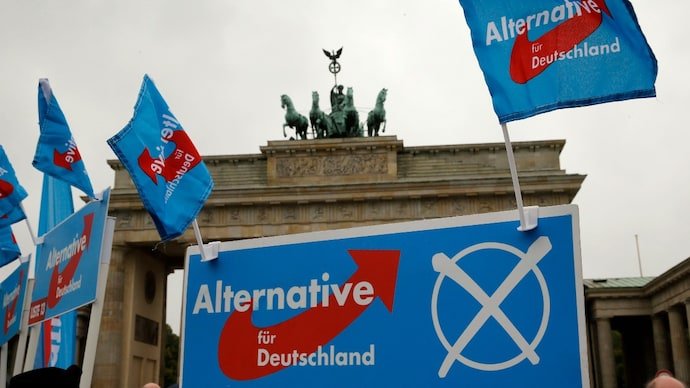
Germany’s far-right Alternative for Germany (AfD) has scored a landmark victory in the Saxony-Anhalt state election, becoming the strongest political force by a wide margin but failing to win enough seats to govern alone.
The AfD received 43.8% of the vote and won 39 of the 83 seats in the state Parliament, according to the final official results. An outright majority requires 42 seats, leaving the party three mandates short of its goal of forming the first far-right state government in Germany since the Second World War.
The result is simultaneously a historic breakthrough for the AfD and a major setback for Chancellor Friedrich Merz’s Christian Democratic Union (CDU). The CDU, which has led Saxony-Anhalt for 24 years, collapsed to just 17.2% and 15 seats, its weakest result in the state.
With Germany’s mainstream parties continuing to reject cooperation with the AfD, the election has produced an unusual political situation. The party that won by far the largest share of the vote cannot govern independently, while the parties opposed to it face their own difficulties in assembling a majority.
AfD more than doubles its previous result
The scale of the AfD’s victory is one of the most significant aspects of the election. In 2021, the party won 20.8% of the vote in Saxony-Anhalt. Its latest result of 43.8% more than doubles that performance.
The increase also gives the party its strongest result in any German state election. It transforms the AfD from a major opposition force into the dominant party in a state where traditional political alliances had long kept it away from executive power.
The result is especially notable because the AfD had openly set an ambitious target before the vote: an absolute majority that would allow it to govern without relying on another party.
It fell short of that goal, but the distance was smaller than many of its opponents had hoped. With 39 lawmakers in an 83-member parliament, the AfD controls nearly half of the legislature.
CDU suffers historic collapse
The election was a dramatic reversal for the CDU, which had governed Saxony-Anhalt for more than two decades and entered the contest as the incumbent political force.
The party won only 17.2% and 15 seats, down sharply from its 2021 performance. The scale of the decline means the election cannot simply be viewed as an AfD surge; it was also a major rejection of the established governing party.
The CDU’s result carries particular weight because the party is led nationally by Friedrich Merz, Germany’s chancellor. Although state elections are shaped by local issues, the result is likely to intensify questions about the popularity of the federal government and Merz’s ability to hold the political center.
Saxony-Anhalt has therefore become an important test of whether Germany’s mainstream parties can recover support in regions where the AfD has established a particularly strong electoral base.
Other parties leave no easy path to government
The election did not produce a simple two-party contest. The Social Democratic Party (SPD) secured 9.3%, the Greens won 8.9%, and the Left Party received 8.6%. Each won eight seats.
The Sahra Wagenknecht Alliance, or BSW, crossed the five-percent threshold with 5.3% and entered the parliament with five seats.
The Free Democratic Party, which had been part of the outgoing state government, failed to reach the threshold and received just 2.6%.
These results create a difficult arithmetic problem for the parties seeking to keep the AfD out of government. The CDU, SPD and Greens together hold only 31 seats. Adding the Left would bring that bloc to 39, still three short of the 42 required for a majority.
That means the anti-AfD parties cannot easily reproduce a conventional governing alliance without finding another parliamentary arrangement or relying on a more complicated form of minority government.
Germany’s “firewall” remains the central issue
The biggest obstacle to an AfD-led government is political rather than mathematical.
Germany’s mainstream parties have maintained a long-standing refusal to cooperate with the AfD, often described as the political “firewall”. The policy reflects the party’s classification by domestic intelligence authorities as a proven right-wing extremist organisation in several regional contexts, including Saxony-Anhalt.
The AfD rejects allegations of extremism and argues that such assessments are politically motivated.
For the CDU, however, the election has not changed its position. Party officials have ruled out cooperation with the AfD, meaning that even after becoming the strongest party, the AfD cannot simply expect the second-largest party to join an administration with it.
This is where the election result becomes an impasse. The AfD has the largest mandate, but its principal potential partners refuse to work with it.
Ulrich Siegmund calls result historic
AfD lead candidate Ulrich Siegmund, 35, presented the result as a historic breakthrough.
He argued that voters had sent a strong signal for political change and portrayed the result as evidence that the existing political direction could no longer continue.
Siegmund also suggested that Chancellor Merz’s political approach had helped the AfD’s campaign, describing the chancellor as a particularly effective campaigner for the party.
His comments reflect the AfD’s broader argument that dissatisfaction with the federal government, particularly over economic conditions and migration, is pushing voters toward the far right.
AfD co-leader Alice Weidel likewise described the result as a major success and said the party had received a clear mandate to govern.
What the AfD wants to change in Saxony-Anhalt
The AfD’s strong showing is not simply a protest vote without a policy programme. Its campaign in Saxony-Anhalt has focused heavily on migration, social benefits, Education and cultural issues.
Siegmund has promoted what he calls a “deportation offensive” and argued for reducing incentives for migrants to come to Germany and access the country’s welfare system.
The party’s regional programme also supports home-schooling, which is currently prohibited in Germany, and seeks restrictions on the display of rainbow flags at schools.
On foreign policy, the AfD opposes financial support for Ukraine and supports lifting sanctions against Russia. Many of these issues fall primarily under federal rather than state authority, but they remain important because state elections increasingly serve as a referendum on national political debates.
Migration remains a major driver of AfD support
The AfD’s success in eastern Germany has been closely linked to opposition to immigration and dissatisfaction with established political parties.
The party uses the term “remigration” in discussions about deporting immigrants, while opponents argue that its broader migration programme is part of a far-right political agenda.
Germany’s domestic intelligence authorities have pointed to hostility toward migrants from Muslim-majority countries among the issues surrounding the classification of some AfD regional organisations.
The party rejects the extremist label and says the designation reflects political hostility toward its positions.
Whatever the competing interpretations, migration has become one of the strongest issues connecting the AfD’s eastern German support base to wider dissatisfaction with mainstream Politics.
Record turnout strengthens the significance of the result
The election also produced exceptionally high voter participation. Turnout reached 77.8%, a substantial increase from 60.3% in 2021 and the highest level recorded in the state since German reunification.
The rise matters because the AfD appears to have benefited not only from retaining its existing supporters but also from mobilising voters who had previously stayed away from elections.
A larger electorate can change the political significance of a result. Rather than winning amid widespread disengagement, the AfD secured its record performance in an election that attracted a much bigger share of eligible voters.
That will likely strengthen the party’s argument that it has received a genuine public mandate rather than simply benefiting from unusually low turnout among its opponents.
Why forming a government could take time
The immediate challenge is finding a governing structure that can command the required majority while respecting the parties’ stated coalition red lines.
A conventional CDU-SPD-Green coalition would not have enough seats. Adding the Left Party would still leave the combined bloc below the majority threshold.
That makes negotiations unusually complicated. The CDU could attempt to construct a minority administration, seek issue-by-issue support from other parties or explore other parliamentary arrangements. But each option carries political risks.
The BSW may become particularly important because its five seats could influence the parliamentary balance. Yet cooperation involving the BSW would raise its own political questions and would not automatically create a straightforward solution.
The AfD, meanwhile, needs outside support to reach a majority. Its path to government therefore depends on whether another party is willing to break, weaken or reinterpret the established firewall.
Thuringia provides a warning but not a direct template
The election is not the first time the AfD has emerged as the strongest party in a German state without taking control of the government.
In neighbouring Thuringia, the AfD previously became the largest party, but the CDU subsequently helped form a minority government instead of entering an administration with the far-right party.
Saxony-Anhalt presents a different mathematical challenge. A coalition designed to keep the AfD out of power could require support from the Left Party, while the CDU has traditionally refused to include the Left in a governing coalition.
The result therefore exposes a structural problem created by the firewall: refusing cooperation with one party can leave other parties with fewer options to construct a stable majority.
Why the election matters beyond Saxony-Anhalt
The significance of the result goes far beyond the state itself.
The AfD is already the largest opposition party in Germany’s federal parliament. A state election victory of this scale strengthens its claim that it is moving from protest politics toward genuine governing potential.
Even without controlling the state government, the party now has greater influence over the political conversation. Mainstream parties will face pressure to explain why so many voters have moved away from them and toward the AfD.
For Merz, the result creates an especially difficult political signal. The CDU did not merely lose first place; it fell to less than half of the AfD’s vote share.
That gap could fuel renewed debate over the CDU’s migration policies, economic strategy and approach to the AfD.
Saxony-Anhalt also matters in Germany’s federal system
Germany’s states have meaningful political powers, including responsibilities involving education and aspects of internal security. That gives state governments real influence even when they cannot determine national foreign policy or immigration rules.
The election also affects the Bundesrat, Germany’s upper house, where the governments of all 16 states participate in votes on certain federal legislation.
Saxony-Anhalt holds four of the Bundesrat’s 69 votes. The composition of its state government can therefore have implications beyond Magdeburg, particularly when federal legislation requires state support.
This is another reason the question of government formation matters. The political consequences of the election will not remain confined to the state parliament.
Merz faces a broader political warning
The CDU’s collapse in Saxony-Anhalt adds to growing pressure on Merz and his governing coalition to respond to concerns over Germany’s Economy, migration and the direction of national policy.
The AfD has been particularly successful in eastern Germany, where historical differences, economic disparities and dissatisfaction with mainstream politics have created conditions for stronger support for the far right.
But the size of the victory makes it harder for national leaders to dismiss the result as a purely regional phenomenon.
The central question for the CDU is now whether it can recover voters without either adopting positions that strengthen the AfD’s agenda or breaking the political firewall that has kept the far-right party outside government.
What happens next in Saxony-Anhalt?
The immediate political focus will turn to coalition negotiations and attempts to identify a candidate capable of securing the necessary parliamentary support.
The AfD has emerged as the largest party, but its lack of a majority prevents it from forming a government alone. The CDU and other mainstream parties face the opposite problem: they have enough combined seats to potentially prevent an AfD government, but no obvious coalition arrangement that comfortably reaches the majority threshold without crossing established political red lines.
That could lead to prolonged negotiations, a minority government or an alternative parliamentary arrangement before a stable administration is established.
The situation also leaves open the possibility that the AfD’s electoral strength will become a major issue in future elections elsewhere in Germany.
Saxony-Anhalt election results at a glance
| Party | Vote share | Seats |
|---|---|---|
| AfD | 43.8% | 39 |
| CDU | 17.2% | 15 |
| SPD | 9.3% | 8 |
| Greens | 8.9% | 8 |
| Left Party | 8.6% | 8 |
| BSW | 5.3% | 5 |
| FDP | 2.6% | Did not enter parliament |
AfD wins the election, but not the power to govern alone
The Saxony-Anhalt election has delivered the AfD its strongest state-level result in German history while simultaneously demonstrating the limits of electoral dominance without a parliamentary majority.
With 43.8% of the vote and 39 seats, the party is unquestionably the state’s largest political force. Yet it remains three seats short of the 42 needed for an outright majority, leaving the next government uncertain.
For the CDU, the outcome is a historic setback after 24 years of state leadership. For the AfD, it is a breakthrough that brings it closer than ever to state-level power without actually delivering control of government.
The most consequential part of the result may therefore be what happens after election night. The AfD has won the vote, but Germany’s political firewall means winning the largest share of votes is not the same as being able to form a government. Saxony-Anhalt now faces a difficult test of whether its established parties can construct a stable administration while refusing cooperation with the party that dominated the election.
For breaking news and live news updates, like us on Facebook or follow us on Twitter and Instagram. Read more on Latest World on thefoxdaily.com.




COMMENTS 0