Sometimes a single sentence captures an entire national debate.
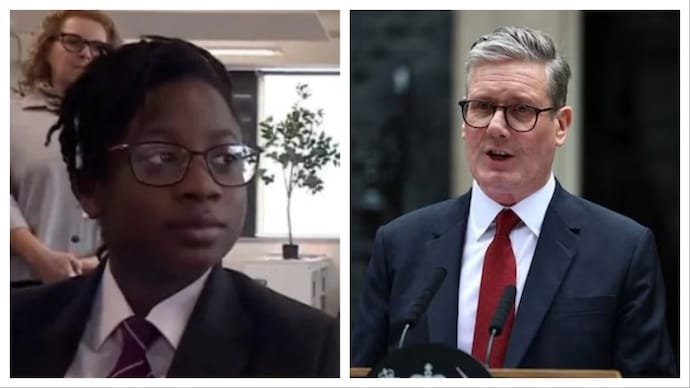
That is exactly what happened when a British teenager named Isabella responded to a BBC interviewer’s question about how she would spend her time if the government banned social media for children under 16.
Her answer was short, blunt, and instantly memorable:
“Stare at a wall.”
Within hours, the clip spread across social media platforms, generating millions of views, thousands of comments, and a wider conversation about whether governments should intervene in the digital lives of children.
The viral exchange came after UK Prime Minister Keir Starmer announced plans to prohibit under-16s from accessing major social media platforms beginning next year. The proposal would make Britain one of a growing number of countries introducing strict age-based restrictions on social media usage.
While supporters view the policy as a necessary step to protect children from online harms, critics argue it could isolate young people from important social connections and create enforcement challenges.
The debate has quickly evolved from a policy discussion into a broader examination of how Technology is reshaping childhood itself.
What Is the UK’s Proposed Social Media Ban?
The British government plans to introduce restrictions preventing children under the age of 16 from accessing major social media platforms.
The proposal forms part of a wider effort aimed at improving Online Safety and addressing concerns about the impact of excessive screen time on young people.
Platforms expected to fall under the restrictions include:
- TikTok
- Snapchat
- YouTube
- X (formerly Twitter)
Messaging applications used primarily for direct communication are expected to remain exempt from the ban.
Government officials have also indicated that additional measures may include:
- Restrictions on livestreaming
- Social media curfews
- Enhanced age verification systems
- Limits on interactions with strangers
- Additional protections in gaming platforms
The proposal follows extensive public consultation and growing political pressure to address concerns surrounding children’s online experiences.
Why Isabella’s Response Went Viral
The reason the clip resonated so strongly is that it highlighted a reality many adults suspect but rarely hear articulated so honestly.
For many teenagers, social media is not merely a source of Entertainment.
It is:
- A communication tool
- A social gathering space
- A news source
- A hobby platform
- A learning environment
- A core part of daily life
When Isabella joked about staring at a wall, many viewers interpreted her comment as a reflection of how deeply integrated social media has become in modern adolescence.
Others saw it as evidence of overdependence on digital platforms.
The differing reactions reveal the central divide in the debate.
The Bigger Question: Is Social Media Replacing Traditional Childhood?
Perhaps the most important question raised by the Controversy is whether social media has fundamentally changed what it means to grow up.
Previous generations spent significant portions of their free time:
- Playing outdoors
- Reading books
- Watching television
- Participating in sports
- Meeting friends in person
- Developing offline hobbies
Today’s teenagers often divide that time between school, streaming services, gaming, messaging apps, and social media platforms.
This shift has occurred rapidly.
In little more than a decade, smartphones have become nearly universal among adolescents in many developed countries.
The result is a generation experiencing childhood in ways that previous generations never did.
The Mental Health Concerns Driving the Ban
Supporters of restrictions point to growing research suggesting that excessive social media use may contribute to Mental health challenges among some young people.
Several studies have identified links between heavy social media usage and:
- Anxiety symptoms
- Depression symptoms
- Sleep disruption
- Reduced attention spans
- Body image concerns
- Cyberbullying exposure
- Social comparison stress
Research published in medical and psychological journals has repeatedly found that adolescents spending multiple hours daily on social media often report poorer mental wellbeing compared with peers who spend less time online.
However, researchers also caution that the relationship is complex.
Social media may contribute to mental health problems in some cases, while young people already experiencing difficulties may also be more likely to spend greater amounts of time online.
The World Health Organization’s Growing Concerns
Health experts have increasingly expressed concern about problematic social media use among adolescents.
Reports from international health organizations have highlighted trends including:
- Increased screen dependency
- Sleep deprivation
- Emotional distress
- Reduced physical activity
- Digital fatigue
Many specialists argue that the issue is not necessarily social media itself but how platforms are designed.
Algorithms are often engineered to maximize engagement, encouraging users to spend more time scrolling, watching, and interacting.
For developing minds, critics argue this can create challenges that previous generations did not face.
The Case Against a Social Media Ban
Not everyone agrees that banning social media is the right solution.
Many experts warn that broad restrictions could create unintended consequences.
Critics argue that social media often provides important benefits for teenagers, including:
- Maintaining friendships
- Accessing educational content
- Finding support communities
- Expressing creativity
- Developing digital literacy skills
- Participating in public discussions
For some young people, online communities provide valuable support networks that may not exist offline.
This was one of Isabella’s own concerns during the BBC interview, where she emphasized the role social media plays in staying connected with friends and family.
Technology companies have also warned that strict bans could push young users toward less regulated corners of the internet.
How Other Countries Are Approaching the Issue
The United Kingdom is not acting alone.
Several governments are increasingly exploring age-based restrictions on social media access.
| Country | Approach |
|---|---|
| Australia | Introduced a nationwide social media ban for under-16s |
| Indonesia | Developing stronger age-based online protections |
| Malaysia | Exploring social media restrictions for minors |
| United Kingdom | Proposed under-16 social media ban with expanded protections |
This trend reflects growing concern among policymakers that existing safeguards may be insufficient to protect children in an increasingly digital world.
The Real Challenge: Can Such a Ban Actually Be Enforced?
One of the biggest questions surrounding the policy is enforcement.
Age verification remains one of the most difficult challenges facing internet regulators.
Governments and technology companies must determine how to verify users’ ages without creating excessive Privacy risks.
Potential solutions include:
- Identity verification systems
- Government-issued ID checks
- Facial age estimation technology
- Parental authorization mechanisms
- Third-party verification services
Each approach raises concerns about privacy, accuracy, accessibility, or implementation costs.
This means the success of the policy may ultimately depend as much on technological solutions as political decisions.
Parents Appear to Support Stronger Restrictions
One reason the government has moved forward is strong parental backing.
Public consultations have reportedly shown widespread support among parents and carers for establishing a legal minimum age for social media access.
Many parents cite concerns regarding:
- Screen addiction
- Online predators
- Cyberbullying
- Exposure to harmful content
- Sleep disruption
- Declining face-to-face interaction
For policymakers, this growing parental concern has become difficult to ignore.
Why Prince Harry and Meghan Support the Ban
The proposal has also received support from Prince Harry and Meghan, who have been vocal advocates for online safety and mental health awareness.
They argued that responsibility for children’s wellbeing should not rest solely on families.
Their position reflects a broader movement that seeks to place greater accountability on technology companies for the design and impact of their platforms.
This perspective argues that protecting children requires cooperation among governments, parents, schools, and digital platforms.
The Insight Most People Are Missing
Much of the debate focuses on whether social media is good or bad.
But that framing may be too simplistic.
The deeper issue is that society has conducted a massive digital experiment on an entire generation without fully understanding the long-term consequences.
Today’s teenagers are the first generation to spend nearly their entire adolescence connected to algorithm-driven social platforms.
Neither parents, educators, governments, nor technology companies possess decades of historical data showing how this experience will shape adulthood.
The UK’s proposed ban is therefore less about punishing teenagers and more about society attempting to recalibrate its relationship with digital technology.
Whether the solution is correct remains an open question.
What Teenagers Might Actually Do Without Social Media
Despite Isabella’s memorable joke, most experts believe young people would not literally spend their days staring at walls.
History suggests that when one activity becomes less dominant, alternatives often emerge.
Possible outcomes could include:
- Greater participation in sports
- Increased reading
- More face-to-face social interaction
- Growth in creative hobbies
- Higher family engagement
- Expanded educational activities
At the same time, many teenagers would likely seek alternative digital spaces, highlighting the importance of designing policies that address root causes rather than simply restricting access.
Future Outlook: A Defining Test for the Digital Age
The viral “stare at a wall” comment may ultimately be remembered as more than a humorous internet moment.
It encapsulates the central challenge facing modern societies: how to balance the benefits of digital connectivity with the need to protect children’s mental health and development.
The UK’s proposed Social Media Ban for under-16s represents one of the most ambitious attempts yet to answer that question.
Supporters believe it could reduce harmful online exposure and improve wellbeing. Critics fear it may limit access to valuable social and educational opportunities while proving difficult to enforce.
What is clear is that the debate is no longer confined to experts and policymakers. It has become a conversation involving parents, schools, technology companies, health professionals, and young people themselves.
And thanks to one teenager’s unexpectedly honest answer, that conversation now has a slogan everyone remembers: if social media disappears, what comes next? For Isabella, at least, the answer was simple stare at a wall.
For breaking news and live news updates, like us on Facebook or follow us on Twitter and Instagram. Read more on Latest World on thefoxdaily.com.






COMMENTS 0