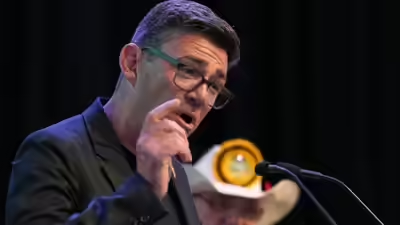
British politics received a significant jolt with Andy Burnham’s victory in the Makerfield by-election. The result does more than simply return the Greater Manchester mayor to Parliament. It potentially reshapes Labour’s internal balance of power, strengthens the position of one of the party’s most influential figures, and increases pressure on Prime Minister Keir Starmer at a time when his government is facing growing political challenges.
Burnham’s success in the north-west England constituency has reignited discussions about Labour’s future direction, Leadership stability, and electoral strategy. While Starmer insists he intends to remain in office and fight any leadership challenge, Burnham’s return to Westminster immediately changes the political calculus inside the governing party.
A Victory Bigger Than One Constituency
The Makerfield by-election was triggered by the resignation of Labour MP Josh Simons, creating an opportunity for Burnham to re-enter national politics after nearly a decade focused on regional leadership in Greater Manchester.
Burnham secured a convincing victory, winning nearly 55 percent of the vote and finishing more than 9,000 votes ahead of Reform UK candidate Rob Kenyon. The scale of the win was important not only because Labour retained the seat, but because Burnham demonstrated an ability to defeat Reform UK in a region where Nigel Farage’s party has been making significant inroads.
In recent years, Labour has struggled to maintain support across parts of northern England that were once considered its electoral heartland. Burnham’s performance therefore carries symbolic and strategic significance.
Political observers immediately interpreted the result as evidence that Burnham retains a unique appeal among working-class and centrist voters WHO have become increasingly difficult for Labour to reach.
Who Is Andy Burnham?
Burnham is hardly a newcomer to national politics.
Before becoming Mayor of Greater Manchester in 2017, he served in several senior government positions and contested Labour leadership Elections on multiple occasions. Over the years, he developed a reputation as a politician capable of connecting with voters beyond Westminster.
His mayoralty significantly enhanced that reputation.
During his time leading Greater Manchester, Burnham became one of Britain’s most recognisable regional leaders. He frequently challenged central government policies, advocated for greater devolution of powers, and promoted what supporters describe as a practical, locally focused style of governance.
His political philosophy has often been labelled “Manchesterism”—an approach centred on local empowerment, public service reform, community investment, and regional economic development.
Supporters argue that this model offers Labour a blueprint for rebuilding trust among voters who have become disillusioned with traditional party politics.
Why Keir Starmer Is Under Pressure
Although Labour won a landslide general election victory in 2024, governing has proven considerably more difficult than campaigning.
Starmer entered office promising economic renewal, improved public services, and solutions to Britain’s cost-of-living challenges. However, many voters remain dissatisfied with the pace of change.
Economic growth has remained sluggish, pressure on public services continues, and household financial concerns persist. These issues have gradually eroded the government’s popularity.
Labour has also faced political pressure from multiple directions.
The party has lost some progressive voters to the Green Party while simultaneously facing stronger competition from Reform UK in traditional Labour strongholds. Managing these competing electoral pressures has become increasingly difficult for Starmer’s leadership team.
The Makerfield result arrives against this backdrop of growing frustration and internal unease.
The Leadership Question Refuses to Go Away
Burnham’s return to Westminster has inevitably revived discussions about Labour’s future leadership.
Several Labour figures have already expressed concerns about the government’s direction. The resignation of Health Secretary Wes Streeting earlier this year highlighted the extent of dissatisfaction within parts of the party.
Streeting’s criticism that Labour lacked a compelling vision added fuel to speculation about potential leadership alternatives.
Burnham’s by-election victory strengthens perceptions that he could emerge as the most serious challenger should a leadership contest occur.
Unlike many potential rivals, Burnham arrives with both national experience and a recent electoral mandate. His success in Greater Manchester and now Makerfield allows him to present himself as a politician capable of winning support across diverse voter groups.
That combination makes him particularly influential within current Labour debates.
Starmer’s Defiant Response
Despite growing speculation, Starmer has shown no intention of stepping aside.
Following Burnham’s victory, the Prime Minister publicly congratulated him while simultaneously reaffirming his commitment to remain Labour leader.
Starmer has repeatedly argued that he was elected on a mandate for change and intends to continue implementing his government’s programme.
His message has been consistent: if a leadership challenge emerges, he will contest it rather than resign voluntarily.
That stance reflects both political necessity and personal conviction. For a sitting Prime Minister, appearing uncertain or indecisive would only encourage further speculation about leadership instability.
However, maintaining authority becomes increasingly difficult when influential figures within the party begin discussing succession scenarios openly.
Can Burnham Actually Challenge?
While speculation is intense, transforming political momentum into an actual leadership challenge remains complicated.
Under Labour Party rules, a challenger requires support from at least one-fifth of Labour MPs. Given Labour’s current parliamentary numbers, that threshold stands at 81 MPs.
Reaching such a figure would require substantial support from across different ideological factions within the party.
Burnham’s allies have indicated that he is unlikely to act hastily. Instead, many expect him to focus initially on rebuilding his parliamentary presence, establishing Relationships with MPs, and demonstrating his value inside Westminster.
This approach would allow him to strengthen his position while avoiding accusations of destabilising the government.
Nonetheless, simply returning to Parliament places him at the centre of every future leadership discussion.
Why Makerfield Matters Politically
The constituency itself offers important clues about Labour’s electoral challenges.
Makerfield sits within a region where Labour must successfully compete against both Conservative and Reform UK advances while retaining traditional support bases.
Burnham’s ability to secure a comfortable victory against Reform UK is therefore being closely studied by party strategists.
Many Labour MPs view his success as evidence that he possesses a political style capable of reconnecting the party with voters who feel neglected by mainstream politics.
This perception could become increasingly important if Labour’s national polling continues to weaken.
The Reform UK Factor
Another important aspect of Burnham’s victory is what it says about Reform UK’s future prospects.
Nigel Farage’s party has emerged as one of the most significant challenges facing Labour in post-industrial communities.
Reform has successfully tapped into voter frustrations surrounding Immigration, economic insecurity, and political dissatisfaction. Its growing influence has forced Labour to rethink aspects of its electoral strategy.
By defeating Reform convincingly in Makerfield, Burnham strengthened his argument that he understands how to neutralise the party’s appeal.
That achievement enhances his standing among Labour MPs concerned about future electoral threats.
What Happens Next?
Burnham is expected to take his seat in Parliament quickly and begin engaging with Labour’s national leadership.
Reports suggest he may seek discussions with Starmer regarding the party’s future direction and broader strategic challenges.
Whether those conversations lead to cooperation or confrontation remains unclear.
Some Labour figures hope Burnham can help strengthen the government from within. Others view his return as the beginning of a gradual leadership transition.
For now, both possibilities remain open.
The Bigger Picture for Labour
The significance of Burnham’s return extends beyond individual personalities.
At its core, the debate reflects broader questions about Labour’s identity, priorities, and electoral coalition.
The party must balance competing demands from progressive urban voters, traditional working-class communities, younger voters, and centrist supporters. Achieving that balance has become one of the defining challenges of modern British politics.
Burnham’s supporters argue that his local-government experience and emphasis on practical solutions offer a path forward. Starmer’s supporters contend that changing leaders would risk further instability at a critical moment.
The coming months will determine which argument proves more persuasive.
Conclusion
Andy Burnham’s Makerfield victory is far more than a routine by-election result. It returns one of Labour’s most recognisable and electorally successful politicians to Westminster at a moment when questions about the party’s future are becoming increasingly difficult to ignore.
For Keir Starmer, the result creates fresh political pressure and ensures that leadership speculation will continue. For Burnham, it provides a national platform from which he can influence Labour’s direction and potentially shape its future leadership debate.
Whether his return ultimately leads to a leadership challenge, a government role, or a broader reshaping of Labour’s strategy remains uncertain. What is clear is that British politics has gained a powerful new dynamic, and the battle over Labour’s future has entered a new phase.
For breaking news and live news updates, like us on Facebook or follow us on Twitter and Instagram. Read more on Latest World on thefoxdaily.com.






COMMENTS 0