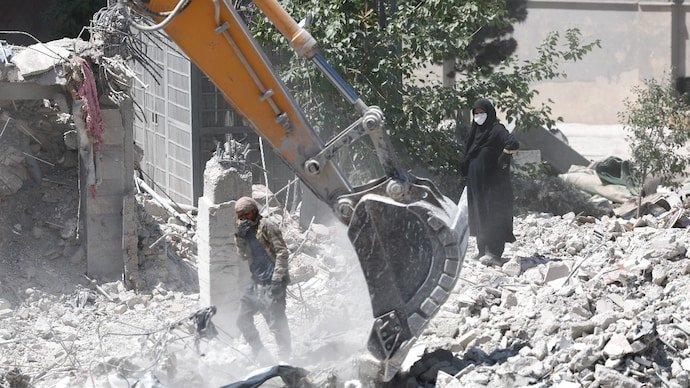
The escalating military confrontation between the United States and Iran has taken a new and controversial turn after Tehran claimed that recent US Strikes damaged critical water infrastructure in the coastal town of Sirik, disrupting access to drinking water for local residents. Iranian authorities allege that two water storage reservoirs were hit during overnight attacks, leaving parts of the city without a reliable water supply and raising broader concerns about the humanitarian consequences of military operations.
The development comes amid one of the most serious direct military exchanges between Washington and Tehran in recent years. What began as a dispute over the reported downing of a US Apache helicopter near the Strait of Hormuz has rapidly evolved into a wider confrontation involving missile attacks, drone operations, military strikes, and increasingly sharp rhetoric from both sides.
Beyond the immediate military implications, the reported damage to civilian infrastructure has introduced a new dimension to the crisis—one that could influence international opinion, diplomatic efforts, and discussions about the laws governing armed conflict.
What Iran Says Happened in Sirik
Iranian officials and state media reported that US strikes hit two water storage tanks located in the Bamani district of Sirik, a strategically located coastal town in Hormozgan Province near the Strait of Hormuz.
According to Iranian authorities, the strikes disrupted the town’s drinking water network, affecting residents who rely on the storage facilities for daily water access. The Iranian Consulate in Mumbai publicly condemned the incident, describing it as a humanitarian concern and arguing that civilian infrastructure should not become a target during military operations.
Iranian media further reported that the attacks also damaged a telecommunications tower, creating additional disruptions in the area.
If confirmed, such damage would represent more than a military setback. Water infrastructure is among the most sensitive civilian assets in any conflict zone because disruptions can quickly affect Public health, sanitation, and emergency services.
Why Water Infrastructure Is So Important During Conflicts
Military conflicts increasingly attract international scrutiny when civilian infrastructure is affected. Water systems are especially important because they directly impact the daily lives of ordinary people who are not involved in military operations.
When drinking water systems are disrupted, communities can face several immediate challenges:
- Reduced access to safe drinking water
- Increased public health risks
- Pressure on emergency response services
- Higher dependence on water deliveries
- Potential sanitation concerns
- Economic disruption for local businesses
In coastal communities such as Sirik, where environmental conditions can already create water management challenges, damage to storage facilities may have a significant local impact until repairs are completed.
| Impact of Water Infrastructure Damage | Potential Consequences |
|---|---|
| Loss of Drinking Water | Immediate hardship for residents |
| Reduced Sanitation Capacity | Higher public health risks |
| Emergency Resource Demand | Need for temporary water distribution |
| Economic Disruption | Operational challenges for businesses |
| Community Stability | Increased pressure on local authorities |
How the Crisis Escalated So Quickly
The reported damage to Sirik’s water infrastructure occurred amid a rapidly deteriorating Security situation in the Gulf region.
The confrontation intensified after US President Donald Trump accused Iran of bringing down an American Apache helicopter near the Strait of Hormuz. According to US officials, the helicopter was allegedly struck by an Iranian one-way attack drone.
Washington responded with military strikes targeting Iranian radar installations, surveillance systems, air defense assets, and command facilities near the strategic waterway.
The United States described the operation as a proportional act of self-defense aimed at protecting American personnel and preventing future attacks.
Iran, however, denied conducting offensive operations in the area and accused Washington of escalating tensions through military action.
The Strategic Importance of Sirik and Hormozgan Province
Sirik is not a widely known city internationally, but its location gives it strategic significance. Situated along Iran’s southern coastline, the town lies near one of the world’s most important maritime routes.
Hormozgan Province serves as a critical gateway to the Strait of Hormuz, the narrow waterway connecting the Persian Gulf to international shipping lanes.
The province contains key transportation infrastructure, coastal facilities, military installations, ports, and communication networks that are important to both regional security and economic activity.
This strategic geography explains why military operations occurring near Hormozgan often attract attention from governments, energy markets, and defense analysts worldwide.
Why the Strait of Hormuz Remains a Global Flashpoint
The latest confrontation has once again highlighted the importance of the Strait of Hormuz in global Geopolitics.
The narrow shipping corridor serves as one of the world’s most important energy routes. A significant share of internationally traded oil and liquefied natural gas passes through the strait every day.
Any military confrontation near Hormuz immediately raises concerns about:
- Global oil supplies
- Energy price volatility
- Shipping route security
- Maritime insurance costs
- Regional economic stability
- International trade flows
Even when energy infrastructure itself is not directly targeted, uncertainty surrounding military operations can trigger reactions in financial and commodity markets.
Iran’s Countermoves and Warnings
Following the US strikes, Iran’s Revolutionary Guards announced that they had launched long-range missiles toward locations associated with the US al-Azraq base in Jordan. Iranian media reported that intended targets included facilities connected to fighter aircraft operations and command-and-control infrastructure.
Iranian officials also warned that any additional US military action would receive what they described as a “crushing and decisive” response.
These statements reflect a broader strategy aimed at demonstrating deterrence while signaling that Iran remains willing to respond militarily if it believes its interests are under threat.
The exchange has created fears that a cycle of retaliation could increase the risk of broader regional instability.
The Humanitarian Dimension Often Missing From Headlines
Much of the coverage surrounding military confrontations focuses on weapons, troop movements, and strategic objectives. However, incidents involving civilian infrastructure often have consequences that extend beyond the battlefield.
The reported damage to Sirik’s water storage facilities highlights an important reality: modern conflicts frequently affect essential services that civilians depend on every day.
Whether through direct damage, power outages, communication disruptions, or transportation interruptions, communities can experience significant hardships even when they are not the intended targets of military operations.
This humanitarian aspect may increasingly become part of the international debate surrounding the latest confrontation.
International Law and Civilian Infrastructure
One of the key questions likely to emerge from the Sirik incident concerns the protection of civilian infrastructure during armed conflicts.
International humanitarian law generally emphasizes the need to distinguish between military objectives and civilian facilities. Water systems, hospitals, schools, and other essential services receive special attention because of their importance to civilian populations.
Whenever reports emerge that critical infrastructure has been damaged, governments, humanitarian organizations, and international observers often seek additional information to determine the circumstances surrounding the incident.
The issue becomes especially sensitive when access to necessities such as drinking water is affected.
How Global Energy Markets Are Watching the Situation
Beyond the humanitarian concerns, financial markets are closely monitoring developments in the Gulf.
Energy traders understand that military tensions near the Strait of Hormuz can influence global oil prices even if no major disruptions occur.
| Area of Concern | Potential Impact |
|---|---|
| Oil Exports | Price volatility in energy markets |
| Shipping Routes | Higher transportation costs |
| Insurance Premiums | Increased costs for cargo operators |
| Regional Security | Greater military deployments |
| Global Trade | Supply chain uncertainty |
Investors are particularly focused on whether the latest exchange remains limited or develops into a prolonged period of confrontation.
The Bigger Geopolitical Question
The most significant issue may not be the individual strikes themselves but what they signal about the future of US-Iran Relations.
Recent years have seen periodic spikes in tensions, but direct military exchanges between the two countries remain relatively rare. The latest confrontation has increased concerns that both sides may be entering a more dangerous phase of competition.
Military analysts note that even when neither side seeks a full-scale war, misunderstandings, accidents, or retaliatory actions can create a cycle that becomes increasingly difficult to control.
The reported damage to civilian infrastructure adds another layer of complexity because it introduces humanitarian considerations into an already volatile geopolitical dispute.
Future Outlook: What Happens Next?
The coming days will likely determine whether the confrontation remains contained or expands further.
Several developments will be closely watched:
- Restoration of water services in Sirik
- Potential additional military actions
- Regional diplomatic efforts
- Naval activity near the Strait of Hormuz
- International reactions to humanitarian claims
- Energy market movements
Diplomatic channels may become increasingly important as regional and global powers seek to prevent further escalation.
Conclusion
Iran’s claim that US strikes damaged water infrastructure in Sirik has transformed an already serious military confrontation into a broader humanitarian and geopolitical issue. The reported loss of drinking water access highlights how modern conflicts can affect civilian populations even when military objectives remain the primary focus.
At the same time, the incident underscores the continuing strategic importance of the Strait of Hormuz and the wider Gulf region. As both Washington and Tehran exchange warnings and military actions, the world is watching closely for signs of either escalation or de-escalation.
Whether the situation stabilizes or intensifies, the events in Sirik serve as a reminder that conflicts in strategically important regions often carry consequences that extend far beyond military calculations, affecting communities, economies, and international security alike.
For breaking news and live news updates, like us on Facebook or follow us on Twitter and Instagram. Read more on Latest World on thefoxdaily.com.




COMMENTS 0