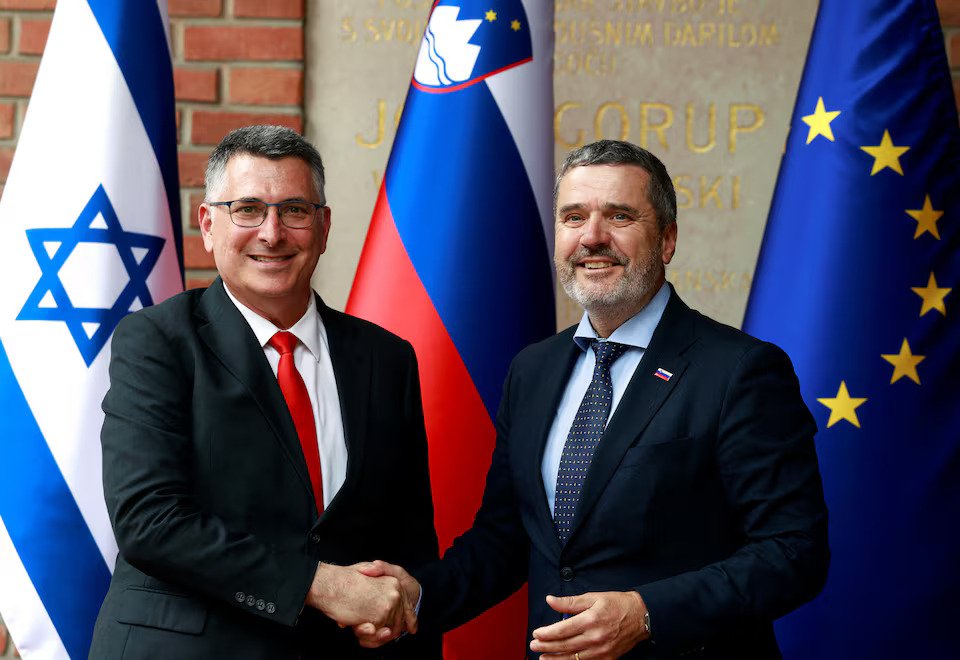
Israel has opened its first resident embassy in Slovenia, marking a significant upgrade in bilateral relations just as debate over Israeli settlements in the occupied West Bank is intensifying across Europe. Israeli Foreign Minister Gideon Saar travelled to Ljubljana for the inauguration on Wednesday, September 9, 2026, where he met Slovenian Foreign Minister Tone Kajzer and promoted closer political and economic cooperation between the two countries.
The opening carries significance beyond the establishment of a new diplomatic mission. It reflects a sharp reversal in Slovenia’s approach to Israel following the formation of a new right-of-centre government led by Prime Minister Janez Janša in June. The previous government under Robert Golob had recognised Palestine, imposed several measures against Israel and taken a particularly critical position on the Gaza war and Israeli settlement policy.
Janša’s government has since removed or reversed several of those measures, creating a new political alignment with Israel. That shift has also triggered Protests inside Slovenia, criticism from the opposition and a broader argument over whether Ljubljana is moving away from its earlier emphasis on international law and Palestinian statehood.
Why Israel’s new Slovenia embassy matters
Israel and Slovenia have maintained diplomatic relations for decades, but Israel’s interests in Slovenia were previously handled through its embassy in Vienna. The new mission in Ljubljana gives Israel a permanent diplomatic presence in the country and is designed to deepen direct political, commercial, scientific and cultural engagement.
The move is particularly notable because Slovenia is a member of the European Union. Israel has increasingly faced disagreements with European governments over the war in Gaza, the humanitarian situation, settlement expansion and the future of a two-state solution.
Against that backdrop, opening an embassy in a European country that has recently changed course is both a diplomatic and symbolic development. For Israel, it creates a more permanent channel with a government that is currently seeking closer ties. For Slovenia, the embassy reflects its new foreign-policy direction under Janša.
Saar described the opening as a historic moment and presented Israel as a key security partner for Europe. His message was not limited to bilateral relations. He linked Israel’s security role to wider European security interests and argued that Israel remained an important strategic partner for the West.
Slovenia’s foreign-policy reversal under Janez Janša
The diplomatic upgrade would have been difficult to imagine under Slovenia’s previous government, which adopted some of Europe’s stronger national measures against Israel.
Under former Prime Minister Robert Golob, Slovenia formally recognised the State of Palestine in June 2024. The government subsequently adopted measures restricting military cooperation with Israel and moved against trade connected to Israeli settlements in the occupied Palestinian territories.
Slovenia also imposed entry restrictions on senior Israeli officials, including Prime Minister Benjamin Netanyahu and ministers Itamar Ben-Gvir and Bezalel Smotrich. Those decisions reflected Golob’s government’s stated emphasis on international humanitarian law and opposition to Israeli policies in Gaza and the West Bank.
That approach changed after Janša’s government took office on June 4, 2026. His administration moved to repeal or end several of the previous government’s measures against Israel and adopted a markedly different diplomatic tone.
The reversal means Slovenia has moved from being one of Israel’s sharper critics within the European Union to a government actively expanding bilateral ties. The embassy is therefore more than a technical diplomatic change; it is a visible marker of that political transition.
The Palestinian flag became an early symbol of the change
One of the most visible signs of the new government’s approach came shortly after Janša took office.
The Palestinian flag had been displayed on Slovenia’s government building alongside the Slovenian, European Union and Ukrainian flags under the previous administration. Janša’s government removed it, a decision that quickly became part of the domestic political argument over Slovenia’s new foreign-policy direction.
Janša has defended the broader policy reversal, arguing that his government is trying to repair damage caused by the previous administration. He has accused the former coalition of pursuing what he described as anti-Israel policies that harmed Slovenia economically and diplomatically.
The disagreement is therefore not simply about Israel. It also reflects a deeper domestic clash between two competing visions of Slovenia’s role in European foreign policy: one centred on stronger political pressure over Israel and Palestinian rights, and another focused on rebuilding direct relations and maintaining broader strategic and economic partnerships.
Opposition says embassy marks a move away from international law
Slovenia’s policy shift has provoked strong resistance from the opposition.
Golob, whose government established many of the measures now being reversed, has accused Janša of moving Slovenia away from its previous commitment to international law. His Freedom Movement party has said it would pursue parliamentary action against Janša and Foreign Minister Kajzer in response to their policies.
The embassy opening has consequently become a domestic political issue as well as an international one. Critics argue that improving relations with Israel while settlement expansion remains a major international concern sends the wrong political signal.
The dispute has also spilled into Slovenia’s role within the EU. Reports in recent weeks have suggested that Ljubljana sought to soften the wording of European criticism concerning Israeli settlements. The move reportedly drew criticism from Slovenian opponents while receiving a more favourable response from Israeli officials.
Kajzer has rejected accusations that Slovenia attempted to block European action, saying the country is contributing constructively to internal discussions. The disagreement illustrates the wider challenge facing EU governments: member states often agree on broad principles concerning international law while differing significantly on how strongly those principles should shape national policy toward Israel.
Pro-Palestinian protesters gather outside new embassy
The diplomatic ceremony did not take place without opposition. Hundreds of pro-Palestinian protesters gathered outside the new Israeli embassy, demanding that the mission be closed.
The demonstrations underlined the gap between the government’s new foreign-policy direction and parts of Slovenian civil society. Students, left-wing groups and pro-Palestinian activists have continued to criticise Israel’s military campaign in Gaza and settlement policy in the West Bank.
The protests also demonstrate why the embassy carries a significance beyond Israel-Slovenia relations. The mission has opened at a time when Israel’s actions in Gaza remain deeply contested internationally and when settlement policy has triggered fresh economic and diplomatic measures from several Western governments.
Europe’s settlement dispute is widening
The timing of the embassy opening is especially important.
Israel is facing increasing pressure from some European countries over Israeli settlements in the occupied West Bank. Britain has announced restrictions on trade connected to settlements, while France and Canada have also moved toward similar measures.
Those decisions have added another layer to the diplomatic conflict surrounding Israel. The settlement issue is distinct from the Gaza war, but the two are increasingly linked in international discussions about the future of the Israeli-Palestinian conflict.
Under widely held interpretations of international law, Israeli settlements in territory occupied since 1967 are regarded as illegal. Israel rejects that legal and political characterisation and has long disputed aspects of the international consensus surrounding the status of the territories.
The widening European response suggests that settlement policy is becoming an increasingly important area of Western pressure, particularly as governments debate whether economic measures should be directed at settlement-related activity while maintaining wider relations with Israel itself.
Why Slovenia’s position is important inside the EU
Slovenia is a relatively small EU member, but its position can still matter because foreign-policy debates in the bloc are heavily influenced by the question of how far individual states are prepared to go against Israel.
During the previous government, Slovenia was among the countries pushing for stronger European action and was willing to adopt national measures when EU-wide agreement proved difficult.
The Janša government has chosen almost the opposite strategy. Instead of using pressure as the main diplomatic instrument, it is emphasising direct engagement and bilateral cooperation.
That difference could affect future discussions within the EU, particularly on sanctions, settlement-related trade, recognition of Palestinian statehood and the bloc’s wider response to the Gaza conflict.
It also illustrates an often overlooked reality of European diplomacy: changes in one national government can quickly alter the balance of opinion inside the wider EU debate.
Israel sees Europe as a security partner
Saar used the embassy opening to make a broader argument about Israel’s relationship with Europe.
He presented Israel as a democratic partner and emphasised the country’s security role in a region facing prolonged conflict and instability. His comments suggested that Israel wants European governments to view cooperation through a wider strategic lens rather than focusing exclusively on disagreements over settlements and Gaza.
That message is likely to resonate more strongly with governments that prioritise defence cooperation, counterterrorism and strategic relations with Israel. It is less likely to persuade European governments and political groups that see the occupation and settlement expansion as central obstacles to lasting peace.
The contrasting approaches are increasingly visible across Europe, making diplomatic relationships with Israel more politically consequential for individual governments.
New cooperation agreement expands ties beyond politics
The embassy opening was accompanied by practical steps to broaden bilateral cooperation.
Kajzer and Saar signed a cooperation programme covering Education, science, culture, youth and sport for the 2026–2030 period. A business forum was also held in Ljubljana, giving the visit an economic dimension alongside its political significance.
These areas could provide a less controversial foundation for the relationship. Science and technology cooperation, educational exchanges and commercial links can continue even when governments disagree over Middle East policy.
For Slovenia, closer economic and technological engagement with Israel also fits the new government’s broader interest in expanding international business partnerships. For Israel, stronger ties with a European Union member offer opportunities for deeper institutional and commercial connections within the European market.
Public opinion may not fully match the government’s policy
The political shift has raised an important question about how closely government policy reflects public sentiment in Slovenia.
Political analyst Andraz Zorko said the new direction does not necessarily correspond to what he sees as the dominant mood among Slovenian voters. According to his assessment, much of the public is either opposed to Israel or holds a neutral position.
That gap could become important if the issue remains politically prominent. The government can change foreign-policy measures relatively quickly, but public attitudes evolve more slowly and can influence future elections, parliamentary debates and civil society activism.
The protests outside the embassy suggest that Israel policy will continue to be contested domestically rather than disappearing from Slovenia’s political agenda after the opening ceremony.
What the embassy opening means for Israel
For Israel, the new embassy provides several advantages at once.
It strengthens direct diplomatic access to the Slovenian government, creates a permanent platform for economic and cultural outreach, and signals that bilateral relations can improve even while other Western partners adopt tougher measures over settlements.
The opening also gives Israel an opportunity to develop closer connections with sectors of Slovenian society beyond government, including businesses, universities and cultural institutions.
But the timing also highlights the contradiction at the centre of Israel’s current European diplomacy. While some countries are tightening restrictions over settlements and the Gaza war, others are seeking closer engagement. Israel is therefore operating in a European Environment that is becoming more divided rather than uniformly hostile or supportive.
What comes next for Slovenia-Israel relations
The immediate focus will likely shift from the symbolism of the embassy to whether the new diplomatic relationship produces measurable results.
That could include stronger trade, research partnerships, educational exchanges, technology cooperation and more frequent high-level political visits. The new 2026–2030 cooperation programme provides a formal framework for some of that work.
At the same time, the Israeli-Palestinian conflict will remain the biggest source of political tension around the relationship. Slovenian opposition parties and civil society groups are unlikely to abandon their criticism simply because diplomatic ties have been upgraded.
The government will also have to balance its closer relationship with Israel against Slovenia’s position within the European Union, where settlement policy and the war in Gaza remain highly divisive issues.
A diplomatic upgrade with wider European consequences
Israel’s first resident embassy in Slovenia is therefore about much more than opening a new building in Ljubljana. It marks the clearest expression yet of the dramatic foreign-policy change brought by Janez Janša’s return to the premiership in June 2026.
The previous government made Slovenia one of Israel’s stronger European critics, recognising Palestine and introducing measures against Israel. The new government has reversed that trajectory, restored diplomatic engagement and now welcomed Israel’s permanent diplomatic presence.
Yet the embassy has opened amid protests, opposition demands for parliamentary action and a widening European dispute over Israeli settlements. That makes the new mission both a symbol of improved bilateral relations and a focal point for Slovenia’s unresolved debate over how it should respond to Israel, Palestine and international law.
For Israel, the Ljubljana embassy represents a diplomatic foothold in a country that has changed direction. For Slovenia, it is a test of whether closer engagement with Israel can deliver practical benefits without deepening the domestic and European political divisions surrounding the Middle East.
For breaking news and live news updates, like us on Facebook or follow us on Twitter and Instagram. Read more on Latest World on thefoxdaily.com.





COMMENTS 0