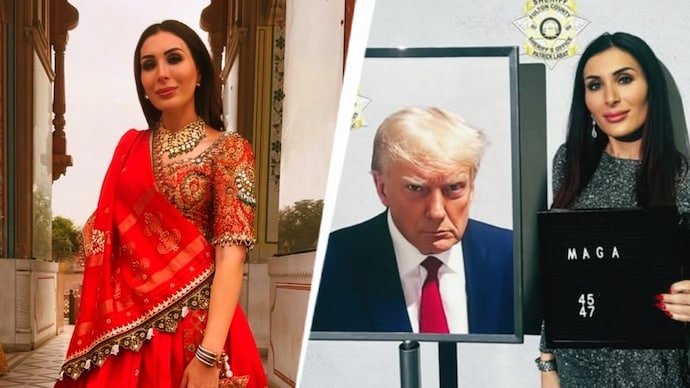
For years, conservative activist Laura Loomer built part of her online identity around fierce criticism of Indian immigrants, H-1B visa holders and multicultural immigration policies in the United States. Her social media posts often targeted Indian professionals working in America’s tech industry, using rhetoric that many critics described as openly racist and xenophobic.
But politics in the age of social media moves quickly and sometimes awkwardly.
This week, Loomer surprised even longtime followers after publicly praising India during US Secretary of State Marco Rubio’s high-profile diplomatic visit to the country. Posting nostalgic comments about her own India trip earlier this year, Loomer described India as “beautiful” and said she wanted to return after seeing Rubio’s photos from Agra, Delhi and Jaipur.
The internet’s response was immediate.
Critics accused Loomer of hypocrisy, pointing to archived posts where she mocked Indian workers, attacked H-1B visa holders and made inflammatory comments about Indian culture. Supporters of tighter immigration policies, meanwhile, questioned whether her tone shift reflected changing political calculations within Donald Trump’s broader MAGA movement.
But beyond the social media drama, the controversy highlights something much bigger: the growing tension between America’s economic dependence on Indian talent and the political backlash against globalisation inside US politics.
And that tension is becoming increasingly difficult for American politicians to navigate.
Why Laura Loomer’s India Comments Became Such a Big Story
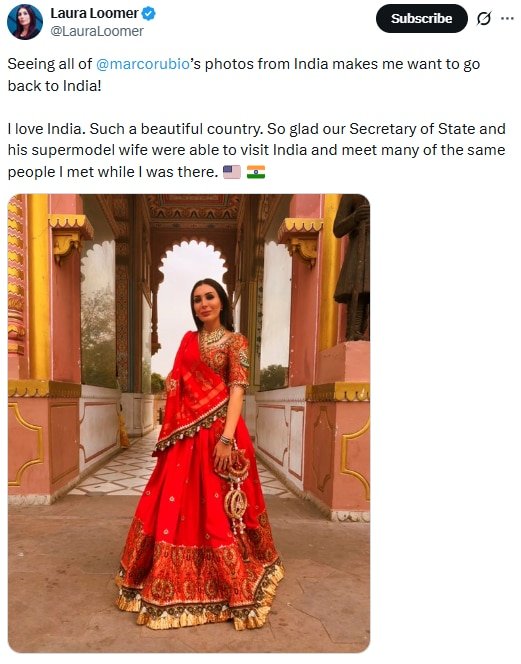
On the surface, the controversy may look like another internet pile-on involving an influencer or political activist. But the story gained traction because it touches several sensitive issues at once:
- US immigration policy
- H-1B visa debates
- US-India diplomatic relations
- MAGA politics
- Race and identity discourse in America
- The influence of Indian professionals in Silicon Valley
Laura Loomer is not a fringe internet personality operating in isolation. She has remained closely associated with Donald Trump’s political ecosystem and has frequently amplified nationalist narratives around immigration, outsourcing and “America First” labor policies.
That is precisely why her sudden appreciation for India drew so much attention.
To critics, it appeared less like personal growth and more like political repositioning.
Especially because her comments came during a moment when US-India relations are strategically stronger than ever.
Marco Rubio’s India Visit Added a Diplomatic Layer
The timing of Loomer’s comments mattered.
US Secretary of State Marco Rubio’s four-day India visit was not simply a tourism-heavy diplomatic stop. It represented a broader strategic effort by Washington to deepen ties with New Delhi at a time when global power balances are shifting rapidly.
Rubio met Indian officials, discussed trade cooperation, Security partnerships and Indo-Pacific strategy, while also visiting major cultural landmarks like the Taj Mahal and Jaipur’s Amber Fort.
Those images carried symbolic importance.
India is no longer viewed in Washington merely as a developing Economy or outsourcing hub. Increasingly, American policymakers see India as:
- A critical counterweight to china
- A strategic technology partner
- A supply chain alternative
- A defense ally in the Indo-Pacific
- A major market for American companies
That geopolitical reality creates an uncomfortable contradiction for hardline anti-immigration voices in America.
Because while parts of the MAGA movement continue attacking Indian workers through the H-1B debate, the US government simultaneously wants deeper strategic alignment with India itself.
The H-1B Visa Debate Is Really About America’s Economic Anxiety
To understand why Laura Loomer repeatedly targeted Indian professionals in the past, it is important to understand the politics surrounding the H-1B visa system.
The H-1B visa program allows US companies to hire foreign workers in specialized fields such as software engineering, medicine, finance and Artificial Intelligence.
Indian professionals dominate the system.
| H-1B Visa Facts | Verified Trend |
|---|---|
| Largest H-1B recipient nationality | Indian nationals |
| Main industries using H-1B workers | Technology, engineering, healthcare |
| Major employers | US tech firms and outsourcing companies |
| Core political criticism | Claims of replacing American workers |
| Main defense of the program | Addresses skilled labor shortages |
According to publicly available US government immigration data over the past decade, Indian nationals consistently receive the overwhelming majority of H-1B approvals.
This dominance has turned Indian tech workers into symbolic targets during periods of economic anxiety in America.
Critics of the program argue that companies use H-1B visas to lower labor costs and outsource opportunities away from American graduates. Supporters counter that the US tech industry depends heavily on global talent to remain competitive.
Both arguments contain elements of truth.
And politicians often exploit that complexity for emotional messaging.
Why Silicon Valley Depends on Indian Talent
One major detail often missing from online political debates is how deeply Indian professionals are integrated into the American technology ecosystem.
Indian-origin executives and engineers have helped shape some of the biggest companies in the world.
- Microsoft
- Adobe
- IBM
- Alphabet
- Nvidia
Many American universities also rely heavily on Indian students in STEM programs.
The relationship is economic, educational and strategic.
That creates a contradiction for nationalist political movements:
America wants technological dominance, but technological dominance increasingly depends on international talent.
This is one reason the H-1B debate never fully disappears from American politics.
It sits directly at the intersection of economics, nationalism and globalization.
Laura Loomer’s Political Evolution Reflects a Larger MAGA Divide
Loomer’s comments also expose a growing divide within conservative politics itself.
One side of the MAGA movement remains deeply protectionist and skeptical of immigration, especially high-skilled immigration connected to tech companies.
The other side increasingly recognizes that America’s competition with China may require stronger partnerships with countries like India.
That divide is becoming more visible.
Some conservative strategists now argue that Indian-American professionals and entrepreneurs align naturally with Republican priorities such as entrepreneurship, education and economic growth.
Others continue viewing immigration primarily through a cultural and nationalist lens.
Loomer’s sudden shift from harsh criticism to enthusiastic praise illustrates how difficult it has become to balance those competing narratives.
The Internet Never Forgets Especially in Politics
One reason the backlash exploded so quickly is because political accountability has changed dramatically in the social media era.
Old posts, deleted tweets and archived comments rarely disappear permanently.
That creates a new challenge for public figures attempting image rehabilitation.
In Loomer’s case, critics quickly resurfaced older posts attacking Indian immigrants, mocking Indian culture and criticizing H-1B workers in highly inflammatory terms.
The backlash was intensified because her new tone appeared dramatically different from her previous rhetoric.
And online audiences tend to distrust sudden ideological reversals especially when they coincide with geopolitical trends or public relations opportunities.
India’s Growing Global Influence Is Changing Western Political Language
Another important reason this story matters is because it reflects India’s changing position globally.
Twenty years ago, Western political discourse often framed India primarily through outsourcing, poverty narratives or call-center stereotypes.
That framing is changing rapidly.
India is now viewed globally as:
- A major technology hub
- A digital economy giant
- A geopolitical balancing power
- A manufacturing alternative to China
- A fast-growing consumer market
- A strategic defense partner
As India’s international importance rises, anti-India rhetoric carries greater diplomatic and political risks.
This partially explains why even previously hostile political figures sometimes soften their tone toward India.
The incentives have changed.
The Bigger Story: Culture Wars Are Becoming Economic Wars
The Laura Loomer controversy also reveals how modern culture wars increasingly overlap with economic competition.
Arguments about immigration are no longer only about borders or identity.
They are also about:
- Who controls technological innovation
- Which countries dominate AI development
- Where global talent flows
- How labor markets evolve
- Which economies attract high-skilled workers
In that environment, Indian professionals occupy a uniquely sensitive position inside American politics.
They are simultaneously celebrated as contributors to innovation and criticized as symbols of globalization.
That contradiction fuels much of the emotional intensity surrounding the H-1B debate.
Could This Actually Help US-India Relations?
Ironically, controversies like this may ultimately strengthen awareness about India’s growing influence.
Because the reaction to Loomer’s comments demonstrated something important:
Anti-India rhetoric now generates substantial political pushback in mainstream public discourse.
That was not always the case.
Indian-American communities today hold greater economic, political and cultural influence across the United States than at any previous point in history.
Indian-origin leaders now occupy influential positions in:
- Technology
- Finance
- Academia
- Healthcare
- Politics
- Media
That visibility changes how political messaging is received.
Comments that may once have circulated quietly inside partisan online spaces now generate national-level backlash.
A Comparison With Earlier US Immigration Debates
The current H-1B debate resembles earlier American political battles over immigration waves involving:
- Irish workers in the 19th century
- Italian immigrants in the early 20th century
- Japanese-American industrial competition in the 1980s
- Mexican labor migration debates
In many cases, economic anxiety became mixed with cultural stereotypes.
History suggests these cycles often intensify during periods of technological or economic transition.
America is currently experiencing exactly such a transition through artificial intelligence, automation and global competition.
That makes immigration politics even more emotionally charged.
What Happens Next?
Laura Loomer’s comments may eventually fade from headlines, but the issues behind them are unlikely to disappear anytime soon.
The United States still faces unresolved questions about:
- How many skilled immigrants it needs
- Whether H-1B reform is necessary
- How to balance nationalism with globalization
- How to compete technologically with China
- How closely it wants to align with India strategically
Meanwhile, India’s influence in global politics and technology continues expanding.
That means American political figures including nationalist voices may increasingly find themselves navigating a delicate balance between domestic immigration politics and international strategic realities.
Conclusion
Laura Loomer’s sudden praise for India after years of harsh anti-India rhetoric became viral not simply because of political hypocrisy allegations, but because it exposed deeper tensions inside modern American politics.
The controversy sits at the crossroads of immigration, technology, nationalism, Diplomacy and social media accountability.
It also reflects a broader global reality: India’s strategic importance is becoming impossible for Western political movements to ignore.
As Washington strengthens ties with New Delhi to counter geopolitical challenges and secure technological partnerships, anti-India messaging increasingly clashes with America’s own long-term strategic interests.
That does not mean debates over H-1B visas or immigration will disappear. If anything, those debates may intensify as economic competition grows.
But one thing is becoming clearer:
In today’s interconnected world, attacking India while simultaneously depending on Indian talent, Indian markets and Indian partnerships is becoming a far more difficult political balancing act.
For breaking news and live news updates, like us on Facebook or follow us on Twitter and Instagram. Read more on Latest World on thefoxdaily.com.





COMMENTS 0