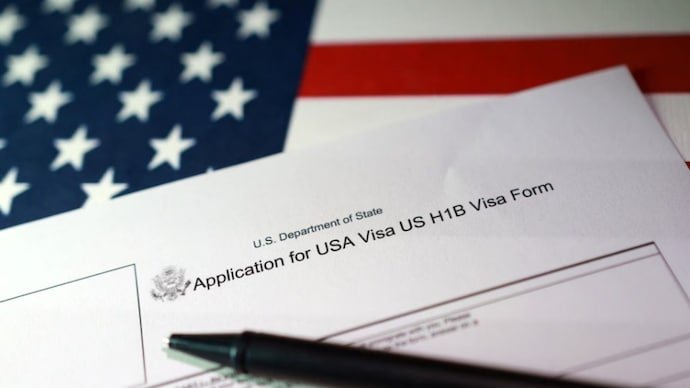
The United States Department of Homeland Security has proposed a new $103,265 fee for H-1B cap-subject petitions, a move that could dramatically change the economics of hiring skilled foreign workers in the US. The proposed charge would come on top of other applicable H-1B fees and would apply to petitions subject to the annual numerical cap, including cases covered by the US advanced-degree exemption.
The proposal is particularly significant for Indian professionals because India-born beneficiaries account for a large majority of approved H-1B petitions. USCIS data for fiscal year 2024 showed that 71% of approved H-1B petitions were for beneficiaries born in India, compared with about 12% for beneficiaries born in china.
The proposal does not target Indian nationals specifically. Instead, it would apply according to the type of H-1B petition being filed. But because Indian workers make up such a substantial share of the programme, they could feel the consequences more strongly if employers become less willing to sponsor new foreign workers.
What is the proposed $103,265 H-1B fee?
DHS is proposing an additional $103,265 payment for each H-1B cap-subject petition. The proposed fee would be paid when the petition is filed and would be separate from other fees already associated with the H-1B process.
The scale of the proposed charge is what makes the measure unusual. Traditional H-1B government fees have generally been measured in thousands of dollars rather than six figures. Adding another $103,265 to the cost of a petition could therefore become a major factor in an employer’s decision about whether to hire a foreign worker.
DHS says the proposed fee is intended to recover costs associated with the federal government’s lawful Immigration system, including adjudication, vetting and related activities. The department estimates that the fee could generate approximately $8.8 billion annually, based on an estimated 85,000 H-1B cap-subject petitions each year.
The 85,000 figure corresponds to the statutory H-1B allocation: 65,000 regular cap visas plus an additional 20,000 places for qualifying foreign workers WHO have earned a master’s degree or higher from a US institution.
Which H-1B applications would be affected?
The most important distinction is between cap-subject and cap-exempt H-1B petitions.
The proposed $103,265 fee is aimed at H-1B petitions subject to the annual numerical limit. That includes petitions filed under the regular 65,000 cap as well as petitions qualifying for the 20,000 advanced-degree exemption.
By contrast, the proposal does not apply the new charge to cap-exempt H-1B petitions. Certain employers and institutions, including qualifying universities, nonprofit research organisations and government research organisations, can file H-1B petitions outside the annual numerical cap.
This distinction matters because not every foreign worker seeking H-1B status would automatically trigger the proposed six-figure payment. The financial impact would depend on the type of petition and the employer involved.
Why the H-1B fee could hit Indian professionals particularly hard
India is not singled out in the proposal, but Indian professionals occupy an unusually large position within the H-1B system.
USCIS reported that beneficiaries born in India accounted for 71% of approved H-1B petitions in fiscal year 2024. China was the second-largest country of birth, at approximately 12%. The remaining countries collectively represented a much smaller share.
That concentration means a policy affecting new cap-subject H-1B hiring will inevitably have a substantial effect on Indian workers, especially those seeking their first H-1B through the annual cap.
Indian technology professionals are also closely associated with the US H-1B system because American companies have long used the programme to recruit workers for specialised occupations. Technology, engineering and other highly skilled roles are among the areas in which H-1B sponsorship is commonly used.
The key issue, however, is not that an Indian applicant would personally receive a $103,265 bill. The proposed payment would be imposed on the H-1B petition process, meaning the immediate financial burden falls on the sponsoring employer. The larger question is whether employers would absorb that cost, pass some of it through compensation decisions, or avoid certain sponsorship cases altogether.
The cost could change how companies approach H-1B hiring
A six-figure government charge could alter an employer’s calculation before a foreign worker is even hired.
For a large technology company, the cost of a single petition may be manageable. But a company recruiting several or many H-1B workers could face a dramatically larger expense. An employer considering whether to sponsor a foreign candidate would have to weigh that additional cost against the value of the employee and the availability of alternative candidates.
That could produce several effects without requiring the government to reduce the annual H-1B quota itself.
- Employers could become more selective about which candidates receive sponsorship.
- Some companies could place greater emphasis on recruiting workers who already have US work authorization.
- Businesses could reconsider whether certain positions should be filled through international recruitment.
- Employers that depend heavily on H-1B workers could face significantly higher recruitment costs.
- New foreign graduates and workers seeking their first cap-subject H-1B could face a more difficult sponsorship environment.
These are potential consequences rather than guaranteed outcomes. The actual effect would depend on whether the proposal becomes final, how employers respond and how the policy survives any legal challenges.
How the new proposal differs from the earlier $100,000 H-1B fee
The timing of the proposal is particularly important because it follows a major legal dispute over a separate $100,000 H-1B payment requirement introduced by the Trump administration in 2025.
A federal district court in Massachusetts ruled in June 2026 that the earlier $100,000 payment requirement was unlawful and vacated the policy. The administration appealed. On July 24, the US Court of Appeals for the First Circuit rejected the government’s request to pause the lower court’s ruling while the appeal continues.
That decision meant the earlier $100,000 payment could no longer be enforced while the litigation proceeds. The new DHS proposal is therefore significant because it seeks to establish a six-figure H-1B charge through a different regulatory route.
DHS itself acknowledges the similarity between the proposed $103,265 fee and the earlier $100,000 payment. But the department says the new proposal relies on different statutory authority and is structured as a fee intended to recover immigration-related costs rather than as the entry-related payment created by the earlier presidential proclamation.
That distinction could become central if the proposed rule is challenged in court.
Why the legal basis matters
The dispute over the previous $100,000 requirement was not simply about whether H-1B hiring should be more expensive. It also raised a fundamental question about the government’s authority to impose such a large payment.
The Massachusetts court concluded that the previous payment requirement exceeded presidential authority and improperly exercised congress‘s power over taxation. The administration has continued to challenge that ruling.
The new DHS proposal attempts to address the issue through a formal rulemaking process and a different legal rationale. Whether that approach ultimately survives legal scrutiny remains unresolved.
This means the proposed $103,265 charge should not be treated as a final H-1B requirement yet. There is a regulatory process still to complete, and the possibility of litigation adds another layer of uncertainty.
What DHS says the money would be used for
The department’s justification focuses on the costs of operating the broader lawful immigration system.
DHS says the proposed fee would help recover expenses incurred by federal agencies in areas such as adjudicating immigration cases, conducting vetting and supporting lawful immigration programmes. The projected $8.8 billion in annual revenue is based on an estimated 85,000 cap-subject H-1B petitions.
That calculation also illustrates the scale of the proposal. If the projected petition volume is roughly equal to the annual numerical allocation, the new charge would represent a very large revenue stream from a relatively small number of petitions.
The proposal therefore has implications beyond individual H-1B applicants. It could become a significant source of funding for immigration-related government operations if implemented at the proposed level.
Supporters and critics see very different consequences
The proposal has already generated opposing arguments over the purpose of the H-1B programme.
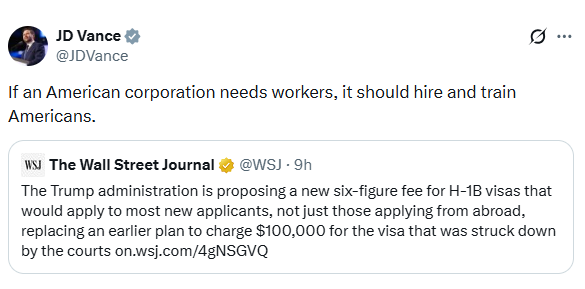
Vice President JD Vance defended the idea by arguing that companies seeking workers should hire and train Americans. The administration has repeatedly raised concerns about the way companies use foreign-worker programmes and whether some employers rely on overseas labour instead of developing the domestic workforce.
Immigration advocates take the opposite view. They argue that making legal immigration dramatically more expensive could weaken America’s ability to attract skilled workers and compete for international talent.
Those competing positions point to the larger policy question behind the fee: whether the H-1B programme should primarily be viewed as a mechanism for meeting employer demand for specialised skills, or as a programme that should be made considerably more restrictive and expensive to encourage greater domestic hiring.
The proposed fee does not change the number of H-1B visas available under the statutory cap. Instead, it would change the financial barrier associated with using the programme.
What the proposal could mean for Indian students and new graduates
The potential impact extends beyond workers already employed in the United States.
International students who graduate from US universities can seek employment pathways that may eventually involve H-1B sponsorship. For candidates who require a cap-subject H-1B petition, a six-figure employer charge could become part of the hiring decision.
That does not mean every international graduate would lose access to H-1B sponsorship. Employers could continue to decide that particular candidates are valuable enough to justify the cost. But the economics could become less attractive for positions where employers have many qualified alternatives.
The proposed fee could therefore have an indirect effect on the competition for entry-level and early-career skilled jobs. The precise impact would depend heavily on employer behaviour, the final wording of the rule and whether exemptions or other changes are introduced.
What happens next with the $103,265 H-1B proposal?
The proposal is not yet a final rule. DHS has opened a 30-day public comment period, giving businesses, immigration groups, workers and other interested parties an opportunity to respond.
After reviewing the comments, the department can decide whether to move forward with a final rule, modify the proposal or take another course.
Even if DHS finalizes the fee, the legal debate may not end. Given the recent court battle over the separate $100,000 H-1B payment, the government’s authority to impose another six-figure charge is likely to receive close scrutiny.
For Indian professionals and US employers, the most important point for now is that $103,265 is a proposed fee, not a newly finalized universal H-1B charge. The proposal targets cap-subject petitions, does not specifically single out Indian nationals, and would be added to existing applicable fees if ultimately adopted.
The bigger issue behind the H-1B fee debate
The controversy is ultimately about more than the price of a visa petition. It reflects a broader argument over how the United States wants to manage high-skilled immigration.
Supporters of tighter restrictions see higher costs as a way to encourage companies to invest more heavily in American workers. Critics argue that making international recruitment prohibitively expensive could make it harder for US businesses to access specialised talent and could reduce America’s attractiveness to skilled professionals.
Indian workers are central to that debate because of their dominant share of the H-1B population. Any policy that significantly changes the cost of cap-subject sponsorship is therefore likely to have a visible effect on Indian professionals, even when the rule itself is nationality-neutral.
The next major milestones will be the end of the public comment period, DHS’s decision on whether to issue a final rule and any legal challenges that may follow. Until those steps are completed, employers and prospective H-1B workers face uncertainty rather than a settled new fee structure.
What is already clear is the scale of the proposed change. A $103,265 charge would represent a fundamental shift in the cost of sponsoring a new cap-subject H-1B worker. If it becomes law, companies will have to decide whether the value of accessing international talent justifies the dramatically higher price of doing so.
For breaking news and live news updates, like us on Facebook or follow us on Twitter and Instagram. Read more on Latest World on thefoxdaily.com.






COMMENTS 0