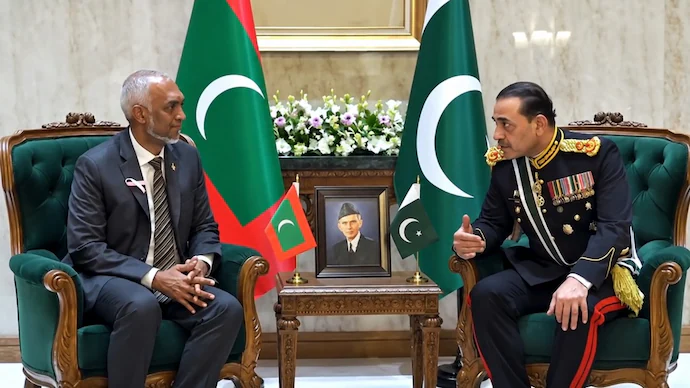
Maldives President Mohamed Muizzu’s three-day state visit to Pakistan from October 20 to 22, 2026, has brought defence cooperation, maritime security and regional diplomacy into focus. The visit resulted in the exchange of 20 agreements covering multiple sectors, including defence, law enforcement, trade, education and fisheries. Muizzu also met Pakistan’s powerful military chief, Field Marshal Asim Munir, and called for reviving the largely inactive South Asian Association for Regional Cooperation (SAARC).
The diplomatic outreach has prompted questions about Pakistan’s growing engagement with the Maldives, an Indian Ocean island nation located near strategically important international shipping routes. The developments come against the backdrop of the Maldives’ previously strained relations with India under Muizzu, who came to power in 2023 after campaigning on an “India Out” platform.
Although the latest agreements expand cooperation between Islamabad and Male, their practical implications remain unclear. The agreements do not, on the information available in the source material, establish a Pakistani military presence in the Maldives. Their strategic significance will depend on how the two countries implement their commitments, particularly in defence and maritime security.
Muizzu’s Pakistan Visit: 20 Agreements and Six Decades of Diplomatic Relations
Muizzu’s visit was the first by a Maldivian president to Pakistan in 11 years. It also coincided with the 60th anniversary of diplomatic relations between the two countries, which were established in July 1966.
The Maldivian president arrived in Islamabad on October 20, accompanied by First Lady Sajidha Mohamed and a high-level delegation. On October 21, Pakistani Prime Minister Shehbaz Sharif welcomed Muizzu at the Prime Minister’s House, where the visiting president received a guard of honour before the two sides held restricted and delegation-level discussions.
The visit included meetings with several senior Pakistani officials, including Sharif, Deputy Prime Minister and Foreign Minister Ishaq Dar, and Field Marshal Asim Munir. Muizzu also met Pakistani President Asif Ali Zardari and First Lady Aseefa Bhutto Zardari.
During the visit, the two governments witnessed the exchange of 20 memorandums of understanding and agreements. The areas covered included:
- Defence and maritime security: Cooperation involving security, capacity-building and professional exchanges.
- Law enforcement: Collaboration between relevant institutions.
- Trade and investment: Plans to expand commercial relations and economic engagement.
- Civil aviation: Cooperation in the aviation sector.
- Health and education: Exchanges and partnerships in public services and academic fields.
- Agriculture and fisheries: Cooperation in sectors relevant to economic development and livelihoods.
- Tourism and technical training: Opportunities for professional development and broader people-to-people engagement.
The Maldivian President’s Office identified defence, security, training and capacity-building as priorities discussed during the visit. Muizzu described the agreements as an opportunity to build a new phase of cooperation between the two countries.
Maldives and Pakistan Set $200 Million Bilateral Trade Target
Economic cooperation was another important component of the state visit. Pakistan and the Maldives agreed to work towards increasing bilateral trade from approximately $13 million to $200 million within two years.
The proposed increase represents an ambitious target compared with the countries’ existing trade volume. Achieving it would require a substantial expansion in commercial activity, supported by stronger business links and practical cooperation across relevant industries.
The agreements covering tourism, fisheries, agriculture, technical training and other sectors could provide areas for further engagement. However, the extent to which the trade target can be achieved will depend on implementation and the development of commercial opportunities between the two countries.
For the Maldives, which relies heavily on tourism and international economic relationships, broader partnerships can provide opportunities to diversify trade and cooperation. For Pakistan, closer engagement with Male offers another channel for developing economic and diplomatic relations in the Indian Ocean region.
Nevertheless, the announcement of a target does not itself establish that the planned increase will occur. The actual outcome will become clearer as the two governments translate their agreements into measurable trade and investment activity.
Muizzu Meets Pakistan Army Chief Asim Munir: Why the Meeting Matters
One of the notable aspects of Muizzu’s visit was his meeting with Field Marshal Asim Munir, Pakistan’s Chief of Army Staff and Chief of Defence Forces. Munir called on the Maldivian president in Islamabad on October 21.
According to Pakistan’s state broadcaster, Radio Pakistan, the discussions covered regional security, defence cooperation, institutional linkages and professional military exchanges.
Muizzu commended the professionalism of Pakistan’s armed forces and expressed appreciation for Islamabad’s stated efforts towards regional peace and stability. The meeting added a security dimension to a visit that also focused on trade, education, tourism and other civilian sectors.
Engagement between a visiting head of state and Pakistan’s military leadership is significant in the context of the country’s political and security institutions. In this instance, the meeting signals that defence and security issues formed part of the broader Maldives-Pakistan relationship.
However, the available details do not specify the full operational scope of the defence-related agreements. They also do not establish that the two countries have agreed to deploy Pakistani troops or create a Pakistani military base in the Maldives.
The distinction matters when assessing the visit’s implications for the wider Indian Ocean. Diplomatic discussions and military training arrangements can deepen bilateral relationships, but their strategic consequences depend on the specific commitments made, the resources allocated and how those commitments are implemented.
Why the Maldives Matters to India’s Indian Ocean Strategy
The Maldives occupies a strategically important position in the Indian Ocean, near international shipping routes that connect major commercial and energy markets. Its location has made the country an important part of India’s maritime security environment and regional diplomatic engagement.
India has traditionally maintained close relations with the Maldives, supporting cooperation in areas including security, development and emergency assistance. The relationship has also included Indian military personnel who operated and maintained aircraft used for humanitarian assistance and medical evacuations.
Under Muizzu’s government, the presence of Indian military personnel became a contentious issue. After coming to power in 2023 on the “India Out” campaign, Muizzu sought their withdrawal. In May 2024, the Indian military personnel were replaced by civilian technical staff, according to the supplied account.
The episode marked a difficult period in bilateral relations. Since then, the Maldivian government has also worked to repair ties with New Delhi, illustrating that its relationship with India has not been defined by a single policy position or diplomatic dispute.
Against this background, Pakistan’s expanded engagement with Male has attracted attention. The defence and maritime security agreements, combined with Muizzu’s meeting with Munir, provide Islamabad with an opportunity to strengthen its institutional links with the island nation.
For India, the development is relevant because it concerns a country within its immediate maritime neighbourhood. However, the existence of agreements with Pakistan does not by itself establish that the Maldives has abandoned its relationship with India or shifted into an exclusive strategic alignment with Islamabad.
Muizzu Calls for SAARC Revival After a Decade of Inactivity
Muizzu’s call to revive the South Asian Association for Regional Cooperation was another major diplomatic development during the visit. The regional organisation, commonly known as SAARC, has remained largely inactive at the summit level for years, with its last summit held in Kathmandu in 2014.
Speaking during the visit, Muizzu said the Maldives continued to believe in the value of SAARC and the region’s potential to address shared challenges through collective action.
He also said Male was prepared to work with member countries towards convening the next SAARC summit at the earliest possible opportunity. The proposal presents regional cooperation as a way to address shared economic and social challenges across South Asia.
Why Has SAARC Remained Inactive?
SAARC was established in Dhaka in 1985 to promote regional economic growth, social progress, cultural development and collective self-reliance. Its eight members are Afghanistan, Bangladesh, Bhutan, India, the Maldives, Nepal, Pakistan and Sri Lanka. The organisation is headquartered in Kathmandu.
Despite its regional mandate, political tensions between India and Pakistan have repeatedly complicated cooperation within the group. The deterioration in bilateral relations following the September 2016 Uri terrorist attack contributed to the cancellation of the SAARC summit that was scheduled to take place in Islamabad.
India subsequently stated that it remained committed to regional cooperation, connectivity and people-to-people contacts but believed that such initiatives could proceed only in an atmosphere free of terrorism.
In its statement following the Uri attack, India said it was unable to participate in the proposed Islamabad summit under the prevailing circumstances. The resulting diplomatic impasse has continued to affect the organisation’s ability to hold high-level meetings.
Muizzu is not the first South Asian leader to advocate reviving SAARC in recent years. In 2025, Bangladesh’s interim government chief, Muhammad Yunus, also pushed for the organisation’s revival during a meeting with Pakistan’s Deputy Prime Minister Ishaq Dar.
Although renewed diplomatic interest could bring SAARC back into regional discussions, a summit would require agreement among its member states. The longstanding differences between India and Pakistan remain a major obstacle to restoring the organisation’s high-level activities.
Pakistan Raises Kashmir and Indus Waters Treaty During Talks
Pakistan also used Muizzu’s visit to communicate its positions on two major disputes with India: Jammu and Kashmir and the Indus Waters Treaty.
According to a statement issued by Pakistan’s Press Information Department on October 21, Prime Minister Shehbaz Sharif shared Islamabad’s perspectives on both issues during his meeting with the Maldivian president.
The discussions took place against the backdrop of heightened tensions over water-sharing arrangements. India placed the Indus Waters Treaty in abeyance in April 2025, a day after the Pahalgam terror attack killed 26 people. India cited Pakistan’s continued support for cross-border terrorism in explaining its decision.
During the joint press appearance, Sharif warned that interference with Pakistan’s water supplies would be considered an act of war. The remarks underscored the continued sensitivity of water security and the treaty within Pakistan’s relations with India.
However, Muizzu did not publicly endorse Pakistan’s position on either Jammu and Kashmir or the Indus Waters Treaty, according to the supplied report. The distinction is important in assessing the diplomatic outcome of the visit.
Sharif’s decision to raise these disputes demonstrates that Pakistan sought to include its concerns about India in the discussions. It does not, on its own, show that the Maldives adopted Islamabad’s positions or agreed to support Pakistan in its disputes with New Delhi.
Muizzu Receives Honorary Doctorate in Islamabad
Alongside the political and economic engagements, Muizzu received an honorary doctorate in Politics and International Relations from the International Islamic University Islamabad.
The degree was presented by Sharif during a ceremony at the Prime Minister’s House on October 22, with university rector Professor Ahmed Saad Al Ahmed in attendance. Muizzu wore academic robes for the ceremony.
According to the Maldivian President’s Office, Muizzu dedicated the honour to the people of the Maldives and described it as recognition of the friendship between the two countries.
The ceremony formed part of a visit designed to mark six decades of diplomatic relations while establishing a broader agenda for cooperation. It also provided a public expression of the goodwill that both governments sought to associate with the visit.
China’s Role Adds Another Dimension to Maldives Diplomacy
Pakistan is not the only country seeking stronger engagement with the Maldives. China has also expanded its presence through infrastructure investment and development projects, including initiatives associated with its Belt and Road Initiative.
Chinese-backed projects in the Maldives have included bridges, housing and other infrastructure. Beijing’s involvement has drawn attention in New Delhi because of the Maldives’ location in the Indian Ocean and the broader strategic competition surrounding the region.
The latest Maldives-Pakistan agreements therefore come within a wider regional environment in which several countries are seeking diplomatic, economic and security partnerships with Male.
For the Maldives, relationships with multiple partners can offer opportunities for investment, trade, training and institutional cooperation. At the same time, deeper engagement with different external powers can attract scrutiny from neighbouring countries when it involves defence or maritime security.
It would nevertheless be premature to treat the Pakistan visit as proof that the Maldives has joined a fixed strategic bloc. The supplied information shows an expansion of bilateral engagement, but it does not establish an exclusive alignment or demonstrate that cooperation with Pakistan will displace the Maldives’ existing relationships with India or other partners.
Is the Maldives Moving into Pakistan’s Orbit?
Muizzu’s visit represents a notable expansion of Pakistan’s diplomatic engagement with the Maldives. The 20 agreements, discussions on defence and maritime security, meeting with Munir and proposal to revive SAARC together give the visit significance beyond routine diplomatic exchanges.
Yet the phrase “Pakistan’s orbit” suggests a degree of strategic alignment that the available details do not conclusively demonstrate. The agreements cover a broad range of civilian and security-related sectors, and the operational details of the defence commitments remain unclear.
Several factors will be important in determining the longer-term significance of the visit:
- Implementation of defence agreements: The extent of training, institutional cooperation and maritime security activity will help clarify the practical depth of the partnership.
- Military presence: Any future arrangement involving personnel, facilities or deployments would be particularly relevant to regional security assessments. The supplied information does not establish that such a presence has been agreed.
- Economic outcomes: Progress towards the $200 million bilateral trade target will indicate whether the visit produces tangible economic benefits.
- Relations with India: The trajectory of Male’s engagement with New Delhi will help show whether its Pakistan outreach complements or complicates its existing regional relationships.
- SAARC diplomacy: Whether member countries respond positively to Muizzu’s proposal will indicate how much room exists for renewed regional cooperation.
The Maldives has described its foreign policy as “Maldives First”, emphasising cooperation with multiple partners rather than exclusive alignment with one country. The approach provides the government with a framework for pursuing diplomatic and economic opportunities while maintaining relationships across the region.
For India, Pakistan’s increased engagement with the Maldives is relevant because of the island nation’s strategic location and longstanding links with New Delhi. However, evaluating the implications requires distinguishing between diplomatic outreach, signed agreements and concrete changes in security arrangements.
What the Maldives-Pakistan Agreements Mean for India
India’s principal concern is likely to centre on how the agreements affect the security environment in its Indian Ocean neighbourhood. Cooperation on maritime security and defence can influence regional relationships, particularly when it leads to sustained institutional links or operational arrangements.
At this stage, however, the available information does not establish that Pakistan has secured a military foothold in the Maldives. Nor does it show that the Maldivian government has publicly adopted Pakistan’s positions on Kashmir or the Indus Waters Treaty.
The visit should therefore be understood as evidence of a broader diplomatic opening rather than conclusive proof of a major strategic realignment. The distinction will become clearer as the countries disclose further details about their agreements and demonstrate how they intend to implement them.
India and the Maldives also have an existing bilateral relationship that Muizzu’s government has sought to repair after the tensions surrounding the “India Out” campaign and the withdrawal of Indian military personnel. The future direction of that relationship remains an important part of the regional picture.
Conclusion: Diplomatic Outreach Is Clear, Strategic Consequences Remain Uncertain
Mohamed Muizzu’s October 20–22 visit to Pakistan has expanded bilateral engagement through 20 agreements, a new trade target, discussions on defence and maritime security, and a call to revive SAARC. His meeting with Field Marshal Asim Munir and Pakistan’s decision to raise Kashmir and the Indus Waters Treaty also gave the visit a broader regional dimension.
The developments have drawn attention because the Maldives occupies a strategically important position in the Indian Ocean and has a history of close engagement with India. Pakistan’s outreach, alongside China’s infrastructure investments, highlights the range of external partnerships available to Male.
However, the available details do not establish that the Maldives has entered an exclusive Pakistani strategic orbit or that the agreements have created a Pakistani military presence in the country. The extent of any lasting shift will depend on implementation, the depth of defence cooperation and the Maldives’ continuing relationships with India and other regional partners.
For now, the visit marks a significant step in Maldives-Pakistan relations. Whether it produces a lasting change in the Indian Ocean’s strategic balance remains an open question.
For breaking news and live news updates, like us on Facebook or follow us on Twitter and Instagram. Read more on Latest World on thefoxdaily.com.




COMMENTS 0