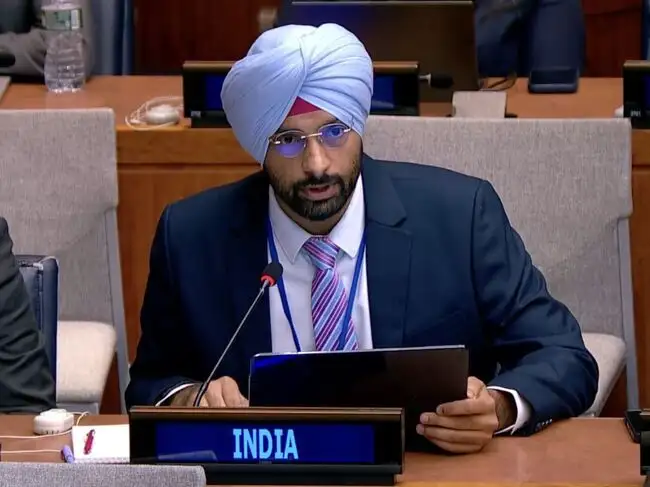
India and Israel have voted against a Pakistan-Belarus-sponsored resolution on conventional arms control at the United Nations, with New Delhi arguing that national security concerns cannot be restricted to regional and subregional boundaries.
India also questioned the need for fresh deliberations on conventional arms control, pointing out that the UN Disarmament Commission had already adopted several guidelines and recommendations on the subject. New Delhi separately opposed a reference to conventional arms control proposals made in the context of South Asia.
India Questions Fresh UN Deliberations on Conventional Arms Control
India argued that conventional arms control is a global issue and should not be pursued primarily through regional and subregional frameworks.
New Delhi also questioned the proposal asking the UN Disarmament Commission to develop principles that could serve as a framework for regional agreements on conventional arms control.
India’s position was based on the commission’s earlier work, which included consensus guidelines and recommendations on regional disarmament, conventional arms control and practical confidence-building measures involving conventional weapons.
New Delhi questioned why another round of deliberations was necessary when the subject had already been discussed extensively within the UN system.
New Delhi Says Security Concerns Extend Beyond Regional Boundaries
India also objected to the resolution’s approach to maintaining a balance in defence capabilities within a particular region or subregion.
New Delhi maintained that countries’ security concerns are not confined to their immediate geographical surroundings. It argued that threats and strategic considerations can extend beyond narrowly defined regional boundaries.
India also questioned the practicality of preserving a balance in military capabilities through arrangements limited to specific regions or subregions.
India Separately Opposes Reference to South Asian Arms Control Proposals
India separately voted against a paragraph referring to conventional arms control proposals made in the context of South Asia.
The paragraph referred to initiatives in different regions, including consultations among some Latin American countries, as well as proposals for conventional arms control in South Asia. It also recognised the relevance of such measures to regional security.
India’s opposition reflected its broader position that arms control discussions should account for the wider security environment rather than assume that national security concerns can be addressed solely through regional arrangements.
The vote highlights New Delhi’s continued preference for a global approach to conventional arms control and its reservations about proposals that seek to frame security arrangements primarily around regional military balances.
For breaking news and live news updates, like us on Facebook or follow us on Twitter and Instagram. Read more on Latest India on thefoxdaily.com.






COMMENTS 0