Oman’s foreign minister, Badr Albusaidi, has called for a regional security agreement involving Iran, Iraq and the six Gulf states, arguing that decades of reliance on the United States have made it harder for Middle Eastern countries to resolve their own security disputes. His proposal would shift the region away from a system in which Washington acts as its primary security provider and towards collective responsibility among neighbouring states.
The proposal comes amid heightened tensions between the United States and Iran, renewed concerns about the Strait of Hormuz and diplomatic efforts to prevent another outbreak of fighting. Albusaidi’s remarks also challenge the long-standing approach of treating Iran as the principal threat around which Gulf security arrangements should be organised.
Speaking at Girton College, Cambridge, on Monday, the Omani foreign minister acknowledged that negotiations would be difficult. However, he argued that the region’s security problems could not be resolved sustainably while external powers continued to determine the terms of engagement and regional governments struggled to establish a shared framework.
Oman Proposes a Non-Aggression Pact for the Gulf
Albusaidi called for a non-aggression security pact bringing together all six members of the Gulf Cooperation Council, alongside Iran and Iraq. The proposed arrangement would include Bahrain, Kuwait, Oman, Qatar, Saudi Arabia and the United Arab Emirates, creating a framework in which regional states could address disputes and security concerns collectively.
The central idea is a change in how regional security is organised. Rather than relying primarily on American military protection, the participating countries would take greater responsibility for preventing conflict, managing disagreements and developing common security arrangements.
Albusaidi argued that the current approach has left important regional questions unresolved. He pointed to the difficulty of reaching agreement on issues such as the Strait of Hormuz, a strategically important waterway through which significant volumes of international energy supplies travel.
“Issues such as the strait of Hormuz have become impossible to resolve because external powers continue to define the terms of engagement,” he said, arguing that regional governments had not been able to take collective responsibility for their own security.
His proposal represents a significant diplomatic position because it openly includes Iran in a regional security structure alongside predominantly Sunni Arab Gulf states. Tehran has long advocated a greater role for Iran in regional security, but deep mistrust between Iran and several Gulf governments has complicated efforts to establish such an arrangement.
Albusaidi Blames Decades of Excluding Iran
The Omani foreign minister said the region’s security arrangements had been shaped for roughly half a century by the assumption that Gulf countries should regard Iran as a security threat. In his assessment, this approach has entrenched antagonism and made regional cooperation more difficult.
Albusaidi said Iran had been systematically excluded from playing a meaningful role in regional security arrangements, producing negative consequences for both Tehran and the wider Middle East.
He also challenged the idea that Iran and the Arab Gulf states were inherently opposed to one another. He described the perception of fundamental regional antagonism between the two sides as false and argued that external powers had helped establish priorities that limited opportunities for regional agreement.
“Perhaps the most damaging of the priorities imposed on the region from the outside has been the requirement that Iran be excluded,” he said. “Not just excluded. Worse. Positioned as the threat against which regional security had to be organised.”
His argument places responsibility not only on Iran’s regional policies but also on the wider security system that has developed around American military involvement. Under this interpretation, excluding Iran from regional discussions has reinforced insecurity instead of creating a durable framework for peace.
However, the proposal faces a substantial challenge: several Gulf states have serious concerns about Iran’s military activities, its attacks on regional infrastructure and the actions of armed groups it supports. A shared security framework would therefore have to address those concerns directly rather than assume that diplomatic inclusion alone would resolve them.
Diplomatic Push in Tehran Amid Fears of Renewed Fighting
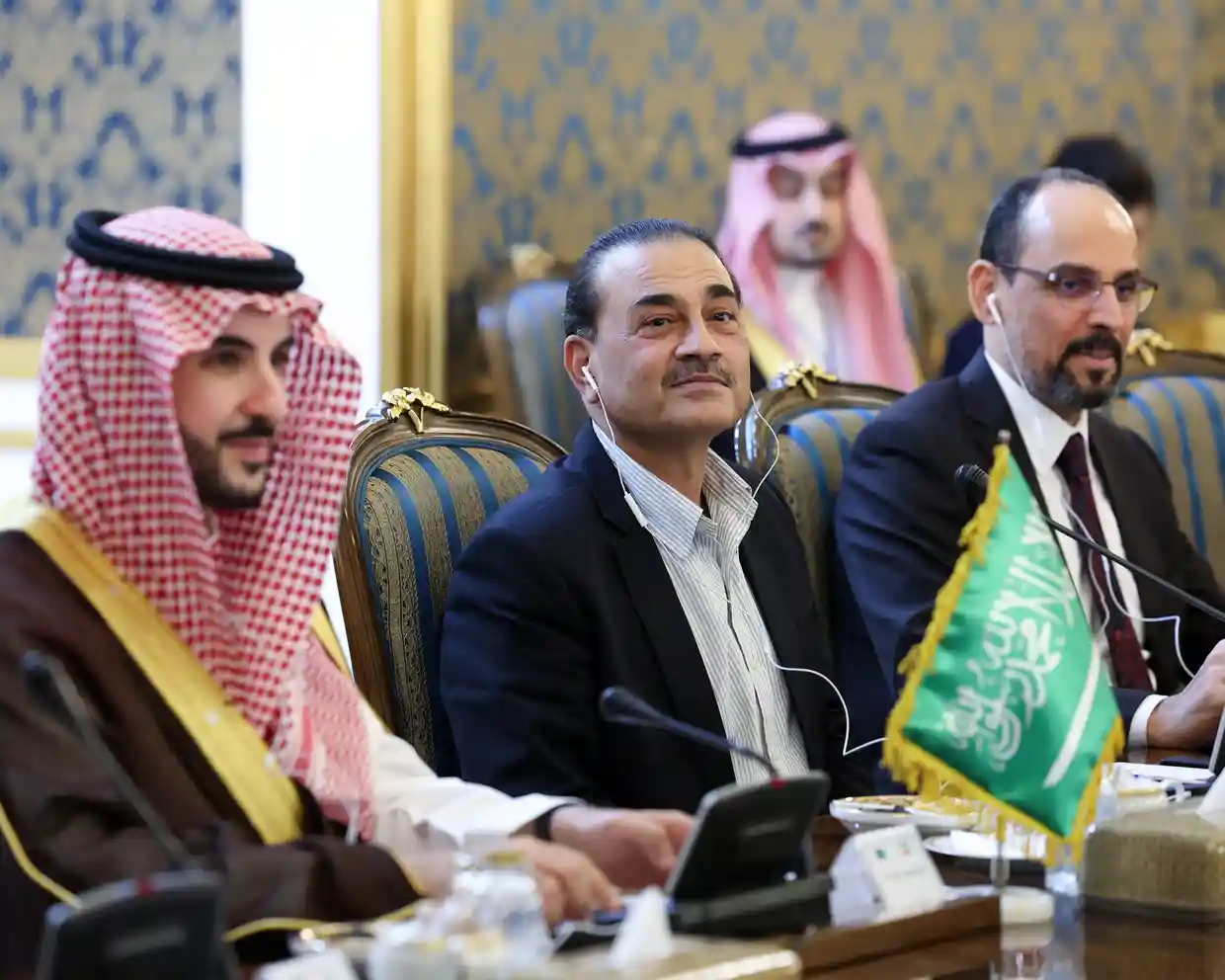
Albusaidi delivered his remarks as senior defence and intelligence officials from Turkey, Pakistan and Saudi Arabia travelled to Tehran in an effort to prevent a renewed outbreak of fighting between Iran and the United States.
The visit highlighted the urgency of diplomatic efforts as military tensions continued to threaten regional stability. According to the account provided, discussions in Tehran also covered possible future security arrangements for the region.
The presence of Saudi Defence Minister Khalid bin Salman was particularly significant given the recent deterioration in regional security. The visit came weeks after Iran had struck Saudi infrastructure, while Iran-backed Houthi forces continued to send missiles towards Riyadh, according to the report.
Saudi Arabia and Iran have spent years navigating a relationship marked by rivalry, diplomatic engagement and competing regional interests. Their participation in discussions about security arrangements does not, by itself, demonstrate agreement on a common framework. It does, however, underline the importance of maintaining communication when the risk of escalation is high.
Turkey and Pakistan’s involvement also reflects the wider diplomatic effort to prevent the confrontation from spreading. Their talks in Tehran took place alongside separate mediation efforts, including discussions by Qatari representatives seeking terms for reopening the Strait of Hormuz.
The diplomatic activity suggests that governments across the region are exploring ways to contain the crisis. Whether these contacts can produce a lasting agreement remains uncertain, particularly while military pressure, blockades and disputes over maritime access remain unresolved.
Why the Strait of Hormuz Is Central to the Dispute
The Strait of Hormuz is a narrow maritime passage between Iran and Oman that connects the Persian Gulf with the Gulf of Oman and the wider Arabian Sea. Its strategic importance makes the security of shipping through the waterway a concern for Gulf governments, energy markets and countries dependent on international oil and gas supplies.
Oman occupies the southern side of the strait, while Iran lies along its northern shores. The two countries have reached a temporary agreement on managing shipping traffic, according to the supplied report. However, implementation has been put on hold until the United States and Iran lift their respective blockades of the waterway.
This impasse illustrates the problem Albusaidi wants a regional security pact to address. Maritime access is a shared concern for neighbouring countries, yet its resolution remains tied to a wider confrontation between Washington and Tehran.
A regional agreement could, in principle, provide procedures for managing shipping disputes, communicating during crises and reducing the risk that maritime incidents trigger military escalation. Such mechanisms would depend on the parties agreeing to clear obligations and accepting a credible process for resolving disagreements.
Even so, a security pact would not automatically settle the immediate dispute over the waterway. Washington’s demand that Iran reopen the strait before sanctions are lifted presents a separate negotiating challenge. A broader agreement could take months to negotiate, while the blockade dispute requires more immediate decisions.
Oman Says Earlier US-Iran Negotiations Were Making Progress
Albusaidi also questioned the case for further military action against Iran, pointing to the progress he said had been made during an earlier round of US-Iran negotiations mediated by Oman in February.
He said the discussions had been making significant progress and that an agreement had appeared within reach. Oman, he added, continued to stand by that assessment.
The remarks offered an alternative to the argument that military pressure is necessary to secure a diplomatic outcome. From Albusaidi’s perspective, the earlier talks demonstrated that negotiations could make progress and that renewed conflict risked undermining an opportunity for agreement.
His comments came amid reports of a major US military buildup and continued Pentagon briefings about preparations for a possible assault after the American midterm elections. The supplied report also cited Israeli media claims that Prime Minister Benjamin Netanyahu had been seeking to push the military towards provoking a war with Iran before Israeli elections scheduled for Tuesday. Those claims remain attributed to media reports and should not be treated as independently established facts.
US President Donald Trump’s repeated support for Netanyahu’s re-election has added to regional concerns about the relationship between American and Israeli policy. Albusaidi’s remarks did not establish that a new attack was inevitable, but they underscored the risk that regional governments see in a security environment dominated by military confrontation.
Why Gulf States May Be Reconsidering Their Security Arrangements
For decades, the United States has maintained a substantial military presence across the Gulf, with facilities and partnerships intended to protect regional interests and deter threats. For governments that fear Iranian attacks, the American security role can provide reassurance and a means of responding to crises.
Yet the current confrontation has raised a difficult question: can a military presence designed to deter conflict also become a source of insecurity when the host region is drawn into a confrontation involving the power providing that protection?
The supplied report says no Gulf state openly supported the US-Israeli attacks on Iran during the previous year or in February, although some reportedly cooperated covertly in the operations. Iran, in turn, sought to defend itself by attacking US bases and energy infrastructure in Gulf states.
These developments illustrate the dilemma facing governments that host American forces while maintaining geographic proximity and economic links with Iran. They may value US protection but also face risks when tensions between Washington and Tehran escalate.
A regional security pact could offer an alternative channel for managing these competing pressures. If it included credible commitments to non-aggression, consultation and dispute resolution, it might help reduce the likelihood that one country’s confrontation becomes a security crisis for its neighbours.
However, the proposal would require governments to agree on what constitutes aggression, how violations would be addressed and whether the pact would cover attacks carried out by non-state armed groups. Without practical answers to those questions, a formal agreement could struggle to provide meaningful reassurance.
Iran’s Regional Activities Remain a Major Obstacle
Although Albusaidi advocates including Iran in regional security discussions, the proposal is likely to face resistance from governments concerned about Tehran’s military conduct and its support for armed groups operating across the Middle East.
The supplied report points to damage caused to Gulf economies directly by Iran or indirectly through intermediaries such as Yemen’s Houthi movement. Missile attacks and threats to energy infrastructure have contributed to concerns that Iran’s regional policies can expose neighbouring countries to substantial security and economic risks.
For Gulf governments, a non-aggression agreement would therefore need to go beyond a declaration of shared interests. They would likely seek clear commitments against cross-border attacks, threats to civilian infrastructure and actions by affiliated armed groups that could destabilise neighbouring states.
Iran’s own security calculations could also complicate negotiations. The report notes that Iranian hardliners increasingly argue that the country’s security would be best protected by assembling a nuclear bomb. Such views would create additional concerns for regional governments and complicate efforts to build trust around a common security framework.
These competing priorities explain why the proposed pact could take many months to negotiate. Iran would need to accept constraints that neighbouring countries considered meaningful, while Gulf states would need to determine whether a regional arrangement could provide reliable security without their existing external partnerships.
Can a Regional Pact Replace the US Security Role?
Albusaidi’s proposal raises a broader question about whether Middle Eastern countries can develop a security system that relies less heavily on outside powers. His argument is that regional governments must take responsibility for their own security if they want to resolve disputes that directly affect their shared interests.
A pact involving the six Gulf states, Iran and Iraq would bring together countries with different alliances, military capabilities and views of regional threats. Turning that diversity into a functioning agreement would require sustained diplomatic engagement and a willingness to accept common rules.
Possible areas of cooperation could include advance notification of military exercises, emergency communication channels, arrangements for preventing maritime incidents and agreed procedures for addressing alleged violations. These are potential elements of a future framework, not confirmed provisions of Albusaidi’s proposal.
The role of the United States would also remain a central question. A regional agreement that reduced Washington’s position as the primary security provider would not necessarily require an immediate end to American partnerships or military deployments. The extent of any change would depend on what participating governments agreed and whether the pact proved capable of managing real security crises.
Trust would be the decisive test. Gulf governments would need confidence that Iran would respect non-aggression commitments, while Tehran would need assurance that regional states would not use the arrangement to facilitate attacks against it. Each side would also need a way to respond to violations without allowing every dispute to trigger a wider confrontation.
What the Proposal Means for Middle East Peace
Albusaidi’s speech places regional diplomacy at the centre of the debate over the Middle East’s future. By challenging the long-standing exclusion of Iran from Gulf security arrangements, Oman is advocating a framework in which neighbouring states would negotiate directly over their shared risks rather than rely primarily on external military power.
The timing is significant. Efforts to prevent renewed US-Iran fighting, uncertainty over the Strait of Hormuz and concerns about attacks on Gulf infrastructure have exposed the consequences of a security system in which regional rivalries can quickly become international crises.
Yet the proposal should not be mistaken for an agreement already within reach. Gulf states have legitimate security concerns about Iran, Tehran and Washington remain locked in a confrontation, and the immediate dispute over the Strait of Hormuz is tied to blockades and sanctions that a wider pact may not resolve quickly.
The proposal’s prospects will depend on whether governments can turn broad support for regional stability into specific, enforceable commitments. That would require difficult negotiations over non-aggression, military activity, maritime security and the role of outside powers.
For now, Albusaidi’s intervention is a call to reconsider the foundations of Gulf security rather than evidence that the region has agreed on a new order. Its central challenge is whether countries with a long history of mistrust can build a system that addresses their security concerns collectively and whether that effort can make diplomacy more effective than another cycle of military escalation.
For breaking news and live news updates, like us on Facebook or follow us on Twitter and Instagram. Read more on Latest World on thefoxdaily.com.






COMMENTS 0