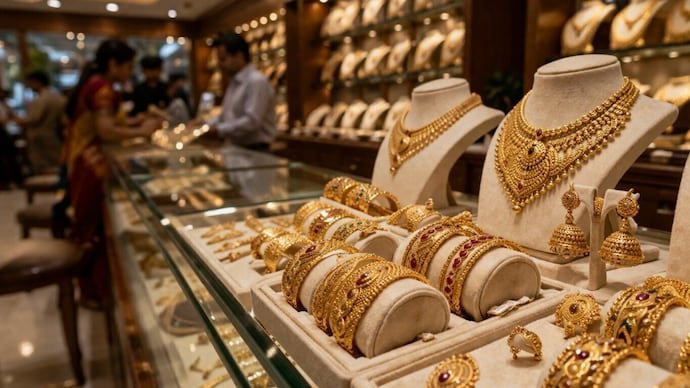
India‘s love affair with gold has long been considered unbreakable. Whether for weddings, festivals, investments, or family wealth preservation, the precious metal occupies a unique place in Indian households. However, 2026 has brought an unusual twist. Despite gold prices falling dramatically from record highs, consumer demand has weakened instead of strengthening.
The decline comes at a time when domestic prices have corrected by more than Rs 50,000 per 10 grams from their peak, yet buyers remain cautious. Instead of purchasing new jewellery, many households are choosing to sell existing gold holdings, creating an unexpected reversal in market dynamics. Combined with higher import duties, global monetary Policy, and changing investor sentiment, India’s gold market is experiencing one of its most significant shifts in years.
This development raises important questions for consumers, investors, jewellers, and policymakers alike. Is the decline temporary, or does it indicate a structural change in India’s gold consumption? More importantly, does the current correction represent a buying opportunity or the beginning of a longer bearish cycle?
Why Gold Demand in India Has Fallen So Sharply
The most immediate reason behind the collapse in demand is the increase in customs duty on gold imports. Higher import taxes have increased the overall cost of acquiring gold, reducing affordability even as international prices decline.
At the same time, market Psychology has shifted dramatically. Consumers WHO previously rushed to buy gold during rallies are now delaying purchases because they expect prices to fall further. This “wait-and-watch” approach has significantly reduced retail demand across jewellery stores and bullion markets.
Industry estimates indicate that domestic demand has fallen by over 70%, making this one of the weakest periods for physical gold buying in recent years.
The Numbers Behind the Gold Market Slowdown
| Market Indicator | Current Trend |
|---|---|
| Domestic Gold Demand | Down by more than 70% |
| MCX Gold Price | Over Rs 50,000 below record high |
| Household Gold Sales | Estimated around 50 tonnes during April-June quarter |
| Spot Gold | Below $4,000 per ounce |
| Investor Sentiment | Cautious with expectations of further declines |
The figures highlight a market driven more by uncertainty than by bargain hunting. Instead of taking advantage of lower prices, consumers are choosing liquidity over accumulation.
India’s Unique Relationship with Gold
India remains among the world’s largest consumers of physical gold. Unlike many developed economies where gold primarily functions as an Investment asset, Indian households purchase gold for multiple reasons.
- Wedding jewellery
- Religious festivals
- Family savings
- Emergency financial security
- Intergenerational wealth transfer
- Portfolio diversification
Because of these cultural and financial factors, demand usually remains resilient even during periods of price volatility. The current decline therefore represents an unusual departure from historical buying patterns.
Why Households Are Selling Gold Instead of Buying It
Perhaps the biggest surprise has been the increase in old jewellery sales.
Many families accumulated gold during previous years when prices were significantly lower. Even after the recent correction, these holdings remain highly profitable. As uncertainty grows regarding future prices, many households are choosing to monetize existing assets while valuations remain historically attractive.
This shift illustrates an important behavioral change. Instead of viewing falling prices as a buying opportunity, consumers increasingly see current levels as an opportunity to lock in gains accumulated over many years.
The increase in recycling also reduces the need for fresh imports, affecting the broader bullion supply chain.
How Global Factors Are Driving Gold Prices Lower
Although domestic policy has influenced Indian demand, international developments continue to dictate overall price direction.
Gold traditionally performs well during periods of economic uncertainty because investors consider it a safe-haven asset. However, its appeal diminishes when interest rates remain high.
Several global factors are currently weighing on bullion prices:
- Higher US interest-rate expectations
- A stronger US dollar
- Persistent Inflation concerns
- Reduced demand for safe-haven assets
- Improving returns from fixed-income investments
Unlike bonds or savings instruments, gold generates no regular income. When central banks maintain elevated interest rates, investors often shift capital toward income-producing assets, reducing demand for Precious metals.
Understanding the Federal Reserve’s Influence on Gold
The US Federal Reserve plays a central role in determining gold prices worldwide.
Whenever markets expect interest rates to remain elevated, Treasury yields generally rise while the US dollar strengthens. Since gold is priced globally in dollars, a stronger dollar makes it more expensive for overseas buyers, reducing international demand.
This relationship explains why every major Federal Reserve announcement is closely watched by bullion traders across global markets.
Upcoming economic indicators, including employment data, manufacturing activity, and inflation reports, could significantly influence gold’s next major move.
Comparison: Today’s Gold Market vs Previous Major Corrections
| Period | Main Driver | Market Response |
|---|---|---|
| 2013 Correction | Fed taper expectations | Sharp global decline in gold prices |
| 2020 Pandemic | Economic uncertainty | Record surge in safe-haven demand |
| 2022 Inflation Cycle | Rising interest rates | High volatility |
| 2026 Correction | Higher rates, stronger dollar, import duty increase | Demand falls despite lower prices |
The current correction differs from previous downturns because both domestic demand and international investor sentiment have weakened simultaneously.
Impact on India’s Jewellery Industry
Lower consumer demand creates significant challenges for jewellery retailers.
Retailers typically depend on seasonal demand during weddings and festivals. A prolonged slowdown could lead to reduced inventory purchases, lower profit margins, and delayed expansion plans.
Smaller jewellers may feel greater pressure than organized retail chains because they generally have less financial flexibility to manage prolonged demand weakness.
However, established brands could benefit over the longer term if consumers increasingly prioritize certified purity, transparency, and buyback guarantees.
Will Festival Season Revive Gold Demand?
India’s festive calendar has historically acted as a strong catalyst for gold purchases.
Events such as Dhanteras, Diwali, and the wedding season often generate substantial buying regardless of price fluctuations.
Whether this seasonal demand returns in 2026 will depend on several factors:
- Future price stability
- Consumer confidence
- Household disposable income
- Inflation trends
- Global economic conditions
If prices stabilize after the recent correction, postponed purchases could gradually return during the festive months.
Investment Perspective: Is This a Buying Opportunity?
A sharp decline from record highs naturally attracts bargain hunters. However, experienced investors recognize that large corrections can continue longer than expected.
Rather than attempting to identify the exact market bottom, financial experts generally recommend systematic accumulation.
This approach reduces the risk associated with market timing while allowing investors to benefit from long-term price appreciation if gold eventually recovers.
For investors seeking diversification, gold continues to serve an important role within a balanced portfolio despite near-term volatility.
Alternative Ways to Invest in Gold
Modern investors have multiple options beyond purchasing physical jewellery.
- Gold Exchange Traded Funds (ETFs)
- Digital Gold
- Gold Mutual Funds
- Sovereign Gold Bonds (subject to government issuances)
- Physical coins and bullion
Each investment vehicle offers different advantages regarding liquidity, storage costs, taxation, and long-term returns.
What Risks Could Push Gold Even Lower?
Several developments could continue exerting downward pressure on prices.
- Stronger-than-expected US economic growth
- Further interest-rate hikes
- Continued appreciation of the US dollar
- Declining geopolitical tensions
- Higher bond yields attracting institutional investors
If these conditions persist simultaneously, gold may remain under pressure despite its long-term reputation as a defensive asset.
What Could Trigger a Recovery?
Markets can change rapidly, especially in the precious metals sector.
Potential catalysts for a rebound include:
- Cooling inflation
- Interest-rate cuts by major central banks
- Weaker US dollar
- Renewed geopolitical uncertainty
- Improved festive demand in India
- Higher central bank gold purchases globally
Historically, gold has often recovered after extended periods of oversold conditions once macroeconomic expectations begin to shift.
A Bigger Shift: Is India’s Gold Market Changing?
One overlooked aspect of the current slowdown is changing consumer behavior. Younger investors are increasingly allocating money toward equities, mutual funds, exchange-traded funds, and digital investment platforms alongside traditional assets.
While gold remains culturally significant, investment preferences are becoming more diversified than they were a decade ago.
This does not necessarily mean gold is losing its importance. Instead, it suggests that future demand may become more sensitive to economic conditions, interest rates, and relative returns compared with other investment opportunities.
The current downturn may represent more than a temporary correction it could mark a transition toward a more financially driven gold market where investment decisions increasingly outweigh traditional buying patterns.
Future Outlook for Gold Prices and Demand
The outlook for gold remains closely tied to global monetary policy, inflation trends, and investor confidence. While short-term volatility is likely to continue, long-term demand drivers including central bank purchases, portfolio diversification, and gold’s status as a store of value remain intact.
In India, consumer demand could gradually recover if prices stabilize and festive buying gains momentum. However, higher import duties and cautious household sentiment may continue to limit any immediate rebound.
For investors, patience is likely to be more rewarding than attempting to predict daily price movements. A disciplined, gradual Investment Strategy may prove more effective than making large purchases during periods of heightened uncertainty.
Ultimately, the current correction illustrates that even one of the world’s oldest safe-haven assets is not immune to changing economic realities. As interest rates, inflation, and consumer behavior evolve, India’s gold market is entering a new phase where informed decision-making will matter more than ever.
For breaking news and live news updates, like us on Facebook or follow us on Twitter and Instagram. Read more on Latest Business on thefoxdaily.com.





COMMENTS 0