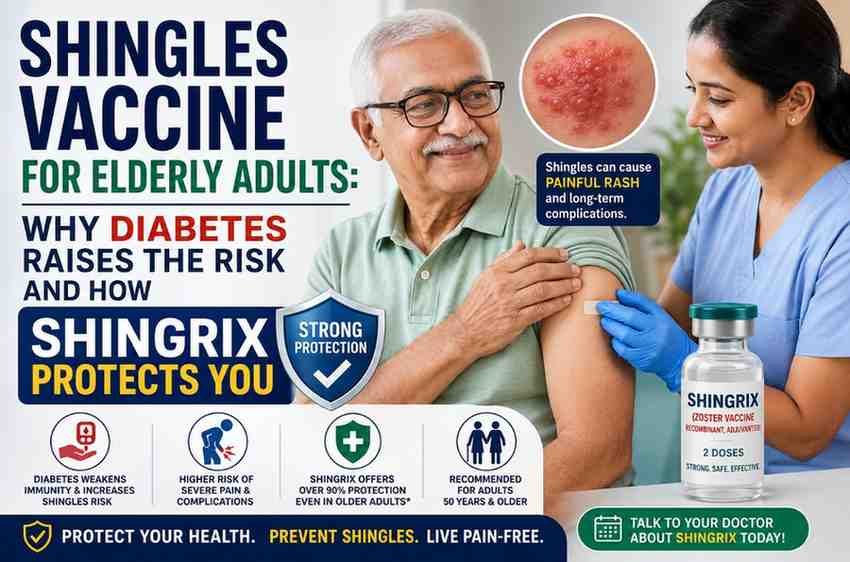
Here’s a fact that surprises most people: if you’re over 50, there’s a very good chance the shingles virus is already living inside your nerve cells right now, waiting. And if you also have Diabetes, your odds of that virus waking up are meaningfully higher than your non-diabetic neighbor’s. This isn’t fear-mongering it’s what more than a decade of population-level research consistently shows.
Who is most affected: adults aged 50 and older, especially those with type 2 diabetes, poor blood sugar control, or diabetes-related complications like heart or kidney disease. What is happening: diabetes appears to independently raise the risk of developing herpes zoster (shingles) and its complications. When should you act: the CDC’s current recommendation covers all immunocompetent adults 50 and older, and separately, adults 19 and older with weakened immune systems. Where this matters: primarily in primary care and endocrinology settings, where shingles vaccination is still under-discussed. Why it’s urgent: shingles in people with diabetes tends to be more severe, more likely to require hospitalization, and more likely to trigger dangerous blood sugar swings. How to respond: get vaccinated with Shingrix, the two-dose recombinant vaccine, which is not a live virus and is considered safe for people with diabetes.
Background: Shingles Isn’t a New Infection It’s an Old One Reawakening
Shingles doesn’t come from catching something new. It comes from something you likely caught decades ago. The varicella-zoster virus the same virus behind chickenpox never fully leaves the body after a childhood infection. Instead, it retreats into nerve tissue near the spinal cord and brain, where it sits dormant, sometimes for 60 or 70 years, kept in check by the immune system.
The catch is that immune surveillance isn’t permanent. As people age, a process called immunosenescence gradually reduces the immune system’s ability to keep the virus suppressed. That’s why shingles risk climbs so sharply after age 50, and why researchers estimate that roughly half of people who live into their mid-80s will experience an episode at some point.
Diabetes adds a second layer to that decline one that’s less widely understood but well documented in clinical literature.
The Diabetes Connection: What the Research Actually Shows
This is the part most general health articles gloss over, so it’s worth being specific. Multiple large population studies and at least one systematic review with meta-analysis have quantified the relationship between diabetes and shingles risk, and the numbers are remarkably consistent across different countries and healthcare systems.
| Study Type / Source | Population | Key Finding |
|---|---|---|
| Systematic review & meta-analysis (Journal of Clinical Endocrinology & Metabolism) | Multiple international cohorts | Pooled relative risk of 1.38 a 38% higher risk of shingles in people with diabetes |
| Taiwan National Health Insurance database study | 25,345 shingles cases matched to controls | 24% increased odds of shingles in diabetic patients (higher still with coronary artery disease or microvascular complications) |
| Population-based study, 2009–2014 | Over 2.28 million adults aged 50+ | Diabetes increased shingles risk by 20%; diabetic patients also showed worse glycemic control after infection |
| 10-year hospitalization study | Diabetic vs. non-diabetic shingles patients | Hospitalization rate of 22.8 per 100,000 person-years in diabetics vs. 6.5 in non-diabetics |
Notice the pattern: it isn’t just that people with diabetes get shingles slightly more often. It’s that when they do get it, they’re far more likely to end up in a hospital bed. That gap 22.8 versus 6.5 hospitalizations per 100,000 person-years is roughly a threefold difference, and it’s one of the most striking numbers in this entire body of research.
Why Diabetes Raises the Risk: The Mechanism Behind the Numbers
It’s worth pausing on the “why,” because this is where most coverage stays vague. There isn’t one single mechanism it’s a combination of several overlapping problems that compound each other.
- Chronic low-grade immune dysfunction. Elevated blood glucose impairs the function of T-cells, the immune cells specifically responsible for keeping the dormant varicella-zoster virus suppressed. This is a slow, cumulative effect rather than a sudden failure.
- Glycemic control matters more than the diagnosis itself. Research has found that hemoglobin A1c levels above 8% are independently associated with higher shingles hospitalization risk meaning poorly controlled diabetes carries more danger than diabetes that’s well managed.
- Vascular and nerve damage compounds the problem. Diabetic patients with coronary artery disease or microvascular complications (nerve, kidney, or eye damage) show measurably higher shingles risk than diabetic patients without those complications, according to Taiwanese cohort data.
- Certain diabetes medications carry their own signal. Interestingly, one large study found that patients on insulin, thiazolidinediones, or alpha-glucosidase inhibitors had somewhat higher shingles risk than those on metformin or sulfonylureas alone a detail that hints medication class, and possibly disease severity, plays a role too.
Put simply: diabetes doesn’t cause shingles directly. It erodes the immune fence that normally keeps the virus locked away, and the erosion gets worse the longer blood sugar stays uncontrolled.
The Real-World Impact: A Two-Way Street
Here’s the insight that rarely makes it into mainstream coverage of this topic: the relationship between diabetes and shingles isn’t one-directional. It’s a feedback loop.
Diabetes raises the risk of shingles but shingles, once it occurs, also destabilizes diabetes. Population data tracking patients before and after a shingles episode found measurable deterioration in glycemic control (worsening A1c) following the infection, alongside increased healthcare resource use. The physical stress of a viral reactivation, combined with pain, disrupted sleep, reduced activity, and sometimes corticosteroid treatment for nerve pain, can all push blood sugar in the wrong direction.
This means a single shingles episode can trigger a cascade: worse glucose control leads to a weaker immune system, which increases vulnerability to further infections and complications, which in turn makes diabetes harder to manage. It’s a cycle that’s entirely preventable with a two-dose vaccine which makes the current vaccination gap especially frustrating.
The Vaccination Gap Nobody Talks About
Despite clear guidance from both the CDC and diabetes-specialist organizations recommending shingles vaccination for this exact population, uptake has historically lagged. CDC surveillance data found that only about 27% of adults 60 and older with diagnosed diabetes had ever received a shingles vaccine meaning roughly three out of four people in one of the highest-risk groups were unprotected.
That gap likely persists today for a predictable reason: shingles vaccination often gets discussed during routine “senior” checkups, but diabetes management appointments are frequently focused entirely on glucose, medication, and diet with preventive vaccines treated as a separate conversation that falls through the cracks between specialties.
Current CDC Guidance: What Actually Applies to You
The recombinant zoster vaccine, sold as Shingrix, is the vaccine currently recommended in the United States. It replaced the older live-virus vaccine, Zostavax, which is no longer available and whose protection was shown to fade substantially with age dropping to roughly 41% effectiveness in people aged 70–79 and just 18% in those 80 and older during the years following vaccination.
Shingrix, by contrast, is not a live vaccine, which makes it a suitable option for people with diabetes and other chronic conditions that involve some degree of immune compromise. Current recommendations include:
- Two doses, given 2 to 6 months apart, for all immunocompetent adults aged 50 and older regardless of whether they’ve had shingles before or received the older Zostavax vaccine.
- Two doses for adults aged 19 and older who are immunocompromised or immunosuppressed due to disease or treatment.
- No need for prior blood testing to confirm chickenpox history — over 99% of adults in this age group have already been exposed to the virus.
- A minimum wait of 8 weeks after a Zostavax dose before receiving Shingrix.
One point worth flagging honestly: postmarketing safety monitoring has noted an increased risk of Guillain-Barré syndrome in the 42 days following Shingrix vaccination, and fainting (syncope) can occur after injection, as with many vaccines. These are recognized, monitored risks rather than reasons to avoid vaccination for most people with diabetes, the risk of severe, hospitalization-grade shingles far outweighs these rare vaccine-related events. This is a conversation worth having directly with a physician, not a reason for self-diagnosis or avoidance based on an article.
An Unexpected Bonus: The Cognitive Health Angle
Here’s a genuinely underreported thread in the research that deserves more attention, especially for an older, diabetic population already concerned about cognitive decline. Recent large-scale studies including a 2024 analysis published in a major medical journal and a 2025 natural-experiment study found that people who received the recombinant shingles vaccine had a measurably lower risk of developing dementia compared with those who didn’t. The mechanism isn’t fully settled, but leading theories point to reduced neuroinflammation from avoiding shingles infection itself, since shingles has separately been linked to small but real increases in stroke and vascular events in the months following infection.
For a diabetic population already facing elevated cardiovascular and cognitive risk from their underlying condition, this adds a second, largely unadvertised reason to prioritize vaccination not just fewer painful rashes, but potentially a meaningfully lower long-term risk to brain health.
A Prediction Worth Watching
Given the accumulating evidence connecting shingles, vascular events, and dementia risk, it’s reasonable to expect that future ACIP guidance may eventually single out diabetes more explicitly as a priority indication for earlier or more strongly emphasized vaccination similar to how immunocompromising conditions are already flagged for adults as young as 19. If cognitive-health data continues to hold up in further studies, shingles vaccination could shift from being framed purely as “rash prevention” to being marketed and prescribed as a broader chronic-disease and brain-health intervention, particularly for people managing diabetes.
Conclusion: A Small Decision With Outsized Stakes
The evidence is not ambiguous. Diabetes raises the risk of shingles by roughly 20% to 38% depending on the population studied, nearly triples the risk of shingles-related hospitalization, and creates a feedback loop that can destabilize blood sugar control for months after infection. Meanwhile, only about a quarter of older diabetic adults have historically taken advantage of a vaccine that’s already recommended for them by name.
If you’re over 50, or living with diabetes at any age with an immune-compromising complication, the two-dose Shingrix vaccine remains one of the highest-value, lowest-effort preventive steps available one that may protect not just your skin and nerves, but potentially your long-term brain health as well. The conversation is worth having at your next appointment, whether that’s with your primary care physician or your endocrinologist. Don’t wait for the two conversations diabetes management and vaccination to happen in the same room by accident.
For breaking news and live news updates, like us on Facebook or follow us on Twitter and Instagram. Read more on Latest Health on thefoxdaily.com.



COMMENTS 0