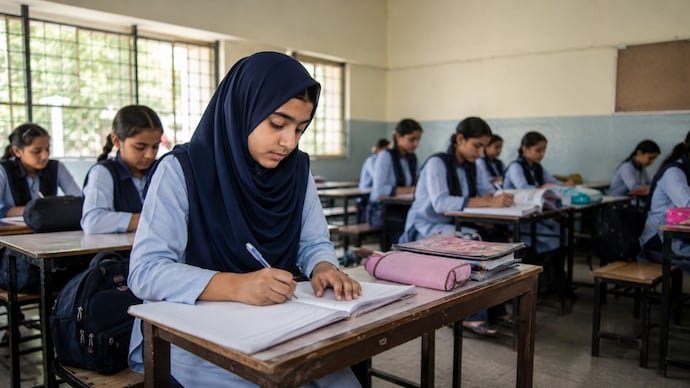
The Allahabad High Court has dismissed a petition filed by a Muslim Class 11 student seeking permission to wear a hijab with her prescribed school uniform, ruling that she had not established that wearing a headscarf is an essential religious practice of Islam protected under Article 25 of the Constitution.
The case involved a student from a school in Prayagraj WHO wanted to continue wearing a headscarf after the institution moved to enforce its prescribed dress code. She argued that she had been wearing the headscarf for several years and that it formed part of her religious practice.
A division bench of Justice JJ Munir and Justice Indrajeet Shukla rejected the petition, holding that a claim of religious practice by itself is not enough to invoke constitutional protection. The court said the petitioner had not placed sufficient factual or legal material before it to establish that wearing a headscarf was an obligatory practice in Islam without which her faith would be affected.
The ruling also addressed a separate but closely connected issue: whether a student can seek an exception to a school’s uniform policy on the basis of personal or religious preference. The court concluded that where a dress code is uniform, non-discriminatory and intended to maintain discipline and institutional identity, the school can enforce it.
Why the Allahabad HC rejected the hijab plea
The central argument before the court was based on Article 25, which protects freedom of conscience and the right to profess, practise and propagate religion, subject to constitutional restrictions.
The student sought protection under this provision by arguing that wearing the hijab was part of her faith. But the court drew a distinction between following a religious practice and demonstrating that the practice is constitutionally protected as an essential religious practice.
According to the bench, the petition did not contain the necessary factual and legal foundation to establish that wearing a headscarf was obligatory in Islam. The fact that the student had personally followed the practice for years was not enough, by itself, to establish the broader constitutional claim.
The court therefore refused to accept the argument that Article 25 automatically required the school to permit the headscarf as an exception to its uniform policy.
Student said she had worn the headscarf since Class 6
The student’s previous experience at the school was an important part of her case.
She had argued that she had been wearing the headscarf from Class 6 through Class 10 without the school objecting to it. From her perspective, the institution’s earlier acceptance supported her request to continue the practice in Class 11.
However, the High Court did not consider the school’s earlier tolerance sufficient to establish a permanent right.
The bench observed that the school may previously have failed to object for several reasons, including inaction, non-enforcement of the uniform policy, hesitation, courtesy or simply a lack of willingness to enforce the rule at that time.
That earlier conduct, the court said, did not prevent the institution from subsequently enforcing its prescribed dress code.
Past permission did not create a permanent right
The court’s reasoning on the previous years of schooling is significant because it separates past practice from an enforceable legal right.
A student being allowed to depart from a school’s uniform rules for several years does not necessarily mean that the school must permit the same departure indefinitely. If the institution later decides to enforce its existing dress policy, previous non-enforcement does not automatically stop it from doing so.
In the case before the court, the student relied on her history of wearing the headscarf without objection. The bench, however, said that this history did not create an estoppel against the school when it decided to enforce its uniform policy.
The distinction matters because schools often have rules that may not be enforced consistently at every point in time. The judgment indicates that inconsistent or relaxed enforcement in earlier classes does not necessarily prevent a school from applying its stated policy later.
What the court said about school uniforms
The Allahabad High Court also placed considerable emphasis on the purpose of a school uniform.
The bench observed that a uniform dress code can serve several institutional purposes, including maintaining discipline and creating a common identity among students. Where such a policy is applied uniformly and without discrimination, the court held that individual students cannot demand changes simply because they prefer a different form of dress.
This part of the judgment means the dispute was not treated only as a question about Religious Freedom. The court also considered the authority of an educational institution to establish and enforce reasonable rules governing students’ appearance.
A school uniform is intended to create a common standard. If individual additions or modifications are allowed whenever a student requests them, the institution’s ability to maintain a uniform dress policy could become difficult to enforce.
In this case, the court found no sufficient basis to require the school to make an exception for the petitioner.
Article 25 does not automatically protect every religious practice
The ruling highlights an important aspect of constitutional religious freedom.
Article 25 provides protection for religious freedom, but the court’s reasoning shows that a person cannot establish a constitutional claim merely by describing a personal practice as religious. Where a petitioner relies specifically on the argument that a practice is essential to a religion, the court can examine whether the necessary foundation has actually been established.
That was the weakness the bench identified in the student’s petition.
The court said there were no sufficient pleadings demonstrating that the practice was obligatory in Islam in the sense required for the constitutional claim being made. The student’s statement that she had worn the headscarf since childhood and since joining the school in Class 6 did not establish that requirement.
The distinction is therefore between personal religious observance and a claim that a practice is constitutionally protected as an essential religious obligation.
Allahabad HC referred to earlier hijab judgments
The bench also considered previous court decisions dealing with the hijab and Islamic religious practices.
The court noted that various High Courts had previously held that wearing a headscarf is not an essential part of Islamic faith for women in the constitutional sense relied upon in such cases.
The bench specifically referred to an earlier judgment of the Karnataka High Court and said it saw no reason to take a different view.
This connection is important because the legal debate over hijab in educational institutions has already produced significant litigation in India. The Allahabad High Court’s decision places the present dispute within that existing line of judicial reasoning rather than treating it as an entirely new constitutional question.
Why the Karnataka hijab judgment matters
The Karnataka High Court’s ruling on hijab in educational institutions has been a major part of the legal debate surrounding religious clothing and school uniforms.
In the present case, the Allahabad High Court noted that the Karnataka ruling remains relevant while the matter before the Supreme Court remains unresolved following a split verdict.
A split verdict occurs when judges hearing a case reach different conclusions and therefore do not produce a single majority ruling on the disputed issue. The Supreme Court’s earlier proceedings on the Karnataka hijab controversy left important questions without a final resolution from a majority of the bench.
That unresolved position is significant when interpreting the Allahabad High Court’s decision. The latest ruling is an important High Court judgment, but it should not be misunderstood as a nationwide Supreme Court determination settling every legal question concerning hijab and school uniforms.
Does the ruling mean hijab is banned in all schools?
No. The Allahabad High Court’s decision should not be interpreted as a blanket nationwide ban on hijab in schools.
The judgment concerns the particular petition brought by the student and the uniform policy of the school involved in the case. The court rejected the student’s argument that she had established a constitutional right under Article 25 to wear the headscarf with the prescribed uniform.
The court also upheld the school’s ability to enforce its uniform policy in the circumstances before it.
That distinction is important. The ruling does not mean that every educational institution in India automatically has identical powers or that every dispute involving religious clothing would necessarily produce the same outcome. The precise school rules, facts, legal arguments and constitutional questions can differ from case to case.
The larger issue: religious freedom versus institutional rules
The case illustrates a recurring constitutional tension between individual religious freedom and rules imposed by institutions.
For students who regard particular forms of dress as part of their religious identity, restrictions can raise questions about freedom of conscience and religious practice. For schools, a uniform is a mechanism for maintaining common standards and institutional discipline.
The court’s decision in this case reflects its conclusion that the student’s Article 25 claim was not sufficiently established to override the school’s uniform policy.
That reasoning does not make the underlying debate disappear. Instead, it demonstrates why disputes involving religious clothing often require courts to examine both the claimed religious practice and the Nature of the institutional rule being challenged.
What the ruling means for schools and students
For schools, the decision reinforces the importance of having a clearly defined uniform policy and applying it consistently. The court’s reasoning places emphasis on whether the dress code is uniform, non-discriminatory and connected to legitimate institutional objectives such as discipline and identity.
For students, the judgment demonstrates that a long-standing personal practice does not automatically create a legal entitlement to an exception from school rules. A student seeking constitutional protection for a religious practice must establish the legal basis for that claim rather than relying solely on personal observance.
The ruling also indicates that previous tolerance by a school does not necessarily prevent the institution from enforcing its rules later.
What could happen next in the hijab legal debate?
The broader legal debate over hijab in educational institutions remains significant because the Supreme Court has yet to provide a final resolution of the questions left open by its earlier split verdict in the Karnataka case.
The Allahabad High Court’s decision adds another judicial assessment to that debate. It supports the view that wearing a headscarf has not been established in the case before it as an essential religious practice that would automatically require an exception to a school’s uniform policy.
For the student involved, the immediate outcome is clear: her petition has been dismissed and the school can enforce its prescribed uniform.
For the wider legal question, however, the ruling is narrower than a nationwide prohibition. It shows how courts may approach a conflict between a student’s asserted religious practice and an institutional dress code when the petitioner has not established that the claimed practice is essential in the constitutional sense.
The case ultimately turns on a distinction that is easy to miss in the broader debate: the court was not simply deciding whether a Muslim student may personally choose to wear a hijab. It was deciding whether the student had demonstrated a constitutional right to wear it in a school that required a prescribed uniform. On the material placed before it, the Allahabad High Court concluded that she had not.
For breaking news and live news updates, like us on Facebook or follow us on Twitter and Instagram. Read more on Latest India on thefoxdaily.com.






COMMENTS 0