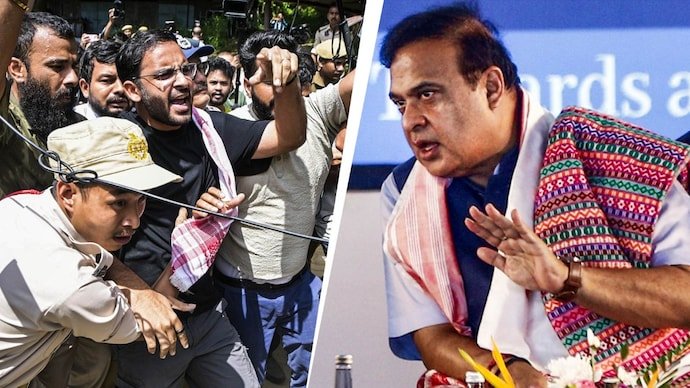
Cockroach Janta Party (CJP) leader Ashutosh Ranka has accused Assam Police of illegally detaining him and more than 40 volunteers in Guwahati, saying the action will not stop the outfit from expanding its campaign across the northeast.
The political confrontation escalated after Ranka and a group of CJP volunteers were detained from the residence of Assam Jatiya Parishad (AJP) leader Kunki Chowdhury in Guwahati on Sunday. The group had gathered ahead of a scheduled meeting to discuss a range of issues concerning Assam, according to Ranka.
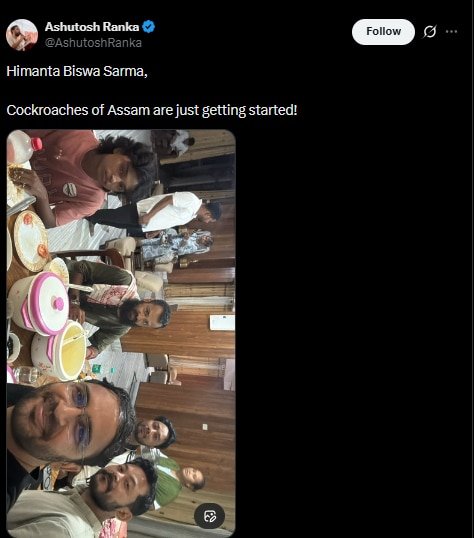
After being released later that evening, Ranka directly challenged Assam Chief Minister Himanta Biswa Sarma and said the CJP campaign was only beginning. In a post on X, he wrote, “Cockroaches of Assam are just getting started!”
The statement followed what Ranka described as an “illegal detention” by Assam Police. The incident has since triggered accusations from opposition figures that the detention was aimed at preventing political dissent, while the circumstances and legal basis for the police action remain a central point of contention.
Why Were Ashutosh Ranka and CJP Volunteers Detained?
Ranka said he and more than 40 CJP volunteers were detained from Chowdhury’s residence before their scheduled meeting. According to him, the group was taken to the 10th Assam Police battalion headquarters in Kahilipara, Guwahati.
Ranka said the detainees repeatedly asked police why they had been taken into custody but claimed that the officers could not provide a clear explanation.
“We asked them on what basis we were detained, but the police said they didn’t know, and that they had orders from the top,” Ranka said at a press conference after his release.
The account presented by Ranka raises questions about the legal basis and procedure surrounding the detention. NCP (SP) spokesperson Anish Gawande separately claimed that no legal notice was served on Ranka or the other volunteers and that they were not informed of the sections under which action had been taken.
There was no detailed police explanation included in the account of the incident provided by the CJP leader and opposition figures. As a result, the competing claims about the detention remain politically disputed.
Ranka Directly Challenges Himanta Biswa Sarma
Following his release, Ranka shifted his focus from the detention itself to a broader political challenge against Chief Minister Himanta Biswa Sarma.
In a post on X, Ranka declared that the CJP would not be intimidated by the police action. He accused Sarma of being afraid of the group and argued that the detention reflected an attempt to prevent the CJP from raising questions about conditions in Assam.
At his press conference, Ranka said the CJP volunteers were not planning an activity that justified their detention. Instead, he said the meeting was intended to discuss public issues including the condition of schools, the rights of indigenous communities and developments around Kaziranga.
He also alleged that constituency boundaries had been redrawn to benefit the ruling establishment ahead of the April election. That allegation was presented by Ranka as part of his wider criticism of the state government and its political administration.
Ranka framed the confrontation as a question of political rights and public accountability rather than simply a dispute over one detention.
CJP Says Its Assam Campaign Will Intensify
Ranka’s strongest message after his release was that the detention would not bring the CJP’s campaign to an end.
“Sarma may have all the resources, but we are not afraid. We are fighting for our rights,” he said, adding that the movement would intensify across the northeast.
The declaration suggests that the CJP intends to use the detention as part of a broader campaign aimed at drawing attention to issues it says affect ordinary people in Assam.
Ranka’s comments focused particularly on schools, employment opportunities for young people and the rights of indigenous communities. He also accused the government of failing to adequately address issues that he believes deserve greater public scrutiny.
“We want schools for our children and jobs for our youth,” Ranka said.
By linking those concerns to the detention, the CJP leader sought to portray the incident as part of a larger political struggle over dissent and public debate in Assam.
What Ranka Said About Kaziranga
Kaziranga emerged as another important issue in Ranka’s criticism of the Assam government. He said the meeting that was disrupted by the detention was intended to discuss the rights of indigenous people in and around the region.
Ranka alleged that the rights of local communities were being affected for the benefit of corporate interests. He also referred to what he described as man-made floods that had resulted in loss of life.
These statements were made as political allegations by Ranka and were not independently established in the material surrounding the detention. They nevertheless form a central part of the CJP’s argument that the group should be able to publicly discuss Governance and development issues in Assam.
The dispute therefore extends beyond the question of whether volunteers should have been detained. It also touches on competing claims about development, indigenous rights, environmental management and the state’s response to criticism.
Ranka Invokes Zubeen Garg in Political Message
Ranka also invoked the legacy of Assamese cultural figure Zubeen Garg while attacking the state government’s alleged response to dissent.
“He forgets that this is the land of Zubeen (Garg), who fought for what is right,” Ranka said.
The reference was intended to connect the CJP’s political campaign with a broader sense of Assamese identity and public expression. Ranka presented the issues of schools, jobs and community rights as matters that should remain open to public discussion.
His message was accompanied by Social Media posts claiming that people in Assam were becoming increasingly aware of the issues raised by the CJP.
Video Shows Ranka With Police Personnel
Before his release, a video uploaded on Ranka’s X account showed him sitting inside a moving vehicle with police personnel.
In the video, Ranka was purportedly heard accusing the chief minister of ordering the detention because of concerns about the CJP’s campaign. He said the group wanted to highlight the condition of schools and other issues that it believed needed public attention.
Ranka had also spoken to reporters while being taken away by police. During those comments, he alleged that the government was concerned about the CJP exposing what he described as shortcomings in Assam.
He specifically referred to schools, indigenous rights in Kaziranga and constituency boundaries. He also repeated his allegation that the assembly election had benefited from changes to constituency boundaries.
Those allegations are political claims made by Ranka and should be distinguished from established findings about the detention itself.
NCP SP Questions the Detention
NCP (SP) spokesperson Anish Gawande also criticised the police action, saying Ranka and 41 others had been detained from a private residence while a meeting with CJP volunteers was scheduled to take place.
Gawande claimed the group had been “illegally and unconstitutionally detained” and said that no legal notice had been served on the detainees.
He also claimed they were not informed about which legal provisions had been invoked.
Gawande described the episode as evidence of what he called “jungle raj” under Chief Minister Sarma and accused the government of being unwilling to tolerate dissent.
As with Ranka’s allegations, Gawande’s statements represent the opposition’s characterization of the incident. The police action and its legal justification would need to be assessed against the official record and applicable procedures before those claims could be treated as established facts.
The Political Dispute Is Now Wider Than the Detention
The detention has quickly developed into a broader confrontation between the CJP and the Assam government. Ranka is using the episode to argue that the group’s campaign has attracted official attention, while opposition figures have presented the incident as a question of political freedom and police procedure.
For the CJP, the immediate issue is no longer limited to the circumstances in which its volunteers were detained. Ranka has made clear that the organisation intends to continue raising questions about education, employment, indigenous rights, development and political representation.
His repeated references to schools and jobs also indicate the issues the CJP wants to place at the centre of its public campaign. Whether those subjects gain wider political traction will depend on the group’s ability to sustain activity beyond the immediate controversy.
The government’s response will also shape the next stage of the dispute. A clear explanation of why the volunteers were detained, what legal authority was used and what happened during their time at the battalion headquarters would address some of the questions raised by Ranka and opposition leaders.
“Just Getting Started”: Ranka Signals More Confrontation
Ranka’s post declaring that the “cockroaches of Assam are just getting started” was more than a response to his release. It was a signal that the CJP intends to continue its campaign despite the detention.
He also compared the episode with what he described as an earlier mistake by Union Home Minister Amit Shah during a Jantar Mantar protest in Delhi, arguing that the Assam government had similarly underestimated the determination of protesters.
“Himanta is scared. People of Assam are waking up,” one of Ranka’s accompanying social media messages said.
For now, the competing narratives remain sharply divided. Ranka and his supporters describe the detention as unlawful and politically motivated, while the precise official basis for the police action has not been established in the material surrounding the incident.
What is clear is that Ranka intends to turn the episode into a larger campaign. His promise to intensify activities across the northeast means the confrontation is unlikely to end with the release of the detained volunteers.
The next phase will depend on whether the CJP can expand its campaign around the issues it has raised and whether the Assam authorities provide further clarification about the detention. The incident has already placed questions about dissent, policing and political mobilisation at the centre of the group’s emerging challenge to the state government.
For breaking news and live news updates, like us on Facebook or follow us on Twitter and Instagram. Read more on Latest India on thefoxdaily.com.






COMMENTS 0