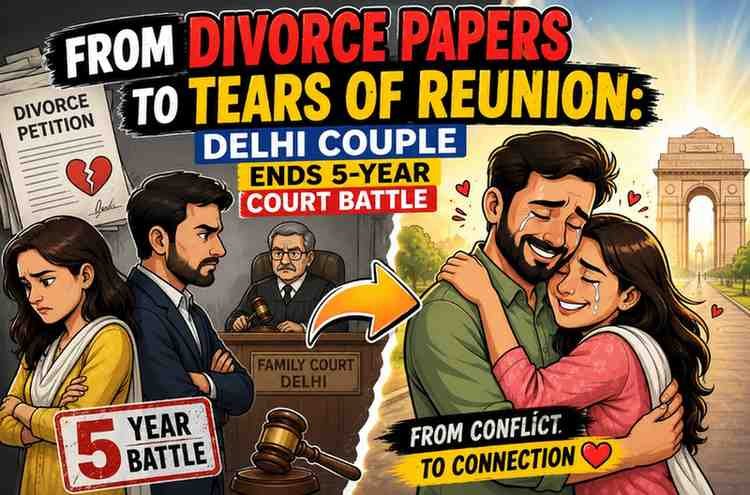
In an era where stories of bitter divorces and prolonged legal disputes dominate headlines, a remarkable incident from a Delhi courtroom has captured public attention for a very different reason. What was expected to be another routine hearing in a five-year divorce case unexpectedly transformed into an emotional reunion when a wife tore up her divorce papers and embraced her husband in front of lawyers, court officials, and a judge.
The story of Shikha and Saurabh is not merely about a marriage saved at the last moment. It is also a story about the emotional cost of prolonged legal battles, the impact of Family crises, and how a single act of kindness can sometimes bridge divides that years of arguments fail to overcome.
The dramatic courtroom moment has resonated with thousands across Social Media because it touches on universal themes: love, regret, forgiveness, family, and second chances.
Who Are Shikha and Saurabh?
Shikha and Saurabh were married in 2020, beginning their journey together with hopes and expectations shared by countless newlywed couples. Like many marriages, theirs started with optimism and dreams of building a future together.
However, the relationship reportedly deteriorated over time due to disputes and disagreements that eventually escalated into legal proceedings. What began as marital conflicts soon evolved into a prolonged courtroom battle involving allegations, emotional confrontations, and years of uncertainty.
For nearly five years, both individuals found themselves not as partners but as opposing parties in a legal dispute, seeking a formal end to their marriage.
As the case dragged on, what might initially have appeared to be a straightforward legal matter gradually became a source of emotional, financial, and psychological strain for everyone involved.
The Hidden Cost of Long Divorce Battles
Divorce proceedings are often viewed primarily through a legal lens, but experts frequently emphasize that the emotional and financial consequences can be just as significant.
Long-running family disputes often affect not only the couple but also parents, siblings, and children. Court appearances, legal fees, social pressures, and emotional exhaustion can accumulate over time.
In this case, reports suggest that Shikha’s family experienced significant financial pressure while navigating the prolonged legal process.
Her father reportedly spent a substantial portion of his savings supporting the litigation and worrying about his daughter’s future. Such situations are not uncommon, particularly in societies where marriage remains closely tied to family identity and social expectations.
Family courts around the world regularly witness cases where the emotional burden becomes heavier with every passing hearing.
When a Medical Emergency Changed Everything
The turning point in the story came not inside a courtroom but inside a hospital.
As the legal battle continued, Shikha’s father reportedly suffered a heart attack, creating a medical emergency that placed additional stress on the family.
Due to financial limitations, the family initially sought treatment at a government hospital. During this difficult period, Saurabh learned about his father-in-law‘s condition.
Despite years of conflict and ongoing legal proceedings, he reportedly chose to help.
According to accounts of the incident, Saurabh assisted in shifting his father-in-law to a better-equipped private hospital in Gurugram, ensuring that he received improved medical care during a critical moment.
The gesture surprised many because it came during an active divorce dispute, a period when communication between couples is often strained or completely broken.
Yet it was this unexpected act of compassion that would eventually alter the course of their relationship.
Why Acts of Kindness Carry Extraordinary Power
Psychologists have long argued that moments of empathy can reshape how people perceive one another, especially in relationships marked by conflict.
When individuals are locked in prolonged disputes, they often begin viewing each other primarily through the lens of past grievances. Positive memories become overshadowed by anger, disappointment, and resentment.
However, an unexpected act of kindness can disrupt that pattern.
It forces individuals to see a different side of the person they have come to view as an adversary.
In relationships, kindness often serves as a reminder of qualities that initially brought people together—care, responsibility, generosity, and emotional support.
For Shikha, Saurabh’s willingness to help her father during a medical crisis may have revealed a side of him that years of litigation had buried beneath conflict.
The Courtroom Moment That Stunned Everyone
The day after the medical emergency, the couple appeared in court once again for a scheduled hearing.
To those present, it seemed like another routine session in a case that had already consumed nearly five years.
Lawyers presented arguments, proceedings moved forward, and everyone expected the hearing to follow its usual course.
Then came the moment that changed everything.
When the judge reportedly asked Saurabh whether he still wanted a divorce, he looked toward Shikha and smiled.
It was a simple gesture, lasting only seconds.
Yet according to accounts of the incident, that brief moment appeared to dissolve years of accumulated anger and emotional distance.
Overwhelmed with emotion, Shikha tore up the divorce papers and rushed toward her husband.
What followed was a tearful embrace that reportedly left the courtroom silent.
A proceeding intended to formalize separation instead became a moment of reconciliation.
Why This Story Resonates With So Many People
The story has attracted widespread attention because it challenges the increasingly common narrative that broken relationships are always beyond repair.
While not every troubled marriage can or should be saved, many people recognize elements of their own experiences in the emotional journey of Shikha and Saurabh.
Relationships often suffer because of misunderstandings, stress, ego clashes, communication breakdowns, financial pressures, or family conflicts.
Over time, these issues can create emotional walls that seem impossible to dismantle.
The Delhi courtroom incident reminds people that human emotions are rarely straightforward. Feelings that appear buried can sometimes re-emerge unexpectedly under the right circumstances.
This emotional complexity is one reason the story has sparked conversations across social media platforms and family discussion groups.
The Rising Trend of Divorce in Urban India
The reunion also comes at a time when family dynamics in India are evolving rapidly.
Urbanization, changing social norms, financial independence, career pressures, and shifting expectations have transformed modern relationships.
While marriage remains a deeply valued institution, couples today face challenges that previous generations may not have encountered in the same way.
Family courts in major cities have witnessed increasing numbers of marital disputes, reflecting both changing social attitudes and greater willingness among individuals to seek legal remedies when relationships become unworkable.
At the same time, mediation and reconciliation efforts have gained importance as courts increasingly encourage couples to explore alternatives before finalizing divorce proceedings.
The story of Shikha and Saurabh highlights why these efforts sometimes succeed.
The Role of Forgiveness in Rebuilding Relationships
One of the most significant lessons from the incident is the role forgiveness can play in healing damaged relationships.
Forgiveness does not mean forgetting past mistakes or ignoring genuine problems. Rather, it involves a willingness to move beyond past grievances in pursuit of a better future.
Relationship experts often note that successful reconciliation requires:
- Mutual willingness to communicate
- Acknowledgment of past mistakes
- Empathy and emotional maturity
- Commitment to change
- Trust-building efforts
- Patience and understanding
While outsiders may never know all the details of Shikha and Saurabh’s relationship, the courtroom reunion suggests that both saw value in giving their marriage another chance.
What Family Courts Can Learn From Cases Like This
The incident also highlights the importance of mediation and counseling within family court systems.
Many legal experts argue that family disputes differ from other forms of litigation because emotions, relationships, and future interactions remain central to the outcome.
Unlike commercial disagreements, family disputes involve people WHO often share years of History, emotional bonds, and family connections.
As a result, solutions based solely on legal arguments may not always address the deeper issues at the heart of the conflict.
| Traditional Litigation | Reconciliation-Oriented Approach |
|---|---|
| Focuses on legal rights | Focuses on relationship repair |
| Adversarial process | Collaborative process |
| Determines legal outcome | Explores emotional solutions |
| Can increase conflict | May reduce hostility |
| Ends relationship formally | May preserve family bonds |
A Reminder That Human Relationships Are Unpredictable
One reason the story has captivated public attention is its unpredictability.
After five years of litigation, few would have expected a dramatic reconciliation in the middle of a courtroom hearing.
Yet life often defies expectations.
History is filled with examples of relationships that appeared beyond repair but eventually found a path toward healing. Equally, some relationships end despite sincere efforts to save them.
The unpredictability of human emotions makes every relationship unique.
That reality is what makes stories like this so compelling.
Can Kindness Really Save a Relationship?
The answer depends on the circumstances.
Kindness alone cannot solve deep-rooted incompatibility, abuse, or serious trust issues. However, in relationships where emotional connection still exists beneath layers of conflict, acts of empathy can become powerful catalysts for change.
Small gestures often carry enormous emotional weight because they communicate something deeper than words: genuine care.
In this case, helping a family member during a medical emergency may have reminded both individuals of the compassion that once formed the foundation of their relationship.
Sometimes people do not need grand declarations of love. They need evidence that someone still cares.
Conclusion
The reunion of Shikha and Saurabh inside a Delhi courtroom is more than a viral human-interest story. It is a powerful reminder of the complexities of relationships and the extraordinary impact of empathy during difficult times.
After nearly five years of legal disputes, emotional strain, and uncertainty, a single act of kindness shifted the course of a marriage that appeared headed for permanent separation. What was expected to be another divorce hearing became an emotional reunion witnessed by an astonished courtroom.
While every relationship is different and not every marriage can be repaired, the story offers a valuable lesson: conflict may create distance, but compassion can sometimes build bridges that seem impossible to cross.
In a world often defined by division and disagreement, the image of torn divorce papers and a tearful embrace serves as a rare reminder that forgiveness, understanding, and humanity still have the power to change lives.
For breaking news and live news updates, like us on Facebook or follow us on Twitter and Instagram. Read more on Latest India on thefoxdaily.com.






COMMENTS 0