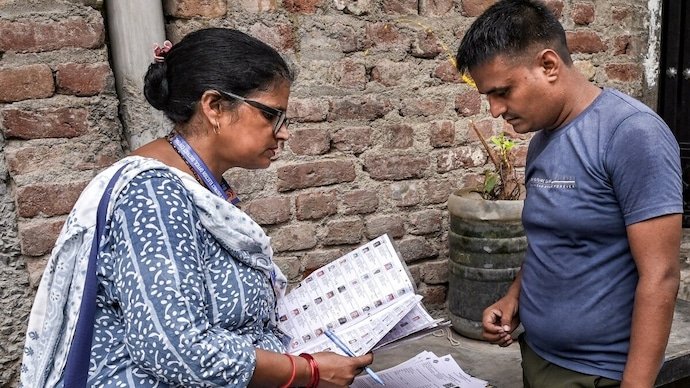
A fresh political dispute has erupted over the ongoing Special Intensive Revision (SIR) of electoral rolls in Jharkhand, with the INDIA bloc alleging that BJP workers and booth-level agents are pressuring Booth-Level Officers (BLOs) to remove the names of selected voters.
An INDIA bloc delegation on Thursday met Jharkhand Chief Electoral Officer K Ravi Kumar in Ranchi and submitted a memorandum seeking action over what it described as attempts to influence the voter-list revision process. The opposition alliance alleged that complaints had emerged from several districts, including Garhwa, Godda and Chatra.
The allegation centres on Form-7, the official form used to raise an objection to an existing electoral-roll entry or seek deletion of a voter’s name under specified conditions.
The Chief Electoral Officer rejected the suggestion that eligible voters could be quietly removed from the rolls. Kumar said the SIR process was transparent, that eligible names could not be deleted without the prescribed process and that details of Form-6 and Form-7 submissions could be checked through the election authorities’ website.
The dispute has gained significance because the voter-roll revision is taking place at a politically sensitive time, while reports of bulk Form-7 submissions in parts of Jharkhand have already triggered scrutiny by district election authorities.
What the INDIA bloc has alleged
The INDIA bloc delegation claimed that BJP workers and BJP-appointed Booth-Level Agents, or BLAs, were putting pressure on BLOs to delete the names of particular voters.
JMM general secretary Vinod Kumar Pandey said complaints were coming from districts including Garhwa, Godda and Chatra. He urged the chief electoral officer to identify those allegedly involved and initiate action against them.
The delegation included leaders from the Jharkhand congress, including state unit president Keshav Mahto Kamlesh, along with representatives of the RJD and CPI (ML) Liberation.
The allegation is particularly serious because BLOs occupy a critical position in the electoral-roll revision process. They are responsible for field-level verification and play an important role in determining whether claims, objections and proposed deletions require further examination.
The opposition parties are arguing that political actors should not be able to influence that process by submitting or encouraging questionable deletion requests.
However, an allegation made by a political party is not itself proof that unlawful voter deletions have occurred. The claims require verification by election authorities and, where appropriate, Investigation into individual applications.
What did the Jharkhand CEO say?
Chief Electoral Officer K Ravi Kumar pushed back against the suggestion that eligible voters could be removed secretly or simply because someone submitted a Form-7 application.
He said the SIR process is transparent and that the names of eligible voters cannot be deleted through an unchecked or hidden procedure.
Kumar also said Booth-Level Agents can submit objections in bulk, with up to 10 forms a day to BLOs. According to him, information about Form-6 and Form-7 submissions, including the number of forms received and the names of voters involved, can be checked online.
That point is central to the election authority’s response. A Form-7 submission is not equivalent to an automatic deletion of a voter’s name.
The official procedure requires electoral authorities to examine the objection or deletion request before taking a final decision. The CEO also rejected the idea that misinformation alone could secretly result in an eligible voter disappearing from the electoral roll.
The distinction between filing a deletion request and actually deleting a voter is therefore crucial to understanding the present controversy.
What is Form-7 and why is it important?
Form-7 is part of the formal voter-registration system and is used to raise objections to the inclusion of a name or request deletion of an existing entry from the electoral roll.
A deletion may become relevant in cases such as a voter’s death, permanent shifting from a constituency or another legally recognised reason. The purpose is to keep electoral rolls accurate and prevent duplicate or otherwise invalid entries.
But because Form-7 can potentially lead to the removal of a person’s name, the process requires verification rather than automatic acceptance.
This is why the current controversy focuses not simply on the number of forms being submitted but on who is submitting them, whose names are being targeted, the reasons given for deletion and whether the claims withstand field verification.
Large numbers of forms are not automatically evidence of wrongdoing. However, a concentrated pattern of deletion requests affecting particular communities, localities or categories of voters can reasonably trigger closer scrutiny by election officials.
Why the Godda controversy matters
The political allegations come shortly after scrutiny over Form-7 applications in Godda district.
Investigations by the Indian Express reported that BJP booth-level agents had submitted large numbers of Form-7 applications in several polling areas of Godda, with local officials raising concerns about the pattern of requests.
The newspaper reported that some of the applications appeared to target Muslim voters. District election authorities subsequently initiated an inquiry into Form-7 submissions at Booth No. 9 in Maheshtikri village in the Basantrai block.
Those reports do not establish that all Form-7 submissions were fraudulent or politically motivated. They do, however, explain why the issue has become a major political concern and why opposition parties are demanding stronger verification before names are removed.
The Election Commission‘s role in such cases is particularly important because the integrity of an electoral roll depends on both removing genuinely ineligible entries and ensuring that legitimate voters are not wrongly excluded.
Deletion is not supposed to happen automatically
The controversy highlights a key safeguard in electoral-roll revision: a request to delete a name is not the same as an order deleting the name.
When a Form-7 objection is filed, election officials must examine the claim and follow the prescribed verification process. That can involve checking records, contacting the concerned voter or conducting field-level verification where necessary.
This safeguards the right of eligible citizens to remain on the electoral roll.
The procedure becomes particularly important during intensive revisions because a large number of names may be reviewed over a relatively short period. Election authorities have to balance the need to correct the rolls with the risk that genuine voters may be wrongly flagged.
The Jharkhand CEO’s insistence that eligible voters cannot be deleted is therefore a significant assurance, but its practical importance will depend on how consistently the verification rules are applied on the ground.
Why BLOs and BLAs are at the centre of the dispute
The controversy has also brought attention to the different roles played by BLOs and BLAs.
Booth-Level Officers are election officials who work at the polling-station level and assist with preparing and updating electoral rolls. Their responsibilities include verification and field-level electoral work.
Booth-Level Agents, on the other hand, are appointed by political parties. They can participate in the electoral-roll process within the framework established by the Election Commission, including raising objections and pointing out entries they believe require scrutiny.
The presence of party-appointed agents is intended to provide political parties with a role in monitoring the electoral rolls. But the system also depends on a clear separation between making an objection and deciding whether an entry should actually be removed.
This is why allegations that party workers are “forcing” BLOs to act would be significant if proven. Political parties can flag concerns, but election officials are expected to apply the rules independently.
BJP rejects the opposition’s allegation
The BJP has rejected the INDIA bloc’s allegations.
Party spokesperson Pratul Shahdeo said the opposition was engaging in political accusations and argued that BJP-appointed BLAs have a legitimate right to flag voters they believe may not meet the requirements for inclusion.
He also stressed that the final decision rests with the Election Commission rather than with the party agents submitting objections.
That response goes to the heart of the disagreement. The BJP argues that identifying potentially ineligible entries is part of the normal electoral-roll process, while the INDIA bloc says the process could be misused if politically motivated deletion requests are submitted against valid voters.
The facts of individual cases will determine which interpretation is justified.
Why the timing of SIR is politically sensitive
Electoral-roll revisions are inherently sensitive because the voter list determines who can participate in an election.
Jharkhand’s SIR has consequently become a political issue in its own right, with the ruling alliance and BJP trading accusations over the treatment of voter entries.
Opposition parties are particularly concerned about the possibility of eligible voters being excluded. The BJP, meanwhile, has argued that voter rolls must also be scrutinised for questionable or ineligible entries.
Both objectives are legitimate components of an accurate electoral process: genuine voters should remain registered, while invalid or duplicate entries should be corrected.
The challenge is ensuring that neither goal is compromised for political reasons.
Why transparency is crucial in voter-list revisions
The CEO’s statement that Form-6 and Form-7 data can be checked online is important because transparency provides a way to identify unusual patterns before they become permanent changes to the electoral roll.
Publicly accessible information can allow political parties, civil-society groups and affected voters to identify whether large numbers of objections have been filed in a particular area or against particular groups of voters.
It also gives voters an opportunity to check their own status and raise objections if their names are wrongly challenged.
That visibility is especially important in an intensive revision exercise, where a large number of applications can be processed over a limited period.
A transparent process does not mean errors cannot occur. It means there are mechanisms for detecting, challenging and correcting those errors.
What happens when a voter’s name is challenged?
The central question for any voter whose name appears in a Form-7 objection is whether they remain eligible under the applicable electoral rules.
A deletion request can be challenged through the prescribed claims-and-objections process. Election authorities then have to determine whether the deletion grounds are valid.
This makes the current revision process important not only for political parties but also for ordinary voters.
A voter who discovers that their name has been challenged should verify the electoral-roll status and use the official process to respond within the applicable period. The existence of a Form-7 request does not by itself establish that a voter has lost eligibility.
For election authorities, the priority is to ensure that every deletion is backed by proper verification and documentation.
Could politically motivated Form-7 applications affect elections?
Potentially, yes, which is why the issue is receiving such intense attention.
Even a relatively small number of wrongful deletions can become significant in closely contested constituencies. Electoral outcomes in India can sometimes be decided by margins far smaller than the number of disputed voter entries.
That does not mean every large batch of Form-7 submissions is an attempt to manipulate an election. Electoral rolls contain genuine errors, and political parties regularly raise objections as part of the revision process.
The real concern arises when deletion requests appear selective, unsupported or concentrated in ways that cannot be explained by legitimate changes in voter status.
That is why independent verification by election authorities is more important than political claims from either side.
The larger debate over the Special Intensive Revision
The controversy in Jharkhand is part of a wider national debate over intensive electoral-roll revisions and the safeguards needed to protect voting rights.
Supporters of rigorous revision argue that accurate electoral rolls are essential to prevent duplicate, deceased, shifted or otherwise ineligible entries from remaining on the list.
Critics worry that aggressive verification can disproportionately affect vulnerable voters, especially where documentation is difficult to produce or local-level errors occur.
The two concerns are not mutually exclusive.
A credible electoral system must be capable of removing genuinely invalid entries without placing legitimate voters at unnecessary risk of exclusion.
That requires clear rules, transparent data, independent verification, accessible appeals and accountability when officials or political actors abuse the process.
What should happen next in Jharkhand?
The immediate issue is whether the allegations made by the INDIA bloc can be substantiated through official examination.
Election authorities can review the disputed Form-7 applications, examine their stated grounds, verify the affected voters and determine whether any political or procedural violations occurred.
Where suspicious patterns are identified, detailed inquiries can help establish whether the applications were legitimate objections or attempts to interfere with the electoral roll.
The recent inquiry ordered in Godda shows one possible route: examine the forms, verify the claims and establish whether the entries were targeted improperly.
The result of such inquiries is likely to be more important than political accusations alone because it can establish whether the alleged irregularities actually affected eligible voters.
What the Jharkhand voter-roll row really means
The latest confrontation between the INDIA bloc and the BJP is ultimately about trust in the electoral process.
The opposition says political workers are pressuring BLOs to remove selected voters through Form-7. The BJP says its booth-level agents are exercising a legitimate right to flag questionable entries. The Chief Electoral Officer says the revision is transparent and eligible voters cannot simply be deleted.
These positions can only be reconciled through evidence and proper verification.
A Form-7 submission should not be treated as automatic proof that a voter is ineligible. At the same time, election authorities cannot ignore credible evidence that an entry may be invalid.
The responsibility therefore rests with the electoral machinery to ensure that every contested name is examined fairly, that political pressure does not influence official decisions and that eligible citizens have an effective opportunity to protect their place on the electoral roll.
The Jharkhand SIR dispute is now likely to remain under close political and public scrutiny. With allegations emerging from multiple districts and officials already examining some disputed Form-7 submissions, the next stage will be determined by the quality of verification rather than the strength of competing political claims.
For voters, the central message is straightforward: the filing of a Form-7 does not by itself mean a valid voter has been removed. The electoral authorities must follow the prescribed process before any eligible name can be deleted, and the transparency of that process will be crucial to maintaining confidence in Jharkhand’s voter rolls.
For breaking news and live news updates, like us on Facebook or follow us on Twitter and Instagram. Read more on Latest India on thefoxdaily.com.





COMMENTS 0