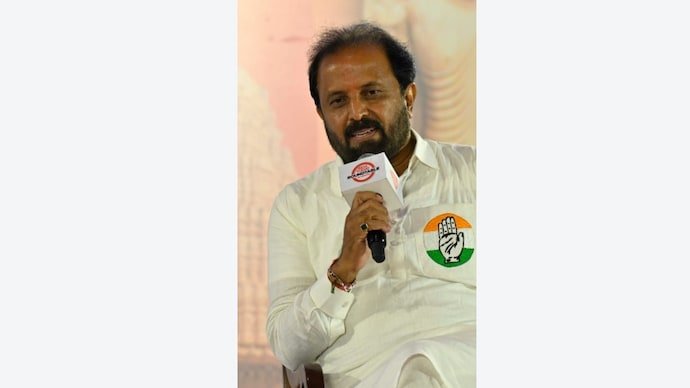
The Congress has appointed former MP Madhu Goud Yaskhi as the new chairperson of the All India Professionals’ Congress (AIPC), replacing Praveen Chakravarty, who was recently elected to the Rajya Sabha from Tamil Nadu.
The appointment was announced by Congress president Mallikarjun Kharge on Wednesday as part of a leadership change at the party’s professional outreach platform. The Congress also acknowledged Chakravarty’s contribution during his tenure and wished him well in his new role as a member of the Upper House.
The leadership change comes at a time when political parties are paying greater attention to professionals, entrepreneurs, technology workers, business owners and other sections of India’s expanding urban workforce. The AIPC was created to provide a platform for engaging with these groups and bringing their concerns into the Congress’s broader political and policy agenda.
Yaskhi’s appointment therefore carries significance beyond a routine organisational change. His political experience and previous electoral roles could help the Congress attempt to strengthen its outreach to professionals and entrepreneurs ahead of future political contests.
Who is Madhu Goud Yaskhi?
Madhu Goud Yaskhi is a senior Congress leader from Telangana and has previously served as a Member of Parliament from the Nizamabad constituency.
His background in parliamentary politics and organisational work gives him experience that can be useful for a platform focused on connecting the party with professionals outside traditional political networks.
Yaskhi has remained active in Congress affairs after leaving Parliament and has frequently spoken on issues involving Telangana, economic policy and the interests of ordinary citizens.
His elevation to the AIPC leadership puts him in charge of an organisation whose primary task is to connect the Congress with professionals who may not necessarily identify with conventional party structures.
Why did Congress replace Praveen Chakravarty?
The leadership change follows Praveen Chakravarty’s election to the Rajya Sabha from Tamil Nadu.
Chakravarty has been one of the Congress’s prominent policy voices on economic issues and had played a central role in the AIPC’s efforts to engage with professionals, entrepreneurs and members of the knowledge Economy.
His move to Parliament creates a need for a new person to lead the AIPC and manage its organisational activities while Chakravarty takes on his responsibilities as a Rajya Sabha member.
The Congress formally thanked Chakravarty for his contributions when announcing Yaskhi’s appointment.
The transition illustrates how political organizations often move leaders between specialised organisational platforms and formal legislative positions depending on their changing responsibilities.
What is the All India Professionals’ Congress?
The All India Professionals’ Congress is a specialised platform of the Congress focused on professionals and entrepreneurs.
Its broader objective is to create a direct channel between the party and sections of society that include doctors, lawyers, engineers, academics, consultants, business professionals, entrepreneurs, startup founders and other skilled workers.
These groups have become increasingly important to Indian Politics as the economy has expanded and the number of people working in professional and technology-driven sectors has grown.
The AIPC can provide the Congress with a mechanism to gather views from these communities, conduct policy discussions and involve professionals in political activities without requiring them to become full-time party workers.
Its role therefore sits at the intersection of policy development and political outreach.
Why professionals matter to political parties
India’s electorate has become increasingly diverse, and traditional caste, regional and community networks are now only part of the political equation.
Urban professionals represent an important section of the electorate, particularly in metropolitan areas and rapidly expanding cities. Their concerns often include taxation, employment, startup policy, infrastructure, digital regulation, housing, Education, healthcare and the wider business Environment.
Professionals also influence public discourse through their roles in companies, universities, media organisations, technology firms and civil society.
For a national political party, maintaining a structured dialogue with these groups can therefore provide both electoral and policy advantages.
The challenge is making sure that such outreach goes beyond conferences and online campaigns and actually translates into policies that voters can see as relevant to their everyday lives.
Yaskhi’s appointment comes with a policy challenge
The AIPC’s new chairperson will have to balance two different priorities.
The first is political engagement: attracting professionals and entrepreneurs who may not traditionally participate in party organizations.
The second is policy engagement: ensuring that conversations with these groups produce concrete ideas on economic growth, employment, taxation, innovation and entrepreneurship.
That second responsibility could become particularly important as political competition increasingly revolves around economic performance and opportunities for younger Indians.
A successful professionals’ platform cannot simply repeat general party messaging. It needs to create space for specialists to contribute technical ideas and for the party to demonstrate how those ideas can shape policy.
Congress wants a stronger connection with India’s urban workforce
The appointment also reflects a broader political challenge facing the Congress.
As India’s economy has become more urban and service-oriented, political parties need to address the concerns of people whose economic lives are increasingly connected to technology, private enterprise and professional services.
These voters may care about issues that do not fit neatly into traditional political categories.
For example, a software professional may be concerned about Artificial Intelligence and employment, a startup founder may focus on regulation and access to capital, while a small professional practice may be more concerned about taxation and compliance.
The AIPC provides the Congress with a specialised platform for addressing such concerns.
Yaskhi’s challenge will be to make that platform visible and relevant across these very different professional communities.
The move gives Yaskhi a wider organisational role
For Yaskhi, heading the AIPC provides an opportunity to work beyond the conventional constituency-based politics associated with elected representatives.
Instead, his role will involve building networks across professional associations, industry groups, academic institutions, entrepreneurs and independent experts.
That can potentially give him a significant role in shaping how the Congress discusses economic and professional issues.
It also means working closely with the party’s central leadership, state units and other organisations to ensure that ideas generated through the AIPC are not disconnected from the Congress’s broader political strategy.
Why the leadership change matters after Chakravarty’s Rajya Sabha election
Praveen Chakravarty’s transition from the AIPC to the Rajya Sabha reflects the importance the Congress attaches to combining policy expertise with parliamentary representation.
Chakravarty had developed a public profile around economic policy and data-driven political analysis. His presence in the Rajya Sabha could allow the party to pursue some of those arguments directly within Parliament.
That leaves the AIPC requiring a leader with the political experience to manage its organisational and outreach activities.
Yaskhi’s appointment appears designed to fill that gap while ensuring the platform remains active rather than losing momentum during the transition.
The AIPC’s role goes beyond party membership
One of the more distinctive features of the AIPC is that participation can focus on professional expertise rather than conventional political organization.
A doctor, lawyer, engineer or entrepreneur may have little interest in attending routine party meetings but may still want to contribute to policy discussions or help shape political proposals.
A platform such as the AIPC can therefore make it easier for the Congress to tap outside expertise.
That is particularly valuable in areas where policymaking requires technical knowledge. Economic policy, technology regulation, healthcare reform, urban planning, education and climate policy all benefit from input by people working directly in those fields.
For Yaskhi, expanding that expert network will likely be one of the most important tasks of his new position.
Can professionals become a stronger political constituency?
Professionals are not a single homogeneous voting bloc.
A young startup founder in Bengaluru may have very different priorities from a doctor in Delhi, an engineering consultant in Hyderabad or a small business owner in Mumbai. Even within the technology sector, concerns can vary significantly depending on income, age, occupation and business structure.
That makes outreach more difficult but also more valuable.
The AIPC must identify common issues without assuming that all professionals think alike.
Topics such as job creation, skill development, economic opportunity, affordable housing, better public transport, digital infrastructure and predictable regulation could provide common ground across different professional groups.
Building a broader policy conversation around those issues could help the Congress strengthen its urban outreach.
The technology sector could be a major focus
India’s technology industry is one area where professional outreach could become particularly important.
Artificial intelligence, automation and the growth of digital services are changing the labour market rapidly. Professionals are increasingly concerned about reskilling, job security, entrepreneurship and the future of knowledge-based work.
Technology companies are also interested in policies concerning data protection, digital competition, taxation, cybersecurity and international trade.
AIPC discussions could potentially bring industry experts and policymakers together around these subjects.
For the Congress, that would help shift some of its engagement with younger professionals from broad political messaging toward detailed policy conversations.
Entrepreneurs are another key target group
India’s startup and entrepreneurship ecosystem has expanded significantly over the past decade.
Entrepreneurs frequently raise issues involving access to finance, regulatory compliance, taxation, intellectual property, infrastructure and market access.
A national political party seeking stronger relationships with entrepreneurs needs to demonstrate an understanding of these practical challenges.
The AIPC could serve as a bridge between the Congress and that community, particularly if it can create forums where policy proposals are discussed with founders and business owners rather than simply presented to them.
Yaskhi’s effectiveness as chairperson will therefore depend partly on whether the organisation can develop a reputation as a serious policy forum rather than merely another political wing.
What Yaskhi inherits from Chakravarty
Chakravarty leaves behind an organisation that has worked to establish a distinctive identity focused on economic and professional issues.
His policy-oriented approach helped connect the AIPC with discussions around the economy, data and public policy.
Yaskhi will need to preserve that policy focus while adding his own political and organizational experience.
The transition could also allow the AIPC to broaden its network beyond established professionals and include a larger number of younger workers, entrepreneurs and technology specialists.
That would be particularly relevant if the Congress wants to strengthen its connection with first-time voters and India’s rapidly expanding professional class.
The appointment is part of Congress’s wider organisational strategy
Leadership appointments within the Congress have increasingly been used to match individuals with specific organisational and political tasks.
The AIPC appointment fits that model.
Rather than leaving the platform without a full-time political head after Chakravarty entered Parliament, the party has moved quickly to install a replacement.
That suggests the Congress wants its professional outreach structure to remain active as it prepares for future elections and continues attempting to rebuild its organization across states.
The effectiveness of such appointments, however, depends on what happens after the announcement. Regular engagement, policy initiatives and grassroots networks matter more than titles when it comes to building a lasting political constituency.
What will determine Yaskhi’s success?
There are several practical indicators by which his tenure could eventually be judged.
The first is whether the AIPC can expand its membership and participation among professionals beyond the party’s existing supporters.
The second is whether it can produce credible policy proposals that the wider Congress organization takes seriously.
The third is whether it can create visible engagement with young professionals, entrepreneurs and technology workers, particularly in India’s major urban centres.
And finally, the AIPC will need to show that its work translates into political relevance whether through better policy communication, stronger candidates, or broader connections with influential professional communities.
A new phase for Congress’s professional outreach
The appointment of Madhu Goud Yaskhi as chairperson of the All India Professionals’ Congress marks a leadership transition triggered by Praveen Chakravarty’s move to the Rajya Sabha.
For the Congress, the AIPC provides an important channel for engaging with professionals and entrepreneurs at a time when India’s electorate is becoming increasingly urban, digital and economically diverse.
Yaskhi brings parliamentary and political experience to a platform that needs to combine political outreach with serious policy discussion. His task will be to build stronger networks among professionals while ensuring that their concerns feed into the party’s broader economic and Governance agenda.
Chakravarty’s move to the Rajya Sabha means the Congress now has an opportunity to use his policy expertise within Parliament while giving Yaskhi responsibility for expanding the party’s professional outreach outside it.
The real test will come in the months ahead. If the AIPC can move beyond symbolic outreach and become a credible forum where professionals, entrepreneurs and experts help shape Congress policy, Yaskhi’s appointment could become more than a routine organisational change. It could form part of the party’s wider effort to reconnect with India’s changing professional and urban electorate.
For breaking news and live news updates, like us on Facebook or follow us on Twitter and Instagram. Read more on Latest India on thefoxdaily.com.






COMMENTS 0