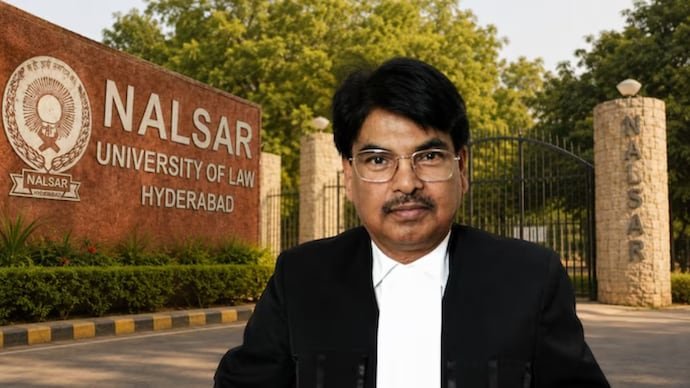
Bar Council of India (BCI) chairman Manan Kumar Mishra has apologised to law students following a controversy over the Council’s decision to temporarily block the enrolment of NALSAR‘s entire 2026 graduating batch. Mishra said he regretted any words or communication that may have hurt the sentiments of students and stressed that they “must always remain free to express their views”.
The apology comes after the BCI withdrew its initial order following widespread criticism and sharp observations from the Supreme Court. The controversy began when students at the National Academy of Legal Studies and Research (NALSAR) in Hyderabad organised a campaign over the university’s decision to invite Chief Justice of India Surya Kant as the chief guest for its convocation.
More than 450 students signed a representation raising concerns about recent judicial developments, including the handling of alleged police excesses during a July 20 Parliament march. The BCI responded by directing State Bar Councils not to enrol any student from NALSAR’s 2026 graduating batch as an advocate and sought information about those behind the campaign.
That decision quickly developed into a wider debate over student dissent, the powers of the statutory body regulating the legal profession and whether an entire graduating class could face consequences because of a protest involving some students.
BCI chairman says he regrets hurting students’ sentiments
In an Independence Day letter addressed to “young friends”, Mishra acknowledged the concern generated by the episode and offered an apology.
“If anything connected with the present controversy, any of my words, or letter, has hurt the feelings of our law students, I sincerely regret and apologise for the same,” he wrote.
Mishra also said that expressing regret should not be viewed as an issue of prestige or ego. Instead, he described an apology as an acknowledgement that the concerns and feelings of students matter.
The language of the letter represents a significant shift in tone from the initial BCI action. Rather than focusing on the student campaign or disciplinary consequences, Mishra’s latest message places emphasis on independence of thought, constitutional values and dialogue.
How the NALSAR controversy began
The dispute centred on NALSAR’s decision to invite CJI Surya Kant to its convocation. A group of students raised objections through a representation to university authorities.
The students’ concerns included recent judicial developments and the handling of alleged police excesses during the July 20 Parliament march. More than 450 students reportedly signed the representation.
The campaign then drew the attention of the BCI, which on August 13 directed State Bar Councils not to enrol students from NALSAR’s 2026 graduating batch. The Council also sought a report identifying those involved in organising the student campaign and indicated that a final decision would be taken on August 19.
The breadth of the order became a central point of criticism. The proposed enrolment freeze applied to the entire graduating batch, raising the question of whether students WHO had not participated in the campaign could face consequences alongside those who had.
BCI withdraws enrolment freeze after backlash
The BCI subsequently changed course following widespread criticism. It allowed NALSAR’s 2026 graduating batch to enrol, saying that the “vast majority” of students were innocent.
The Council later dropped the proceedings altogether.
Mishra had also told India Today that the matter stood closed and that the action had been withdrawn. He said the BCI’s role was to protect the rights and interests of law students and lawyers.
Although the order was eventually withdrawn, the episode had already raised questions about the extent of the BCI’s supervisory authority and the process through which its initial decision had been taken.
Supreme Court calls the BCI intervention ‘absolutely unnecessary’
The controversy reached the Supreme Court, where a bench headed by CJI Surya Kant criticised the BCI’s intervention.
The court described the now-withdrawn order as “absolutely unnecessary” and affirmed that students had a right to protest. It also directed that no punitive action be taken against NALSAR students or faculty at the instance of the BCI or State Bar Councils.
The Supreme Court’s intervention brought the issue of institutional boundaries into sharper focus. The court questioned the BCI’s role in what it characterised as a dialogue involving students and the Chief Justice of India.
At the heart of the dispute was a legal and institutional question: whether the BCI could use its supervisory authority over State Bar Councils to impose a blanket freeze on the enrolment of an entire graduating class because some students had participated in a campaign.
What does the Advocates Act say about enrolment?
The controversy also prompted scrutiny of the BCI’s powers under the Advocates Act, 1961. The Act establishes different responsibilities for State Bar Councils and the BCI in relation to the legal profession.
Section 6 empowers State Bar Councils to admit people as advocates on their rolls and maintain those rolls. Section 25 provides that applications for enrolment are made to the State Bar Council within whose jurisdiction the applicant proposes to practise.
The BCI nevertheless has substantial supervisory responsibilities. Section 7 gives it general supervision and control over State Bar Councils and also provides powers relating to standards of Legal Education and recognition of universities whose law degrees qualify students for enrolment.
Section 48B further allows the BCI to issue directions to State Bar Councils concerning the proper and efficient discharge of their functions.
But the Advocates Act also contains specific provisions dealing with people who are already enrolled as advocates. Section 26(1), for example, permits the BCI to remove a name from a roll in circumstances involving misrepresentation of an essential fact, fraud or undue influence, subject to the person being given an opportunity to be heard.
The Act also provides separate disciplinary mechanisms for advocates accused of professional or other misconduct.
The NALSAR graduates were not yet advocates on a State roll when the BCI issued its initial order. That distinction became central to the debate over whether a collective enrolment freeze could lawfully be imposed on students before they entered the legal profession.
Questions raised over the BCI’s authority
The initial decision drew criticism from legal observers who questioned whether the Council had exceeded the scope of its statutory authority.
A senior corporate lawyer quoted anonymously by India Today Digital argued that the BCI chairman had repeatedly used the office to issue orders or directives in areas the lawyer considered to be outside the Council’s jurisdiction.
The lawyer also argued that a statutory organisation responsible for regulating lawyers should be particularly careful about the limits of its legal powers. The criticism reflected a broader concern raised during the episode: the institution responsible for regulating the legal profession must itself operate within the framework of the law.
These arguments were part of the wider debate triggered by the initial enrolment freeze. Because the students had not yet become advocates, questions arose about the legal basis for imposing a collective professional consequence on them.
Mishra says students can think for themselves
In his latest letter, Mishra directly addressed the issue of student independence. He described law students, especially those studying at National Law Universities and other leading institutions, as among the country’s most informed and discerning young citizens.
He pointed out that law students study the Constitution, the rule of law, fairness and the importance of hearing different sides before reaching conclusions.
“They do not require anyone to decide for them. Nor should they be subjected to pressure or influence from any quarter,” Mishra wrote.
His message was that students should be allowed to assess controversies independently rather than being directed towards a predetermined position. That argument became especially relevant after the dispute over the NALSAR campaign and the BCI’s initial response.
Mishra also emphasised the long-term importance of students at leading law schools. Today’s students could become advocates, senior advocates, academics and judges, including people who eventually hold some of the highest positions in India’s legal system.
‘Peaceful disagreement’ is part of constitutional democracy
One of the clearest statements in Mishra’s letter concerned the right to dissent.
“Peaceful disagreement, questioning and protest are important features of a constitutional democracy. Students must always remain free to express their views,” he wrote.
The statement directly addresses the central tension that emerged during the NALSAR controversy. Students were expressing objections to a decision involving their convocation, while the BCI’s initial response had threatened consequences for their professional enrolment.
Mishra also argued that disagreement and reconsideration are not mutually exclusive. He said a person can raise a genuine grievance and later fairly consider new facts or clarifications.
That distinction allows room for disagreement without making it permanent or adversarial. It also reflects the legal profession’s emphasis on considering evidence and competing arguments before reaching a conclusion.
Students should decide whether to attend the NALSAR convocation
Mishra also addressed the immediate question surrounding the NALSAR convocation. He described the ceremony as a special occasion for graduating students and their families after years of academic work.
He said the decision to attend should ultimately belong to the students themselves.
“No student should be compelled to attend, and no student should feel compelled to abstain,” Mishra wrote.
His appeal was for students to consider the issue fully and make their own decisions. That position is consistent with his broader argument that law students should not be pressured or influenced by institutions or political forces when forming their views.
Mishra calls for dialogue and reconciliation
The BCI chairman’s letter also sought to move the dispute away from confrontation. He argued that the relationship between the judiciary, the Bar, universities and law students is deeper and more enduring than any individual controversy.
“Differences may arise and strong views may be expressed, but such differences should ultimately be capable of resolution through dialogue, clarification and mutual respect,” he wrote.
Mishra said the BCI regarded law students as the future of the legal profession and that their dignity, independence of thought and legitimate concerns should be respected.
At the same time, he stressed that dialogue, mutual respect and constitutional values were important principles for people preparing to enter the legal profession.
He urged students and institutions to approach the dispute with fairness and reconciliation and cautioned against allowing outside influence to give the controversy a political or extraneous character.
Calls for Mishra’s resignation emerged after the controversy
The BCI’s initial action also led to calls for Mishra’s resignation.
Saurav Das, co-convenor of the Cockroach Janata Party, said the BCI chairman should step down following the Supreme Court’s criticism of the intervention. AIMIM MP Asaduddin Owaisi also questioned the authority of the BCI and its chairman to initiate the action against the NALSAR graduating batch and seek information about those who organised the campaign.
Those reactions demonstrated how quickly the dispute expanded beyond the university and the legal profession into a broader debate about institutional power and student dissent.
The separate ‘cockroach’ controversy adds political context
The NALSAR dispute also unfolded against the backdrop of a separate controversy involving remarks attributed to CJI Surya Kant in which he referred to unemployed youths as “cockroaches”. The phrase subsequently became associated with the Cockroach Janata Party, which used it as part of a campaign focused on concerns affecting young people.
The political campaign and the NALSAR controversy are separate developments, but the connection between them became part of the wider public discussion surrounding the students’ concerns.
Against this backdrop, the Supreme Court’s affirmation of the students’ right to dissent and the BCI’s subsequent withdrawal of its action became particularly significant.
What the apology means for the BCI and law students
Mishra’s latest letter attempts to draw a line under a controversy that raised difficult questions about student expression, professional regulation and institutional authority.
The most important change is the shift from a collective enrolment freeze to an explicit acknowledgement that students should be free to express their views. The BCI has withdrawn the action against the 2026 NALSAR graduating batch, and the Supreme Court has directed that punitive measures not be taken against students or faculty at the instance of the BCI or State Bar Councils.
The broader institutional questions, however, are likely to remain relevant. The episode demonstrated how quickly a decision by a statutory professional body can become a constitutional and legal debate when it affects students’ ability to enter the profession.
It also highlighted a basic principle at the heart of legal education: students who are trained to understand Constitutional Rights, statutory limits and judicial review must have meaningful space to question institutions and express disagreement.
A fresh emphasis on independent thought
Mishra ended his Independence Day message by returning to the theme of independent thinking. He described law students as future leaders of the Bar, Bench and legal academia and said their strength would come from their ability to think independently, listen to opposing viewpoints and reach conclusions based on reason, fairness and the Constitution.
The statement represents a clear attempt to restore confidence after a dispute that placed the BCI itself under scrutiny. The Council’s initial action, its subsequent withdrawal and the Supreme Court’s criticism have made the episode an important case study in the boundaries between professional regulation and student expression.
For the students involved, the immediate outcome is that the enrolment freeze has been withdrawn and the proceedings have been dropped. For the wider legal community, the episode leaves a broader lesson: disagreement, protest and institutional criticism need not be treated as threats to the legal system when they are exercised peacefully and within constitutional boundaries.
Whether the controversy is now fully settled will depend on how the institutions involved move forward. But Mishra’s latest message is unequivocal on one point: law students should be allowed to think for themselves, express their views and make their own decisions without institutional pressure.
For breaking news and live news updates, like us on Facebook or follow us on Twitter and Instagram. Read more on Latest India on thefoxdaily.com.


COMMENTS 0