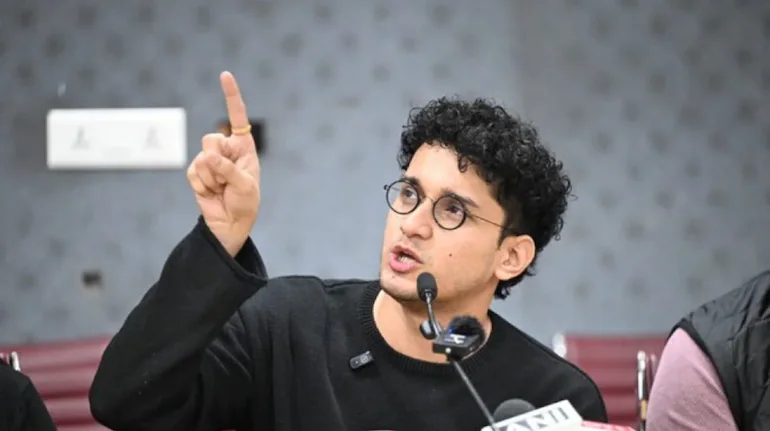
Cockroach Janata Party (CJP) activist Saurav Das has strongly opposed the proposed Delimitation Bill, alleging that the legislation could allow the ruling Bharatiya Janata Party (BJP) to influence constituency boundaries and strengthen its electoral position for decades. Addressing a press conference in New Delhi on Sunday, Das accused the government of attempting to manipulate India’s electoral map through the proposed Delimitation Commission and urged Opposition parties to reject the legislation in Parliament.
Das argued that delimitation, when combined with the Special Intensive Revision (SIR) of electoral rolls and the proposed ‘One Nation, One Election’ framework, could weaken democratic competition. He also questioned the proposed commission’s protection from judicial scrutiny, raised concerns about the use of voter-related data and demanded immediate implementation of women’s reservation rather than linking it to a future delimitation exercise.
His remarks come as the proposed Bills are expected to trigger a major political debate over parliamentary representation, constituency boundaries, women’s reservation and the distribution of seats among states ahead of the 2029 general elections.
Saurav Das alleges BJP could benefit from constituency redrawing
At the centre of Das’s criticism is the possibility that the proposed delimitation exercise could be used to redraw electoral constituencies in ways that favour the ruling party. He alleged that the government could exercise influence over the proposed Delimitation Commission and shape constituency boundaries to strengthen the BJP’s electoral prospects.
Delimitation involves determining or redrawing the boundaries of electoral constituencies to reflect changes in population and representation. The process can significantly influence electoral politics because it determines which geographical areas are grouped together to elect representatives to Parliament and state legislatures.
Das warned that the exercise could become a form of gerrymandering if constituency boundaries were designed to produce political advantages for a particular party. Gerrymandering refers to manipulating electoral district boundaries to benefit one political group or weaken its opponents.
Rejecting the proposed legislation, he said, “The Cockroach Janata Party strongly opposes the Delimitation Bill. We, the Cockroach Janata Party, strongly oppose the Delimitation Bill in very strong terms.”
Taking aim at the government’s electoral record, Das alleged that attempts to influence voting outcomes were now extending beyond the voting process itself to the distribution of political representation.
“Their mind is not satisfied with vote theft, so now the government has come to steal seats,” he said.
These statements represent Das’s allegations against the government. Whether constituency boundaries are manipulated for partisan advantage would depend on the legal framework, the composition and functioning of the commission, the criteria used for delimitation and the transparency of the process.
Why the proposed Delimitation Commission is facing scrutiny
Das also questioned the proposed Delimitation Commission’s protection from judicial scrutiny. He argued that if the commission’s decisions could not be challenged in court, affected political parties and voters might have limited opportunities to seek legal remedies against disputed constituency boundaries.
He compared the proposed protection with immunity provisions concerning Election Commissioners and alleged that extending similar safeguards to the delimitation body could prevent meaningful legal challenges to its decisions.
The issue is significant because delimitation determines the geographical structure of electoral representation. Decisions about constituency boundaries can affect the political influence of communities, urban and rural regions, and different areas within a state.
However, the legal position needs to be distinguished from Das’s interpretation. India’s constitutional framework provides specific protections concerning the finality of delimitation orders, and the scope of judicial intervention depends on the applicable constitutional and statutory provisions. A claim that a commission has immunity does not, by itself, establish that every aspect of its functioning is beyond all forms of legal scrutiny.
For the proposed exercise, the commission’s composition, decision-making procedures and accountability arrangements are therefore likely to remain important subjects of parliamentary and public debate.
Das links SIR, delimitation and One Nation, One Election
Das’s opposition extends beyond the delimitation proposals themselves. He connected three developments that he believes could collectively affect electoral competition: the Special Intensive Revision of electoral rolls, the proposed delimitation exercise and the government’s push for ‘One Nation, One Election’.
The Special Intensive Revision is an exercise to verify and update electoral rolls. Das alleged that the process had resulted in voters being removed from electoral lists and accused the government of weakening electoral participation through the exercise.
He warned that delimitation could then change constituency boundaries and the distribution of representation, while the proposed simultaneous-election framework could further alter the country’s electoral system.
“So tell me, first they got the SIR done. By doing the SIR, they cut people’s votes. Now they are pushing for delimitation. They will manipulate and tweak things to create constituencies however they want,” he said.
He added that the government would subsequently introduce ‘One Nation, One Election’, arguing that the combined effect of these developments could undermine democratic competition.
“And after that, the democracy of this country will end,” Das alleged.
The three issues involve different constitutional and administrative questions. Electoral-roll revision concerns who is eligible to vote and whether the voter lists are accurate. Delimitation concerns the boundaries and structure of constituencies. Simultaneous elections concern the timing and coordination of elections to different legislatures.
Although these processes could have significant consequences for India’s electoral system, their effects need to be assessed separately as well as in combination. Das’s warning reflects his political opposition to the proposed changes rather than an established conclusion that democracy would end if the Bills were passed.
‘No one will be able to vote out BJP’: Das warns of long-term political consequences
One of Das’s strongest claims concerned the possibility that delimitation could make it difficult for voters to remove the BJP from power through elections.
He alleged that the proposed changes could allow the ruling party to gain an electoral advantage by influencing how constituencies are structured. In his view, the consequences could extend beyond a single election and affect political competition for several years.
“No one will be able to vote out the BJP if the Delimitation Bill is passed,” he said.
Das also accused the BJP of using alleged horse-trading, political pressure and defections to secure the parliamentary numbers needed to pass the legislation. He claimed that MPs were being bought or pressured and that political parties were being split to strengthen the ruling party’s position.
These allegations were made during his press conference and were not accompanied in the supplied account by independently established evidence. They should therefore be understood as accusations rather than proven findings.
The political importance of the proposed Bills, however, extends beyond the immediate parliamentary contest. Any major change to the distribution of seats or the boundaries of constituencies could influence how political parties organise campaigns, select candidates and build support across different regions.
Das appeals to Opposition parties to reject the legislation
Das urged Opposition parties to unite against the proposed delimitation legislation, arguing that the issue should not be treated as a routine political disagreement. He called on parties to consider the potential long-term consequences for electoral representation and democratic competition.
He also appealed directly to younger voters, warning political parties that supporting the Bills could create public resentment among the country’s youth.
“The youth is watching you, and if you betray the youth, we will not forgive you,” he said.
His appeal reflects an attempt to frame delimitation as an issue extending beyond party politics. By linking the proposed changes with employment, education, women’s representation and electoral fairness, Das sought to broaden the debate to include concerns affecting younger generations.
Whether Opposition parties adopt a common position will be important for the parliamentary debate. Different parties may support some aspects of the proposed reforms while objecting to the timing, methodology or constitutional arrangements associated with delimitation.
Youth representation becomes another point of criticism
Alongside his concerns about electoral boundaries, Das questioned the limited representation of younger people in Parliament. He argued that India’s political institutions do not adequately reflect the demographic profile of the country.
He claimed that nearly 60 per cent of India’s population is below the age of 35, while only around 5 per cent of MPs belong to this age group. He also cited an average parliamentary age of 56 and claimed that approximately 90 per cent of MPs are above 41.
These figures were presented by Das during his remarks. They highlight his broader argument that young people remain underrepresented in political decision-making despite forming a substantial share of the population.
The question of youth representation is different from the technical process of delimitation. Redrawing constituencies does not automatically create age-based representation or guarantee that younger candidates will receive more opportunities to contest elections.
Greater youth participation would also depend on political party candidate selection, campaign financing, internal party structures and the willingness of established political organisations to promote younger leaders.
Das’s criticism therefore raises a wider question about whether electoral reforms should also address the diversity of representation within legislatures, rather than focusing only on the number and boundaries of constituencies.
Women’s reservation: Why Das wants implementation before 2029
Das also questioned the government’s decision to link the implementation of women’s reservation with the proposed delimitation exercise. While stating that the CJP supports greater representation for women in Parliament, he argued that the reservation should be implemented in the existing Lok Sabha rather than being deferred until 2029.
The Constitution (106th Amendment) Act, 2023, commonly known as the Nari Shakti Vandan Adhiniyam, provides for 33 per cent reservation for women in the Lok Sabha and state legislative assemblies. Its implementation is linked to a delimitation exercise following the relevant population census, under the constitutional provisions governing the law.
Das questioned why women should have to wait for a future electoral reorganisation to receive the representation promised through the constitutional amendment.
“If you really, in the truest sense, want to benefit women and want our women to move forward, and have more representation for them in Parliament, then why don’t you give them reservation right now?” he asked.
His argument focuses on the gap between the passage of a constitutional commitment and its actual implementation. Supporters of immediate implementation may argue that existing parliamentary seats could be used to begin increasing women’s representation without waiting for a broader restructuring of constituencies.
However, the government’s proposed approach links the reservation framework to the constitutional process involving population data and delimitation. This has made the timing and sequencing of women’s reservation a major point of political disagreement.
Concerns over women’s safety and criminal cases involving MPs
Das also raised questions about the safety of women in Parliament, referring to claims about lawmakers facing criminal cases, including serious charges. He used these concerns to challenge the broader argument that increasing the number of women representatives alone would be sufficient to improve their position in political institutions.
Greater representation and a safe working environment are related but separate issues. Women’s participation in Parliament depends not only on access to seats but also on institutional safeguards, political support, security and the ability to participate without intimidation or harassment.
Any claims about criminal cases involving MPs need to be assessed through verified records and the distinction between allegations, charges and convictions. The existence of a case does not establish guilt, and individual circumstances must be considered before drawing conclusions about lawmakers collectively.
Das’s remarks nevertheless underline the importance of examining the broader conditions in which women enter and participate in electoral politics.
Unemployment, education and paper leaks feature in Das’s criticism
Moving beyond delimitation and representation, Das criticised the government’s handling of unemployment and education. He referred to Prime Minister Narendra Modi’s earlier employment-related promises and questioned whether the opportunities promised to young people had materialised.
He also raised concerns about examination paper leaks, including the NEET paper leak, arguing that repeated disruptions to competitive examinations have affected students and their confidence in the education system.
Competitive examinations are particularly important for young people seeking admission to professional courses and government jobs. Allegations of paper leaks and examination irregularities can create uncertainty for students who spend years preparing for high-stakes tests.
Das also questioned the absence of a full-time Education Minister, bringing the issue into his wider criticism of the government’s priorities. He argued that Parliament should focus on employment, education, health and the concerns of young citizens alongside major electoral reforms.
By connecting these issues, he sought to present the delimitation debate as part of a wider discussion about accountability and the representation of public concerns in national politics.
What are the key features of the proposed Delimitation Bills?
The proposed legislative package is expected to bring significant changes to India’s electoral and parliamentary structure. Its major features include an expansion in the number of seats in the Lok Sabha and state legislative assemblies, a new constituency map ahead of the 2029 general elections, and the framework for implementing 33 per cent women’s reservation.
The proposals also include provisions concerning the allocation of seats among states and a freeze on the relevant state-wise allocation until 2051. The details of the constitutional amendments and accompanying legislation will determine how the changes are implemented.
The major proposals outlined in the legislation include:
- Increase in legislative seats: A proposed 50 per cent increase in the number of Lok Sabha and state Assembly seats.
- New constituency boundaries: A fresh delimitation exercise intended to redraw electoral constituencies ahead of the 2029 general elections.
- Women’s reservation: A framework intended to facilitate 33 per cent reservation for women in the Lok Sabha and state legislative assemblies.
- Seat-allocation arrangements: Provisions concerning the distribution of seats among states, including a proposed freeze on allocation until 2051.
The proposed changes could represent one of the most significant reorganisations of India’s electoral structure in decades. They raise questions about population-based representation, the relative influence of states, the size of legislatures and the implementation of women’s reservation.
Why delimitation could reshape India’s political landscape
Delimitation is not simply an administrative exercise involving constituency maps. It determines how voters are grouped and how representation is distributed across geographical areas. Changes to constituency boundaries can therefore influence political competition, campaign strategies and the relationship between population and parliamentary representation.
A major expansion of legislative seats could also change the balance of political influence between states, depending on the criteria used to allocate representation. This is particularly important in India, where states have different population sizes and demographic trends.
The proposed freeze on state-wise seat allocation until 2051 is relevant to concerns about how representation may be distributed over the longer term. Any decision involving population data and seat allocation is likely to attract political scrutiny because it can affect the relative weight of different states in Parliament.
Women’s reservation adds another dimension to the debate. While there is broad political significance attached to increasing women’s representation, parties disagree over the timing and process through which the reservation should become operational.
Das’s objections reflect one strand of the opposition to the proposed legislation: the concern that a major electoral restructuring could be used to consolidate political power rather than simply improve representation. The government’s legislative framework, the commission’s procedures and the criteria adopted for delimitation will be central to evaluating such claims.
What happens next in the Delimitation Bill debate?
The proposed legislation is likely to face intense parliamentary and political scrutiny as parties debate its implications for representation, federal balance and women’s reservation. Opposition parties will have to decide whether to reject the entire package or seek changes to specific provisions.
For activists such as Saurav Das, the immediate priority is to build public pressure against the Bills and persuade political parties not to support measures they believe could weaken electoral competition. His appeal to younger voters also suggests that the debate may extend beyond Parliament into wider discussions about democratic accountability and political representation.
Ultimately, the controversy surrounding delimitation is about more than the number of seats in India’s legislatures. It concerns how electoral boundaries are drawn, how states and communities receive representation, how women’s reservation is implemented and whether the process commands public confidence.
Das has warned that the proposed changes could make it difficult to vote the BJP out of power. That remains his political allegation, not an established outcome of the legislation. The real test will be whether the proposed framework provides transparent, impartial and constitutionally sound arrangements for determining India’s future electoral map.
For breaking news and live news updates, like us on Facebook or follow us on Twitter and Instagram. Read more on Latest India on thefoxdaily.com.





COMMENTS 0