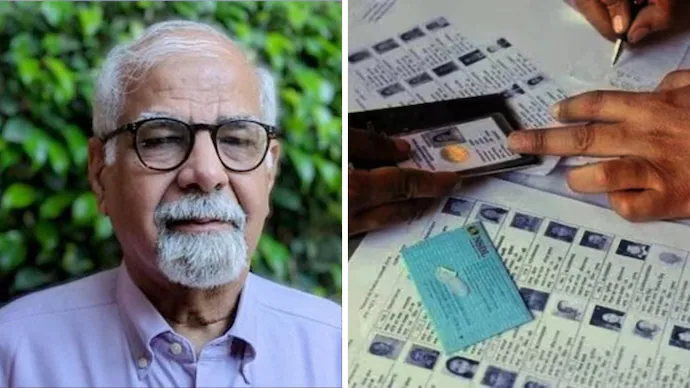
The Election Commission of India’s Special Intensive Revision (SIR) of electoral rolls has triggered a nationwide debate over the removal of millions of voter names. While draft-stage deletions have reached 13.37 crore across the three phases of the exercise, economist Surjit Bhalla estimates that around 70 lakh eligible voters may have been removed without adequate explanation in states where the revision process has been completed.
In an analysis published on Saturday, October 17, Bhalla argued that the headline figure of 13 crore deletions does not distinguish between voters who were legitimately removed and eligible citizens who may have been wrongly excluded. The deleted entries include people who have died, relocated, appeared more than once on electoral rolls or could not be traced during verification.
Bhalla’s calculation uses population estimates, official birth and death data, and the Election Commission’s Voter Registration figures before the SIR. His estimate is not an official Election Commission count, nor does it establish that every voter in the unexplained category was removed incorrectly.
The analysis attempts to separate two questions at the centre of the controversy: how many names were removed during the electoral roll revision, and how many eligible voters may still be missing from the final lists.
Why Were 13.37 Crore Names Removed During the SIR?
The Election Commission reported that 13.37 crore names were removed from draft electoral rolls across the three phases of the SIR. According to the figures cited in the report, 7.22 crore deletions came from Bihar and the 12 states and Union Territories covered in Phase II, while another 6.15 crore came from the 17 states included in Phase III.
These figures refer to deletions recorded at the draft stage, before the claims and appeals process had been completed. They therefore should not automatically be interpreted as the number of eligible voters permanently removed from the final electoral rolls.
The reported categories of deleted entries include:
- 2.8 crore deceased voters: Names associated with people who had died.
- 6.3 crore relocated voters: People reported to have moved from their registered locations.
- 1 crore duplicate entries: Names appearing more than once in electoral records.
- 3 crore untraceable voters: People who could not be located during the verification exercise.
These categories account for the 13.1 crore names described in the cited breakdown, which is slightly below the overall 13.37 crore deletion figure. The available figures do not explain the difference.
Bhalla argues that the categories must be examined separately because not every deletion represents the loss of an eligible voter’s registration. Removing a deceased person’s name or eliminating a genuine duplicate entry serves a different purpose from removing the name of an eligible citizen who remains entitled to vote.
The central issue, therefore, is whether the verification process correctly identified voters who should have been removed and whether people who remained eligible were given a fair opportunity to retain or restore their registration.
How Surjit Bhalla Calculated the 70 Lakh Estimate
Bhalla’s estimate begins with an assessment of India’s adult population. He puts the country’s population aged 18 and above at approximately 100.8 crore in mid-2026.
However, he argues that electoral rolls should not necessarily contain the names of every adult. Voter registration is voluntary, and some eligible citizens never enrol. A realistic benchmark must therefore account for the proportion of adults who are not registered to vote.
Using the Election Commission’s pre-SIR registration data for people aged 18 to 29, Bhalla estimates that approximately 7.5% of adults in that age group are unregistered. He allows for a further 1% non-registration rate among older adults, producing an estimated overall rate of around 8.5%.
After accounting for this estimated non-registration, he calculates that a clean electoral roll should contain approximately 92.2 crore names nationwide.
Bhalla then applies the methodology at the state level, using population estimates and voter registration data to account for differences between states. His comparison focuses on states where final SIR electoral rolls were available at the time of the analysis.
Across nine large states with final rolls, he estimates that the lists should contain 53.51 crore names. The actual final rolls contained 52.78 crore, leaving an estimated gap of approximately 73 lakh names.
After allowing for an estimated five lakh non-citizens whose removal he considers legitimate, Bhalla arrives at a figure of around 70 lakh eligible voters whose removal remains unexplained.
The estimate is based on data available up to October 16, 2026. It represents Bhalla’s own calculation rather than an official assessment by the Election Commission.
Does the 70 Lakh Figure Prove Wrongful Voter Deletions?
No. Bhalla explicitly cautions that an unexplained deletion is not the same as a proven wrongful deletion. His estimate identifies a gap between the expected size of electoral rolls and the number of names appearing on final lists, based on his assumptions about population and registration rates.
That gap may indicate potential exclusions requiring investigation, but it cannot independently establish the eligibility of every person who is missing from the rolls.
Bhalla wrote that the unexplained category does not prove that every one of the estimated 70 lakh people was wrongly removed. He also stressed that the figure should not be dismissed as insignificant to the individuals affected.
His broader argument is that the 13.37 crore draft-stage deletion figure combines legitimate removals with cases that may require further scrutiny. Treating every deletion as evidence of disenfranchisement would overlook the purpose of correcting electoral records, while assuming that every deletion was justified would overlook the possibility of administrative errors.
Bhalla estimates that seven out of every eight net deletions in states with final rolls were justified. He puts necessary removals at approximately 5.1 crore out of 5.8 crore net deletions, leaving around 70 lakh unexplained.
The distinction matters because electoral roll accuracy involves two separate responsibilities: removing ineligible or duplicate entries and ensuring that eligible citizens are not excluded. A revision can achieve the first objective while still requiring corrective action to address failures in the second.
Historical Electoral Rolls Also Contained Errors
Bhalla places the SIR controversy in the context of earlier electoral rolls, arguing that discrepancies between voter lists and estimates of the eligible adult population are not new.
He notes that after the previous nationwide intensive revision, the 2004 electoral roll contained approximately 2.8 crore more names than the estimated adult population, an excess of 4.4%. In 2014, the number of names on electoral rolls was around 3.1% higher than the estimated adult population.
Bhalla argues that compiling an accurate list covering nearly a billion people is inherently difficult. The challenges are particularly significant in a country with a large population of migrant workers and people living in economically vulnerable circumstances.
People may move between states for employment, change their residential addresses or face difficulties producing documentation. Such circumstances can complicate verification and make it harder to distinguish between someone who has genuinely relocated and someone who remains eligible to vote at a particular address.
However, historical inaccuracies do not automatically justify the removal of names during a new revision. Past discrepancies provide context for understanding the administrative challenge, but individual deletions still need to comply with applicable rules and safeguards.
Concerns Over Documentation and the SIR Process
Although Bhalla argues that many deletions were necessary, he acknowledges criticism of the way the SIR was conducted. Concerns have included the speed of the exercise, documentation requirements for poor and migrant voters, and notices issued over what authorities described as “logical discrepancies”.
These issues are important because the accuracy of a voter list depends not only on the criteria used to identify ineligible entries but also on whether eligible voters can participate meaningfully in the verification process.
For people who have moved for work, obtaining documents or responding to notices within a limited period can be difficult. If a voter cannot complete the required procedure, an administrative problem could result in a name being omitted even when the individual remains eligible.
Bhalla also raised questions about the Election Commission’s introduction of a compulsory declaration on Form 6 for new voter registrations. The form asks applicants whether they, their parents or their grandparents appeared on an earlier SIR electoral roll.
The legality of this change remained unresolved in the account of Bhalla’s analysis, which said the Supreme Court had questioned whether the modified form had received the necessary approval.
The issue illustrates why the overall deletion figure cannot settle the wider debate. The process must also be assessed in terms of the legal basis for its requirements, the accessibility of verification procedures and the remedies available to people who believe their names were wrongly removed.
West Bengal Emerges as a Major Exception in Bhalla’s Analysis
While Bhalla’s national estimate suggests that unexplained deletions account for a relatively small proportion of the total, his state-level calculations identify West Bengal as a significant exception.
According to his analysis, West Bengal’s electoral roll declined from 7.66 crore names to 6.77 crore, a reduction of approximately 89 lakh, or 11.6%.
Bhalla estimates that a clean electoral roll for the state should contain around 7.33 crore names. Compared with the final total of 6.77 crore, that leaves a gap of approximately 56 lakh names beyond his estimated benchmark.
He places the likely number of eligible voters removed without explanation in West Bengal between 40 lakh and 60 lakh. His broader estimate is around 50 lakh, equivalent to approximately 6% to 7% of the state’s adult population.
These figures are estimates based on his methodology, not a verified count of individual wrongful deletions. Nevertheless, they indicate why national averages can obscure substantial differences between states.
If the estimated shortfall is concentrated in particular regions or population groups, the administrative questions may require state-specific investigation rather than relying solely on an all-India calculation.
Muslim Voters and the Adjudication Process in West Bengal
Bhalla’s analysis also highlights concerns surrounding adjudication of cases flagged for “logical discrepancies”. According to the figures he cited, approximately 60 lakh voters were flagged in this category, and judicial officers struck off 27 lakh names during adjudication in April 2026.
Muslims accounted for around two-thirds of these adjudication-stage deletions, according to Bhalla’s account. The figure raises questions about the distribution of deletions across communities and the reasons individual cases were rejected.
However, the demographic breakdown alone does not establish why each person’s name was removed or whether every affected voter was eligible. Assessing the issue requires information about the evidence considered in individual cases, the standards applied during adjudication and the outcomes of appeals.
The figures nevertheless make transparency important. Where deletions affect particular communities disproportionately, clear explanations of the decisions and accessible appeal procedures can help establish whether the process was applied consistently.
Appeals Could Help Establish the Scale of Wrongful Exclusions
The appeals process is a key part of determining whether eligible voters were incorrectly removed. According to Bhalla’s account, the Election Commission told the Supreme Court in September that 22.2 lakh appeals had been filed seeking restoration of deleted names.
Bhalla said approximately 93% of the appeals decided by the time of his analysis had found the voters eligible. However, only around 1.3 lakh appeals had been decided at that stage.
The distinction between the number of appeals filed and the number decided is important. A high proportion of successful appeals among resolved cases may indicate that some voters were wrongly excluded, but the result cannot automatically be applied to every unresolved case or every deletion across the country.
People who file appeals may also differ from those who do not, including in their awareness of the process and their ability to navigate it. Consequently, the available results cannot by themselves establish the final scale of wrongful deletions.
Further decisions and updated figures would be needed to assess how many voters were restored, how many appeals were rejected and whether the process adequately addressed the concerns of those seeking reinstatement.
Bihar Presents a Different Electoral Roll Picture
Bhalla’s analysis reaches a different conclusion for Bihar, where the SIR controversy initially attracted significant attention.
He estimates that Bihar’s final electoral roll contains approximately 60 lakh more names than a clean roll would be expected to contain under his methodology.
He attributes much of the estimated surplus to migrant workers who live and work in other states but remain registered in Bihar. Migration can complicate electoral registration because a person’s place of residence may change while their existing registration remains active.
However, the presence of a surplus relative to an estimated benchmark does not establish that every additional entry is invalid. Determining whether an individual registration is eligible requires applying the relevant electoral rules to the circumstances of that voter.
The contrast between Bihar and West Bengal is central to Bhalla’s argument: the same nationwide revision can produce very different patterns across states. In one state, the estimated number of names may exceed his benchmark, while in another, the final roll may fall substantially below it.
These differences reinforce the need to examine state-level data alongside the national deletion total.
What the SIR Debate Reveals About Electoral Roll Accuracy
The controversy over the Special Intensive Revision highlights the difficulty of maintaining accurate electoral rolls in a country with a vast population, substantial internal migration and varying levels of access to official documentation.
Removing the names of deceased voters, correcting duplicate entries and updating records when people relocate can improve the quality of electoral lists. At the same time, the process must protect eligible citizens from being excluded because of mistakes, incomplete verification or difficulties responding to administrative requirements.
Bhalla’s analysis attempts to quantify the potential shortfall by comparing the expected number of registered voters with the final rolls in states where the revision was complete. His estimate of approximately 70 lakh unexplained removals is considerably lower than the headline figure of 13.37 crore draft-stage deletions.
But the two figures measure different things. The 13.37 crore figure counts names removed at the draft stage across three phases, while the 70 lakh figure is an estimate of potentially unexplained exclusions derived from population and registration assumptions in states with final rolls.
Neither figure alone resolves every question about the SIR. The final assessment will depend on the accuracy of the underlying data, the handling of individual cases, the outcome of appeals and whether eligible voters can secure restoration of their names.
What Happens Next in the SIR Controversy?
The next phase of the debate is likely to focus on the remaining appeals, state-level discrepancies and the procedures used to restore names where deletions are found to be incorrect.
West Bengal presents a particularly important test of Bhalla’s estimates because his analysis identifies a large gap between the final roll and his expected benchmark. The adjudication figures and appeals outcomes will be relevant to determining whether that gap reflects wrongful exclusions, limitations in the population estimates or a combination of factors.
In Bihar, the estimated surplus raises a different set of questions about migration, duplicate registration and the accuracy of electoral records. Both cases show why national figures should be interpreted alongside state-specific evidence.
Ultimately, the credibility of the SIR will depend on whether the electoral rolls become more accurate without denying eligible citizens their right to vote. Bhalla argues that most deletions were justified, but his own analysis leaves a substantial number of potentially unexplained cases that require attention.
The central question is therefore not simply how many names were removed. It is whether each deletion was justified under the applicable rules and whether every eligible voter has a fair and practical route to challenge an incorrect decision.
For breaking news and live news updates, like us on Facebook or follow us on Twitter and Instagram. Read more on Latest India on thefoxdaily.com.






COMMENTS 0